
Northern Serengeti
The Northern Serengeti is widely regarded as East Africa’s most dramatic safari destination. Stretching across the northern reaches of Tanzania’s Serengeti National Park — a UNESCO World Heritage Site and one of the Seven Natural Wonders of Africa — this remote corner of the ecosystem delivers an experience unmatched anywhere on the continent.
Unlike the central or southern Serengeti, the north remains relatively uncrowded. Fewer lodges, longer distances from Arusha, and a safari season that coincides with the peak migration period from July through October combine to give the Northern Serengeti an exclusivity that safari veterans actively seek out.
What Makes the North Different?
The Northern Serengeti is defined by the Mara River — the same crocodile-filled waterway that flows north into Kenya’s Maasai Mara. Every year, more than 1.5 million wildebeest, 300,000 zebras, and hundreds of thousands of gazelles and other herbivores complete one of the world’s last great wildlife migrations, converging on these river banks for the most thrilling spectacle in the natural world: the Mara River crossing.
Beyond the migration, the region offers dense resident wildlife populations, extraordinary predator activity, and landscapes that range from open golden plains to riverine forests thick with leopard and vervet monkeys.
Geography & Location
The Northern Serengeti is roughly defined as the area north of the Seronera River valley, extending to the Mara River at the Tanzanian-Kenyan border. Key subregions include Lamai Wedge, Kogatende, Wogakuria, Kogakuria Kopjes, the Sand River area, and the Loliondo Game Controlled Area to the east.
Coordinates: Approximately 1°20’S to 1°55’S latitude; 34°40’E to 35°10’E longitude
Altitude: 1,400–1,850 metres above sea level
Area: The Northern Serengeti corridor covers roughly 2,000 km² of the larger 14,763 km² Serengeti ecosystem
Distance from Arusha: Approximately 420–470 km (6–8 hours by road; 1.5–2 hours by light aircraft)
Distance from Nairobi: Approximately 400 km via the Mara River border crossings
The northern section abuts the Maasai Mara National Reserve in Kenya, creating a continuous ecosystem that supports the circular annual migration. The Mara River bisects the landscape, running generally southwest-to-northeast before entering Kenya. Its banks are lined with fever trees, fig trees, and acacia woodland, contrasting with the open short-grass plains to the south and the rocky kopjes (granite outcrops) that punctuate the horizon.
| Key Geographic Features
✓ Mara River — the crossing point; heart of the migration spectacle ✓ Lamai Wedge — premium migration-viewing triangle between the Mara River and Sand River ✓ Kogatende Airstrip — main air access point for the northern sector ✓ Kogakuria & Wogakuria Kopjes — rocky outcrops favoured by resident lion prides ✓ Sand River — seasonal river; forms the Kenya-Tanzania border in the northeast ✓ Loliondo — community conservation area bordering the park’s eastern boundary
|
The Great Migration in the Northern Serengeti
The Great Wildebeest Migration is the principal reason most visitors make the long journey to the Northern Serengeti. This annual movement of over two million animals — the largest overland migration on Earth — follows a broadly circular route around the Serengeti-Mara ecosystem, driven by rainfall patterns and the resulting growth of fresh grass.
The Annual Cycle
Understanding the migration’s rhythm helps you plan your visit to maximise your chances of witnessing the crossings.
| Month | Migration Location | What to Expect |
| January – February | Southern Serengeti / Ndutu | Calving season — 500,000 calves born; predator activity peaks |
| March – April | Central Serengeti (Seronera area) | Herds move north; long rains begin; lush green landscape |
| May – June | Western Corridor (Grumeti River) | Grumeti River crossings; massive herds; smaller crocodile crossing |
| July – August | Northern Serengeti / Mara River | PEAK SEASON — dramatic Mara River crossings; heavy predator action |
| September – October | Northern Serengeti (Lamai / Kogatende) | Continued crossings; herds entering Kenya’s Maasai Mara |
| November | Return south; central/western areas | Herds begin moving back; short rains start |
| December | Southern Serengeti | Pre-calving; herds congregate on short-grass plains |
The Mara River Crossings
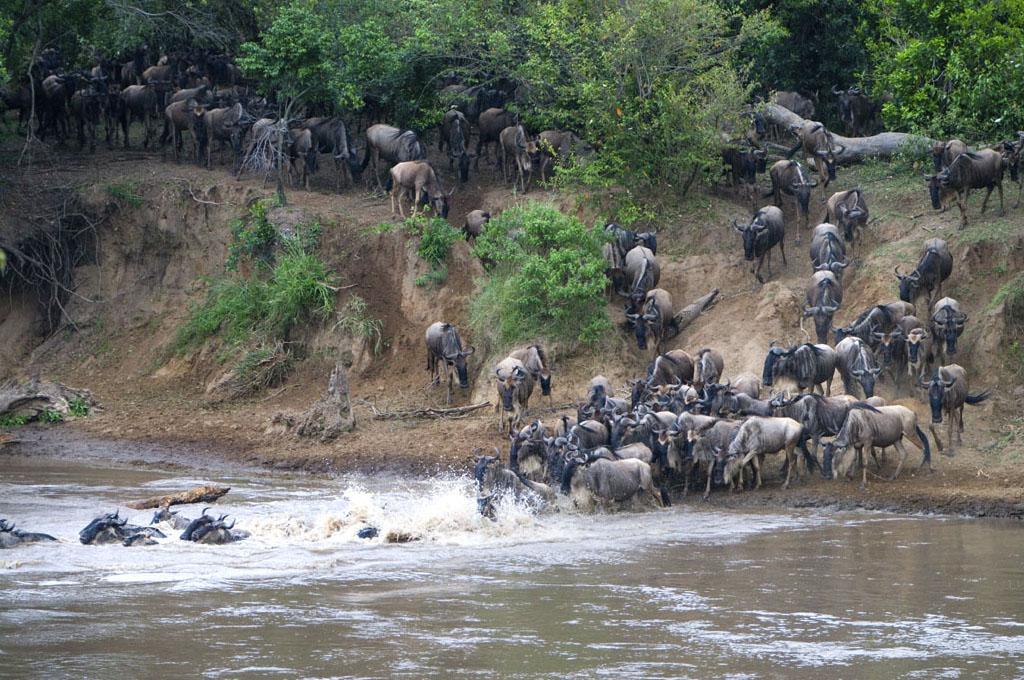
Nothing in the natural world quite compares to a Mara River crossing. Thousands of wildebeest and zebras mass on the northern bank, pacing, hesitating, retreating — then, triggered by an invisible signal, the entire herd plunges into the crocodile-infested current in a churning, thundering rush of hooves and spray.
The crossings are entirely unpredictable. Some days the herds gather and mill for hours before retreating without crossing; other days multiple crossings occur within a single morning. This uncertainty is part of what makes witnessing one so intensely exciting.
Crossing Hotspots
- Kogatende Crossing Point — the most famous, accessed from Kogatende Ranger Post area; multiple crossing bends
- Lamai Crossing — in the Lamai Wedge; often less crowded than Kogatende; excellent elevated viewpoints from some camps
- Wogakuria Crossing — another reliable bend with good photographic angles
- Sand River Crossing — northeast corner; crossings into Kenya’s Maasai Mara
| Migration Viewing Tips
→ Book your Northern Serengeti camp for minimum 3 nights — crossings are unpredictable → Early mornings (before 9 AM) offer the best light for photography → Position yourself downwind of the herd; vehicles and engine noise can deter crossings → A riverside camp lets you hear the crossing activity and react quickly → July is reliable but August–early October often delivers the most concentrated viewing → Ask your guide which banks currently have the most animals — the herds shift daily
|
Wildlife of the Northern Serengeti
The Northern Serengeti supports some of the highest wildlife densities in Africa, sustained by the year-round presence of resident populations and amplified dramatically during the migration months. Beyond wildebeest and zebra, the region harbours extraordinary variety.
The Big Five
All Big Five — lion, leopard, elephant, buffalo, and rhinoceros — are present in the Northern Serengeti, though sightings vary significantly by season and location.
Lion
The northern sector is lion country par excellence. Several well-habituated prides inhabit the kopjes around Kogatende, Wogakuria, and Kogakuria. During the migration, lion activity is extraordinary — coalitions of males work in concert to ambush wildebeest herds, often in broad daylight. The Marsh Pride and several other famous groups are regularly observed. Northern Serengeti lions frequently climb rocks and even trees, particularly in the Lamai area.
Leopard
Leopard densities in the riverine woodland along the Mara and Sand Rivers are among the highest in Tanzania. Early morning drives through the fig-tree and acacia thickets frequently yield sightings of these elusive cats. The trees overhanging the riverbanks are favoured resting spots, often holding kills wedged in the branches.
Elephant
Large elephant herds migrate through the northern corridor, particularly between July and October. Family groups of 20–50 individuals are common, often seen crossing the same river bends used by wildebeest. The wooded sections around Kleins Gate and the eastern boundary hold resident elephant populations year-round.
Buffalo
Buffalo are present throughout the year in the north. Large bachelor herds of 100–300 animals are frequently encountered in the Lamai Wedge and Kogatende areas. Old dagga boys (solitary old males) are commonly found wallowing in seasonal pools.
Rhinoceros
Black rhino exist in the Northern Serengeti but remain extremely rare and shy. Sightings are sporadic; the best chances are in the more remote eastern sections near Loliondo. Rhino are more reliably seen in Ngorongoro Crater.
Predators Beyond the Big Five
- Cheetah — frequently seen on the open plains south of the Lamai Wedge; coalitions of males are present
- Spotted hyena — massive clan sizes during migration season; often seen following wildebeest crossings
- Wild dog (African painted wolf) — rare but present; packs occasionally move through the northern corridor
- Serval — frequently spotted at dawn in long grassland near seasonal marshes
- Bat-eared fox — common at dusk around termite mounds
- Caracal — nocturnal; occasional sightings during night drives in concession areas
Herbivores & Other Wildlife
- Topi — abundant resident antelope; distinctive posture atop termite mounds
- Eland — the world’s largest antelope; large herds in the Lamai area
- Impala — found near woodland and water; common throughout
- Warthog — ubiquitous; entertaining family groups near camp
- Giraffe — Maasai giraffe populations move through the acacia woodland
- Hippo — found in permanent pools along the Mara River; best seen on boat safaris where available
- Nile crocodile — the Mara River holds one of Africa’s highest crocodile densities; waiting for wildebeest crossings
- Olive baboon — large troops in riparian forest
- Vervet monkey — common in acacia woodland
Birdlife
The Northern Serengeti is a birdwatcher’s destination in its own right, with over 500 species recorded across the broader Serengeti ecosystem. The northern sector’s habitat diversity — open plains, riverine forest, woodland, and wetland — supports particularly impressive variety.
- Raptors: African fish eagle, martial eagle, bateleur, tawny eagle, Verreaux’s eagle-owl, lappet-faced vulture
- Waterbirds: grey-crowned crane, saddle-billed stork, African openbill, yellow-billed stork, hammerkop
- Grassland specialists: kori bustard (world’s heaviest flying bird), secretary bird, ground hornbill, Jackson’s widowbird
- Oxpeckers: red-billed and yellow-billed oxpeckers on buffalo and giraffe
- Migration-associated species: European bee-eater, Montagu’s harrier, lesser kestrel (Oct–April)
Best Time to Visit the Northern Serengeti
| Season | Months | Highlights | Drawbacks |
| Peak Migration | July – October | Mara River crossings; massive herds; predator action; dry weather; excellent game drives | Highest prices; advance booking essential (12–18 months) |
| Late Season | November | Herds begin south migration; green landscape arrives; fewer vehicles | Crossings less frequent; short rains can interrupt drives |
| Green Season | Dec – Mar | Lush landscapes; calving in south; photography paradise; good deals | Herds are in southern Serengeti — not the north |
| Shoulder | April – June | Western Corridor crossings; Grumeti River; long rains tapering off | Long rains in April–May; roads can be difficult; fewer visitors |
The unambiguous answer for the Northern Serengeti specifically is July through October. The Mara River crossings, which are the defining experience of this area, occur almost exclusively during these months. July and August tend to be drier and cooler (nights can drop to 12°C), while September and October remain warm and clear before the short rains begin in November.
| Climate at a Glance — Northern Serengeti
→ Dry season: June – October; daytime 24–28°C; nights 12–16°C → Short rains: November – December; afternoon showers; roads passable → Long rains: March – May; some lodges close; roads challenging → Hottest months: January – March; temperatures up to 32°C on the plains → Annual rainfall: approximately 700–1,000 mm; concentrated in two rainy seasons
|
Getting to the Northern Serengeti
The Northern Serengeti is remote by design. Its distance from Arusha — the main safari hub — is precisely what keeps it exclusive. Access is either by light aircraft or by an extended road journey.
By Air (Recommended)
Flying into the Northern Serengeti is the most practical choice for most visitors. Several scheduled and charter services connect Arusha, Kilimanjaro, Dar es Salaam, and Nairobi to the northern airstrips.
| Airstrip | Location | Airlines Serving It | Flight Time from Arusha |
| Kogatende Airstrip | Kogatende (NW corner) | Auric Air, Coastal Aviation, Grumeti Air | ~1 hr 30 min |
| Lamai Airstrip | Lamai Wedge | Charter and scheduled services | ~1 hr 30 min |
| Mara Kogatende | Near Mara River | Various charter operators | ~1 hr 40 min |
| Kleins Camp Airstrip | Eastern boundary | Charter services | ~1 hr 45 min |
Auric Air and Coastal Aviation operate scheduled circuits connecting Arusha/JRO → Seronera → Kogatende/Lamai, with connections from Ngorongoro and other airstrips. Book early during peak season as capacity is limited.
By Road
Road access to the Northern Serengeti requires a 4WD vehicle and should be treated as part of the safari experience. The drive from Arusha takes 7–9 hours in dry conditions; longer during the rains.
- Route via Ngorongoro: Arusha → Karatu → Ngorongoro Crater Rim → Seronera → Kogatende (most common self-drive route)
- Route via Loliondo (Eastern): Arusha → Karatu → Loliondo → Kleins Gate → Kogatende (better road quality, scenic alternative)
- Route via Naabi Hill Gate: direct entry for those coming from Ngorongoro; pass through central Serengeti
A Toyota Land Cruiser (76/79 series or the safari-converted versions) is strongly recommended. High clearance is essential, particularly during the rains. Fuel should be topped up in Karatu or at Seronera — no reliable fuel supply exists in the northern sector.
| Self-Drive Requirements for Northern Serengeti
✓ Valid Tanzania national park pass (TAZAMA system — pay online or at gates) ✓ 4WD vehicle with high clearance mandatory in the north ✓ Minimum two spare tyres; punctures are common on rocky tracks ✓ Fuel: fill up completely before entering — Seronera is the last reliable point ✓ Offline maps (Maps.me or Avenza) essential — mobile coverage is very limited ✓ Driving after dark prohibited within the park ✓ Overnight stays only at designated campsites or lodges
|
Where to Stay: Accommodation in the Northern Serengeti
The Northern Serengeti hosts some of the finest safari camps in Africa. Accommodation ranges from ultra-luxury private conservancy lodges to mobile tented camps that move with the migration and affordable public campsites. The key areas for accommodation are the Lamai Wedge, Kogatende, and the Sand River / Kleins Gate corridor.
Ultra-Luxury & Private Conservancy Camps
Lamai Serengeti (Singita)
Perched on a granite kopje above the Mara River with sweeping views across the northern plains, Singita Lamai is widely regarded as one of the finest safari camps in Africa. Nine stone cottages blend into the rocky landscape. Exclusive traversing rights on 350,000 acres of private concession land mean game drives avoid the crowds common at public crossing points. 24-hour guiding, private dining, an extraordinary wine programme, and wellness spa. Best time: July–October for the crossings; the kopje viewpoint is unmatched.
Namiri Plains (Asilia Africa)
Located in the eastern Serengeti near the Namiri area (technically in the central-north transition), Asilia’s Namiri Plains was specifically chosen for its extraordinary cheetah and wild dog activity. Twelve tented suites; guiding by expert naturalists. Particularly good in the low season for predator sightings.
Kimondo Camp (Asilia Africa)
A permanent luxury tented camp in the Lamai Wedge, positioned for outstanding Mara River crossing views from camp. Eight tents; private plunge pools; river-facing decks. The elevated site allows guests to watch crossings directly from their room on some occasions. All-inclusive with wine and spirits; expert guiding.
Mahali Mzuri (Virgin Limited Edition)
Richard Branson’s 12-tent camp in the Mara North Conservancy, Kenya — right on the border area and directly relevant for guests doing Northern Serengeti / Maasai Mara combinations. Infinity pool, extraordinary guiding team, and community Maasai cultural programmes.
Mid-Range & Premium Camps
Kaskazi Mara Camp
A well-positioned semi-permanent camp in the Kogatende area with direct Mara River access for the crossings. Comfortable canvas tents on raised platforms; full board; professional guides. Good value at the premium mid-range level. Popular with photographers.
Serengeti River Lodge
Permanent lodge on the Mara River with stunning water-level views. Canvas-and-thatch rooms; river sundeck; swimming pool. Well-priced for its location — the river frontage is extraordinary. Can get busy during peak migration. Advance booking essential.
Kubu Kubu Tented Lodge
Actually positioned on the central-north boundary on a stunning kopje, Kubu Kubu offers spectacular panoramic views across the Serengeti plains. A reliable mid-range option for couples and families who want comfort without ultra-luxury pricing. 24 tents; swimming pool; solid guiding.
Budget & Public Campsites
Tanzania National Parks (TANAPA) operates several public campsites in and around the northern Serengeti. These offer basic facilities (long-drop toilets; some have showers) and must be booked through the TANAPA system.
Kogatende Public Campsite
The main public campsite for northern Serengeti self-drivers. Positioned close to the Mara River crossing area. Basic but functional; communal ablutions. Bring all food, water, and firewood. Book through Tanzania National Parks online booking system. Rates: approximately USD 40 per person per night (non-resident adults, 2026 rates).
Lamai Wedge Special Campsite
A handful of exclusive special campsites in the Lamai Wedge can be booked for private groups. These offer complete exclusivity in a spectacular location — essentially your own private patch of the northern Serengeti. No facilities; bring your entire camp. Contact TANAPA for bookings. Rate: approximately USD 100 per site per night plus per-person camping fees.
| Camp / Lodge | Style | Location | Best For | Price Range (per person/night) |
| Singita Lamai | Ultra-luxury permanent | Lamai Wedge kopje | Honeymoon, special occasions | USD 1,800–3,000+ |
| Kimondo Camp | Luxury tented | Lamai Wedge | Crossing views; couples | USD 900–1,600 |
| Kaskazi Mara Camp | Premium tented | Kogatende | Photographers; value luxury | USD 600–1,000 |
| Serengeti River Lodge | Permanent lodge | Mara River bank | River views; families | USD 350–600 |
| Kubu Kubu Tented | Mid-range tented | Central-North border | Value; panoramic views | USD 300–500 |
| Kogatende Public Camp | Self-drive campsite | Kogatende | Budget; self-drive safari | USD 35–50 pp |
Safari Activities in the Northern Serengeti
Game Drives
Morning and afternoon game drives form the backbone of any Northern Serengeti safari. Vehicles depart at sunrise (around 6:30 AM) to catch the first light — the golden hour on the plains is spectacular — and again at 3:30–4:00 PM for the late afternoon until sunset. Full-day drives are common during the migration, as locating the herds and waiting for a crossing can take most of the day.
All game drives within the national park must be conducted in a licensed safari vehicle. Self-drivers are permitted on park roads; off-road driving is strictly prohibited within the national park boundary (permitted in some private concessions).
What to Prioritise on Your Drive
- The Mara River crossing bends (Kogatende, Lamai, Wogakuria) — spend extended time here during migration season
- Kogakuria and Wogakuria Kopjes — resident lion prides; often 10–20 animals together
- Riverine woodland along the Mara River — leopard, elephant, buffalo
- Open plains south of Lamai — cheetah and topi herds
- Sand River confluence area — excellent bird photography; crocodile sunbathing
Hot Air Balloon Safari
One of the most iconic safari experiences in Africa, a Serengeti balloon safari launches at dawn from the central Serengeti (Seronera area) or occasionally from northern departure points. Drifting silently over the landscape as the sun rises, with a bird’s-eye view of the herds below, followed by a champagne breakfast in the bush — it is an unforgettable experience.
Operator: Serengeti Balloon Safaris (the main provider) — book well in advance during July–October
Duration: Approximately 1 hour in the air; 3–4 hours total with transfers and breakfast
Price: USD 599–650 per person (2026 rates)
Best Time: June–October for the migration views; possible year-round
Walking Safaris
Walking safaris are permitted in some areas of the Northern Serengeti and in adjacent conservancies and game-controlled areas. This is the most intimate way to experience the bush — the smell of the grass, insect sounds, bird calls, and the adrenaline of moving on foot through big game territory.
Guided walks must be conducted with a licensed walking guide (usually armed). Luxury camps like Singita Lamai and Kimondo offer guided walks on their private concession land, where the experience is fully tailored. Walks typically last 1.5–3 hours and are best done in the early morning.
Sundowner Drinks in the Bush
Most camps include sundowner stops during afternoon game drives — vehicles pull up at a scenic viewpoint, a folding table appears, and cold drinks and snacks are served as the sun drops over the Serengeti. During the migration, this often coincides with golden-hour photography of the herds and crossing spectators.
Photography
The Northern Serengeti is a world-class photography destination. The light — particularly in July–October — is exceptional. The Mara River crossings, lion hunts at dawn, leopard in fever trees, and enormous herd panoramas offer subjects that fill memory cards in hours.
- Use a telephoto lens (400–600mm equivalent) for river crossing action
- Wide-angle lenses capture the landscape scale and herd panoramas
- Arrive at the river early and position facing east for the morning light
- Dedicated photography camps and vehicles with roof hatches removed are available
- Ask your camp about photography guides — specialist guiding makes a significant difference
Practical Information
Park Entry Fees — Northern Serengeti / Serengeti National Park
All fees are payable through the TAZAMA online system or at park gates. Prices are set in USD and are subject to annual revision by Tanzania National Parks (TANAPA).
| Category | Fee (USD) per 24 hrs | Notes |
| Non-resident adult | USD 71.50 | 2024/25 rate; subject to change |
| Non-resident child (5–15 yrs) | USD 20.00 | Under 5 free |
| East African resident adult | USD 35.00 | ID required at gate |
| East African citizen adult | USD 10.00 | Tanzanian/Kenyan/Ugandan passport holders |
| Vehicle fee (non-resident) | USD 50.00 | Per vehicle per entry |
| Camping — public campsite | USD 40.00 pp/night | Adults non-resident |
| Camping — special campsite | USD 100.00 per site/night | Plus per-person fees |
| Concession fee (private areas) | Variable | Set by camp; often included in full board rate |
Health & Safety
Malaria
The Serengeti is in a malaria-risk zone. Take antimalarial prophylaxis as advised by your doctor (mefloquine, doxycycline, or atovaquone/proguanil are most commonly prescribed). Use DEET-based insect repellent, long sleeves and trousers at dusk and dawn, and sleep under a mosquito net. All quality lodges provide nets and mosquito coils.
Yellow Fever
Tanzania does not require yellow fever vaccination for entry unless you are arriving from a yellow fever endemic country. However, vaccination is recommended as good practice for sub-Saharan travel. Keep your International Certificate of Vaccination readily accessible.
Wildlife Safety
- Never exit your vehicle in the national park unless at a designated exit point or with a licensed guide
- Do not approach animals on foot — the minimum safe distance is enforced by TANAPA rangers
- Store food securely; hyenas and baboons are persistent camp raiders
- Hippos and buffalos are statistically the most dangerous animals — give wide berth
- Carry a charged communication device; some lodges provide radios
Travel Insurance
Comprehensive travel and medical evacuation insurance is strongly recommended for the Northern Serengeti. Medically equipped aircraft can reach Kogatende from Arusha in under 2 hours; the Flying Doctors Society (AMREF) provides emergency medical evacuation cover widely used in Tanzania. Single-trip evacuation cover should provide a minimum of USD 100,000 medical cover.
Visa & Entry Requirements
Tanzania requires most nationalities to hold a visa. The easiest option is the Tanzania e-Visa, available online at www.immigration.go.tz. Processing takes 2–5 business days; apply at least 10 days before travel.
| Visa Type | Cost | Validity | Notes |
| Single-entry tourist visa | USD 50 | 90 days | Most common option; apply online |
| East Africa Tourist Visa | USD 100 | 90 days | Valid for Tanzania, Kenya, Uganda — excellent value for multi-country trips |
| Visa on arrival | USD 50 | 90 days | Available at JRO, DAR, and major borders; queues can be long |
| Citizens of EAC states | Free | Per stay | Tanzanian, Kenyan, Ugandan, Rwandan, Burundian passport holders |
What to Pack
Packing for the Northern Serengeti during peak migration season (July–October) requires planning for both warm, dry days on the plains and cool to cold nights and mornings.
Clothing
- Neutral-coloured clothing — khaki, olive, beige, grey (avoid blue and black which attract tsetse flies)
- Lightweight long-sleeved shirts for sun and insect protection
- Fleece or light down jacket for cool mornings (12–16°C before 9 AM in July–August)
- Waterproof jacket or packable poncho
- Comfortable closed-toe shoes or lightweight boots for walking activities
- Sandals for camp use
- Hat with full brim; sunglasses with UV protection
Equipment
- Binoculars — 10×42 recommended; essential for spotting across the plains
- Camera with telephoto lens — a minimum 300mm equivalent is recommended
- Power bank — game drives can last 8+ hours; camera batteries run down quickly
- Universal travel adapter — most camps use standard 3-pin or 2-pin EU sockets
- Personal torch / headlamp
- Sunscreen SPF 50+; altitude amplifies UV exposure significantly
Health & Hygiene
- Prescribed antimalarial medication — start before travel as directed
- DEET insect repellent (50%+) for evenings and dawn
- Personal first aid kit: plasters, antiseptic, blister treatment, oral rehydration salts
- Personal medications with sufficient supply for the trip plus a week’s buffer
- Hand sanitiser
Sample Northern Serengeti Itineraries
5-Day Northern Serengeti Migration Safari (July–October)
Day 1 — Arrive Kogatende; Afternoon Game Drive
Fly from Arusha (JRO) to Kogatende Airstrip (approximately 1 hour 30 minutes via scheduled service). Meet your guide and transfer to camp. After lunch and a brief rest, depart for your first afternoon game drive. Head immediately to the Mara River crossing points to assess herd positions and scout for potential afternoon crossing activity. Sundowner drinks in the bush. Return to camp for dinner around a campfire.
Day 2 — Full-Day Mara River; Lion & Cheetah Search
Depart at sunrise with packed breakfast. Spend the morning at the river crossing bends — Kogatende and Lamai are typically the focus depending on where the herds are massing. After midday, move to the open plains south of Lamai to search for cheetah (frequently seen here), resident topi herds, and the kopje lion prides. Late afternoon drive returns to the river for the golden hour. Return to camp after dark.
Day 3 — Lamai Wedge; Elephant & Leopard Focus
Morning game drive through the Lamai Wedge woodland to find leopard in the riverine forest. The Sand River area frequently produces sightings. Mid-morning tea stop on the plains before returning toward camp for a late breakfast / brunch. Optional: guided walking safari from camp (concession camps only). Afternoon drive toward Wogakuria Kopjes — resident lion prides and regular buffalo herds. River crossing watch at sunset.
Day 4 — Dawn River Crossing Watch; Photography Afternoon
Early start before sunrise for the best photographic light at the crossing points. Position the vehicle at an established crossing bend and wait — this is frequently when crossings occur, in the first cool hours of the day. If a crossing occurs, it may occupy the entire morning. Afternoon optional hot air balloon safari (book in advance) or further game drive focusing on bird photography along the riverine forest. Special dinner at camp — often bush dinner under the stars at camps like Singita or Kimondo.
Day 5 — Final Morning Drive; Fly Out
One last dawn drive before packing and transferring to Kogatende or Lamai Airstrip. Fly back to Arusha (JRO) for connection onward or overnight in Arusha before an international departure.
| 5-Day Itinerary Cost Estimate (per person, 2026)
→ Luxury camp (Singita / Kimondo tier): USD 10,000–17,000 pp (all-inclusive, flights, park fees) → Mid-range camp (Serengeti River Lodge / Kaskazi tier): USD 3,500–6,000 pp → Budget self-drive (own vehicle, public camping): USD 600–900 pp (excluding vehicle costs) → Single-supplement: add 50–80% of per-person rate at most luxury camps → Best booking lead time for July–August: 12–18 months ahead
|
3-Day Mara Crossing Focused Trip
For travellers adding the Northern Serengeti to a broader Tanzania circuit, three nights is the practical minimum. Focus exclusively on the Mara River corridor, basing at Kogatende or Lamai, and dedicating all three days to migration and crossing activity.
- Day 1: Arrive Kogatende; afternoon crossing scout; sundowner
- Day 2: Full-day river; seek crossing; predator afternoon
- Day 3: Dawn crossing attempt; final drive; fly out
Frequently Asked Questions
How different is the Northern Serengeti from the central Serengeti?
Very different. The central Serengeti (Seronera area) has the most infrastructure — the most lodges, the most vehicles, and year-round wildlife concentrated around the Seronera River. The northern sector is more remote, harder to reach, dramatically less crowded, and the specific destination for the Mara River crossing experience from July–October. The landscapes are also distinct: the north is more hilly and wooded near the river, with a wilder, more exclusive feel.
Is the Northern Serengeti worth visiting outside migration season?
The honest answer is that the central or southern Serengeti offers better value outside July–October if you are not specifically seeking the crossings. The northern sector in the green season (December–March) is beautiful but very quiet — most of the herds are in the south. November can be excellent for the return migration phase. For non-migration wildlife, the resident predators and elephants remain year-round, but densities are lower and the journey is long.
Can I combine the Northern Serengeti with the Maasai Mara?
Yes — this is one of the most popular and rewarding East Africa safari combinations. The two areas share the same ecosystem and the same migrating animals. A 10–14 day itinerary might cover the Northern Serengeti (3–4 nights) with a cross-border transfer into the Maasai Mara (3–4 nights), adding Ngorongoro and Lake Manyara for a Tanzania circuit. The East Africa Tourist Visa (USD 100) covers Tanzania, Kenya, and Uganda in one pass — excellent value for multi-country itineraries.
How far in advance should I book a Northern Serengeti camp?
For peak migration season (July–October), book 12–18 months in advance for first-choice camps like Singita Lamai or Kimondo. The Northern Serengeti has limited capacity by design — most luxury camps have fewer than 20 beds — and demand from repeat safari guests is very high. November–June bookings can typically be made 3–6 months ahead.
Is it safe to self-drive in the Northern Serengeti?
Self-driving in the Northern Serengeti is permitted and entirely possible, but requires a well-equipped 4WD vehicle, good navigation tools, and self-sufficiency in fuel and food. The northern tracks are rougher than those in the central Serengeti and can be very challenging in wet conditions. The main limitation of self-driving is the prohibition on off-road driving within the national park — experienced guides know exactly where to position for the best crossing views, which a self-driver may miss. For the crossings specifically, guided support significantly enhances the experience.
What is the difference between Lamai and Kogatende?
Lamai Wedge refers to the triangular area of land between the Mara River and the Sand River in the northeastern corner of the northern Serengeti. Kogatende is the operational name for the area around the Kogatende Ranger Post, west of Lamai on the main Mara River bank. Kogatende tends to have the most famous crossing bends and the highest number of vehicle congregations during the migration peak; Lamai tends to feel more exclusive and elevated (some camps have views directly over the river). Most visitors choose camps based on these distinctions.
Do I need a yellow fever vaccination for Tanzania?
Yellow fever vaccination is not required for entry to Tanzania unless you are arriving from a yellow fever endemic country. However, it is strongly recommended for travellers visiting sub-Saharan Africa more broadly and may be required when moving to other destinations on the same trip. Check current requirements with your government’s travel health advisory before departure.