
Serengeti Road Conditions
The Serengeti National Park, one of Africa’s most iconic wildlife destinations, covers approximately 14,750 square kilometres of vast plains, woodlands, kopjes, and riverine forests in northern Tanzania. For self-drive safari visitors, understanding road conditions is not merely helpful — it is essential for safety, vehicle selection, and planning a successful trip. The park’s road network varies dramatically from well-maintained gravel roads in the high-traffic south to challenging, remote tracks in the far north and western corridor.
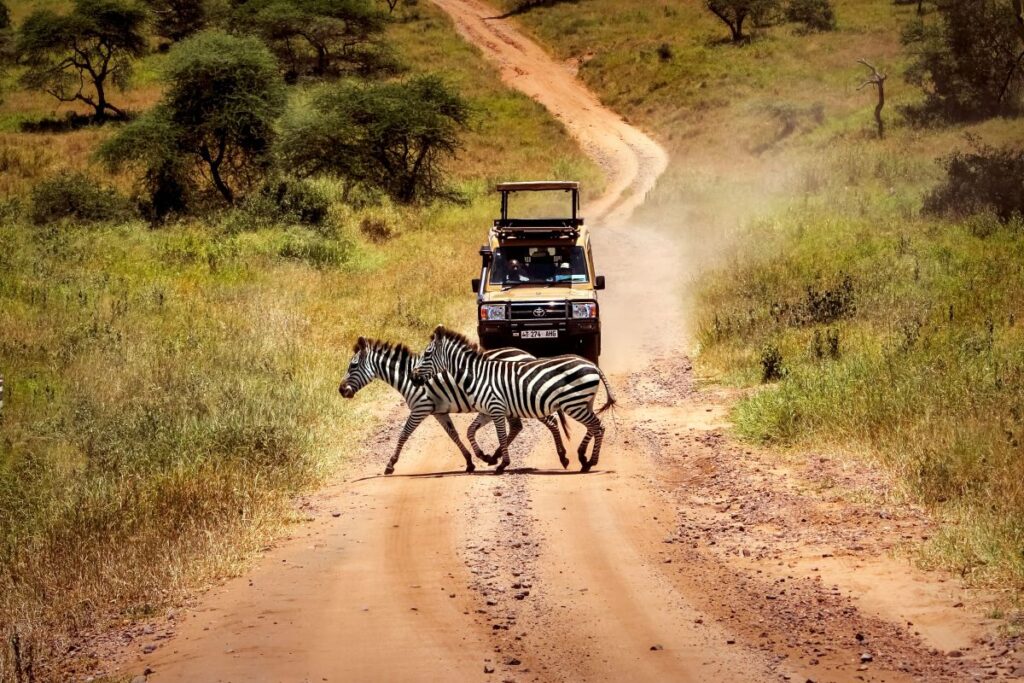
This comprehensive guide covers everything self-drive travellers need to know about Serengeti road conditions: seasonal changes, zone-by-zone breakdowns, vehicle requirements, navigating common hazards, and practical tips drawn from experienced safari guides and operators.
Quick Reference: Serengeti Road Zones at a Glance
| Zone | Road Type | Best Season | Min. Vehicle | Difficulty |
| Southern Serengeti | Gravel / Murram | June – Oct | 4WD SUV | Moderate |
| Seronera Valley | Gravel (maintained) | Year-round | 4WD SUV | Easy–Mod |
| Western Corridor | Murram / Sandy | Jun – Oct | High-clear 4WD | Difficult |
| Northern Serengeti | Rocky / Remote Track | Jul – Oct | High-clear 4WD | Very Difficult |
Seasonal Road Conditions Overview
Road conditions inside the Serengeti are fundamentally governed by rainfall patterns. Tanzania experiences two distinct wet seasons and two dry seasons, each dramatically transforming the drivability of park roads.
Dry Season: June to October
The long dry season from June through October is the optimal time for self-drive safaris across virtually all zones of the Serengeti. This is when the Great Migration moves through the northern Serengeti and Mara River crossings become accessible.
- Main roads are firm, well-graded, and passable by most 4WD vehicles.
- Dust is the primary challenge — expect powdery murram on major arteries.
- Side tracks remain dry but can be heavily corrugated from previous wet-season traffic.
- Western Corridor and Loliondo roads become far more accessible but still require high-clearance 4WD.
Short Dry Season: January to February
The short dry spell between January and February coincides with wildebeest calving season in the Ndutu and southern plains. Roads here are generally firm, though localized standing water can remain from December’s short rains.
- Short-grass plains roads near Ndutu are passable but require care at marsh edges.
- Northern and western routes remain difficult and are best avoided for self-drivers.
Long Rains: March to May
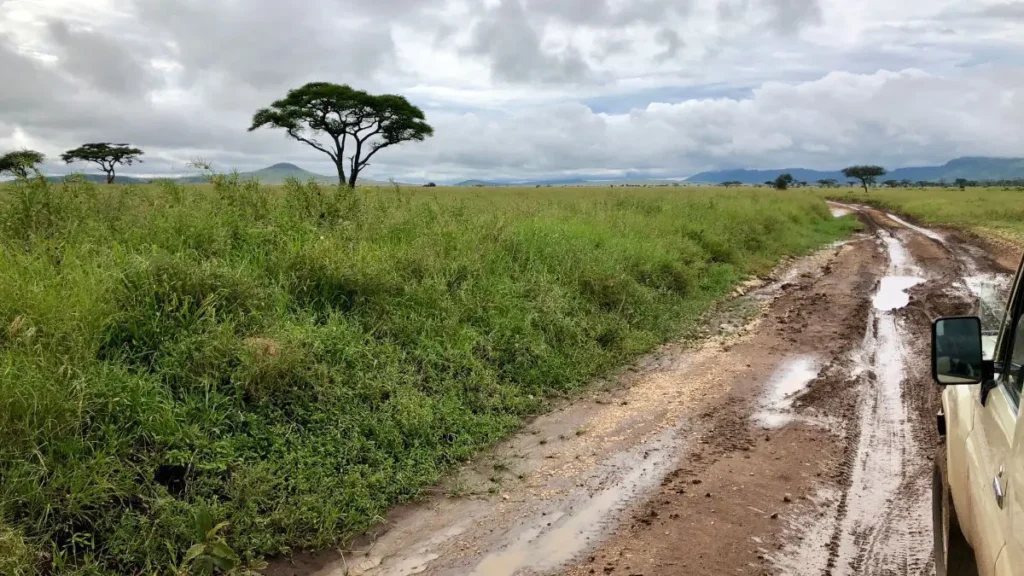
The long rains from March through May present the most challenging road conditions. Many secondary tracks become impassable, and even primary roads can suffer significant damage. This period is not recommended for self-drive visitors.
- Deep mud on black cotton soil sections, particularly on western and northern approaches.
- Seasonal stream crossings become flooded and impassable without proper recovery equipment.
- Road closures enforced by TANAPA rangers at certain entry gates.
- Even experienced guides with expedition 4x4s have been stuck for hours in these conditions.
Short Rains: November to December
The short rains of November and December bring lighter but still impactful rainfall. Main roads remain mostly passable, but off-road game drives become risky. The plains begin greening rapidly, and dust is replaced by slick mud on untarmacked sections. Visitors during this period should stick to well-established routes and avoid early-morning drives on wet black cotton soil.
Zone-by-Zone Road Conditions Guide
1. Southern Serengeti & Ndutu Area
The southern Serengeti, encompassing Ndutu, the Ngorongoro–Serengeti boundary zone, and the short-grass plains, is the most visited area during the calving season (January–March). Road conditions here are closely tied to the vegetation and soil types that characterise this open landscape.
Road Surface and Characteristics
- Road Type: Primarily graded gravel and murram (laterite) tracks; some sections are sandy near Ndutu Lake.
- Maintenance: Moderate — main arteries are graded periodically by TANAPA, but secondary tracks deteriorate quickly during rains.
- Soil Type: Mix of hard laterite and black cotton soil near seasonally flooded pans.
- Notable Sections: Lake Ndutu circuit, Olduvai Gorge junction road, Naabi Hill access.
During calving season, game-viewing drives regularly go off-road following wildebeest herds. While this is permitted in designated areas of the Ndutu Wildlife Management Area, it demands vehicles with good ground clearance and locking differentials. Sandy patches near the lake are deceptively soft and have swallowed vehicles without winch recovery capability.
2. Seronera Valley — The Central Hub
Seronera sits at the geographical and logistical centre of the Serengeti. The network of game-viewing roads radiating from Seronera Camp and the Visitor Centre represents the best-maintained road network inside the park. This is where most self-drive visitors spend the majority of their time, and where the roads are most forgiving.
Road Surface and Characteristics
- Road Type: Compacted gravel, some sections with improved grading and water drainage channels.
- Maintenance: Best in the park — TANAPA prioritises Seronera roads due to high visitor volumes.
- Navigability: Year-round, though some tracks become slippery after heavy rain events.
- Notable Sections: Seronera River loop roads, Maasai kopje tracks, Seronera–Lobo road.
Corrugations are common on the Seronera–Lobo stretch, especially during peak dry season when heavy traffic from lodge transfers has not been followed by grading. Speed should be kept below 40 km/h on corrugated sections to protect vehicle suspension and reduce washboarding acceleration.
3. Western Corridor — Grumeti River Region
The Western Corridor extends from Seronera westward toward the Grumeti River and the Kirawira area. This is wildebeest migration territory from May through July, when herds and their predators concentrate around Grumeti River crossings. Road conditions here are notoriously demanding and represent a significant step up in difficulty from the central zone.
Road Surface and Characteristics
- Road Type: Murram transitioning to sandy and rocky tracks further west. Sections of black cotton soil near river crossings.
- Maintenance: Minimal — primarily used by lodge transfer vehicles and guided safaris.
- Grumeti River Crossings: Concrete causeway at primary crossing point, but approaches are muddy and can flood.
- Closed Season: Most tracks are effectively impassable March–May without specialist equipment.
Self-drivers should approach the Western Corridor only during the June–October dry season and should travel in convoy where possible. Recovery gear — high-lift jack, traction boards, tow rope, and a full-size spare — is not optional in this region. The western stretch to Fort Ikoma Gate involves river crossings that can be deceptively deep even in dry season.
4. Northern Serengeti — Lobo, Kogatende & Lamai
The northern Serengeti from Lobo northward through Kogatende to the Kenya border near Lamai Wedge is the most remote and challenging zone for self-drivers. It is also, from July to October, arguably the most spectacular — the Mara River crossings here draw tens of thousands of wildebeest at a time. However, the road infrastructure reflects the remoteness of the region.
Road Surface and Characteristics
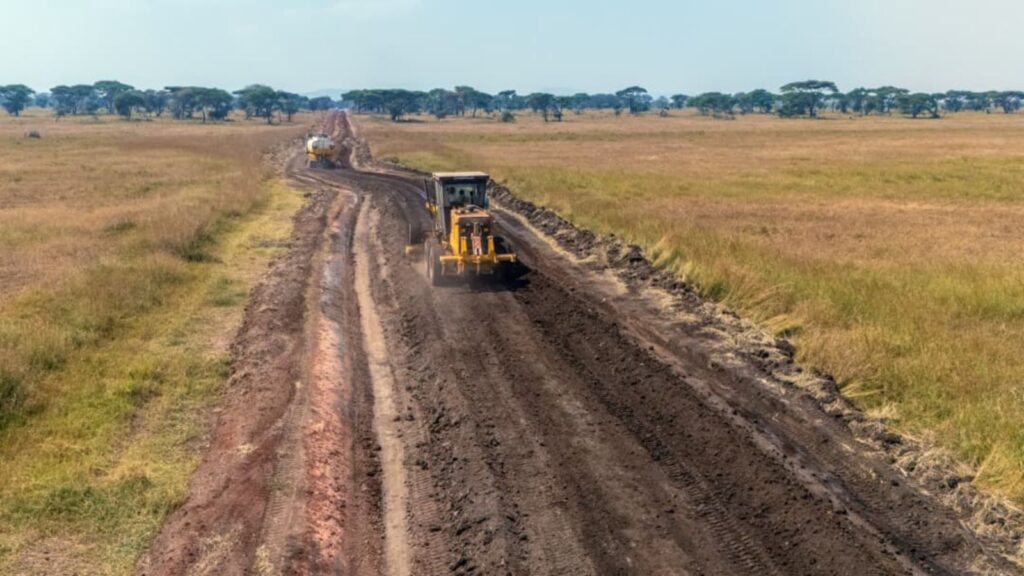
- Road Type: Largely unmaintained bush tracks — rocky, narrow, and in sections little more than game trails.
- Seronera to Lobo: Approximately 80 km on a deteriorating gravel road — expect 2.5 to 3.5 hours depending on stops.
- Lobo to Kogatende: 90+ km of increasingly technical driving with steep escarpment descents, loose rock, and sandy river valleys.
- Mara River Area: Access tracks to common crossing points are heavily eroded and rutted from elephant traffic.
- Fuel: No fuel stations — self-drivers must carry sufficient extra fuel from Seronera or Lobo.
Solo self-drivers without prior off-road experience are strongly discouraged from attempting the Kogatende circuit. This area requires a fully-equipped 4WD with a bull bar, underbody protection, and ideally a satellite communicator. TANAPA rangers at Kogatende Gate can provide current road status updates, but their assessment of ‘passable’ often assumes a fully-kitted expedition vehicle.
Vehicle Requirements for Self-Drive
Choosing the right vehicle for a Serengeti self-drive is one of the most consequential planning decisions you will make. No 2WD vehicle, regardless of its road-holding in everyday conditions, is suitable for any zone of the park. The minimum requirement throughout the Serengeti is a 4WD vehicle with high ground clearance.
Minimum Requirements: Central Zone (Seronera)
- 4WD (four-wheel drive with low-range transfer case, not just AWD)
- Ground clearance minimum 200mm (ideal 220mm+)
- Full-size spare tyre (not a space-saver)
- Basic tool kit and tyre repair kit
Recommended Vehicles: Western & Northern Zones
- Toyota Land Cruiser 70 or 80 Series (most recommended — parts availability and reliability)
- Toyota Land Cruiser 100/200 Series (excellent comfort, strong off-road capability)
- Toyota Hilux Double Cab 4WD (popular for self-drivers; good load capacity for camping gear)
- Land Rover Defender (capable but more complex repairs in remote areas)
- Nissan Patrol GR (robust choice, though less common in rental fleets)
Essential Recovery & Safety Equipment
- High-lift jack (60-inch minimum) with base plate for soft ground use
- Kinetic recovery rope (snatch strap) — not a tow rope
- Recovery boards (MaxTrax or equivalent) — essential for black cotton soil
- Portable air compressor and tyre pressure gauge
- Shovel (folding or full-size) — invaluable in mud and sand
- Satellite communicator (Garmin inReach or SPOT) — mobile coverage is virtually nonexistent in northern zones
- Extra fuel: minimum 20-litre jerrycan for northern routes, 40 litres for the Kogatende circuit
Common Road Hazards in the Serengeti
1. Corrugations
Corrugations — the rhythmic ridges that form on unpaved roads — are arguably the most pervasive road hazard for Serengeti visitors. They form when vehicle tyres repeatedly hit the same points on soft road surfaces at speed, creating a washboard effect. Ironically, the standard instinct (driving faster to ‘float’ over them) accelerates suspension wear, reduces directional control on bends, and throws up large dust clouds that obscure visibility. The correct approach is to drop to 25–35 km/h, slightly lower your tyre pressure to 28–32 PSI (re-inflate before high-speed main road sections), and steer with a relaxed grip to allow the vehicle to follow the road naturally.
2. Black Cotton Soil
Black cotton soil — known locally as mbuga — is a dark, expansive clay soil found across the Serengeti plains and particularly in depressions and watercourse margins. When dry, it is rock-hard and easily traversed. When wet, it becomes extraordinarily sticky and slippery, with almost no grip. Vehicles that enter mbuga sections in wet conditions can sink instantly to their axles and require significant effort to recover. During and immediately after rain, any black soil section should be avoided entirely unless you are prepared for a lengthy recovery operation. TANAPA rangers will often close affected routes.
3. Dust & Visibility
During peak dry season, fine murram dust reduces visibility significantly, especially in the morning when low sun angles interact with airborne particles. Dusty conditions mean following other vehicles requires greater spacing — a minimum of 200 metres in clear conditions and up to 400 metres in heavy dust. Dust also infiltrates air filters rapidly; check your air filter every 2–3 days on extended stays.
4. Wildlife on Roads
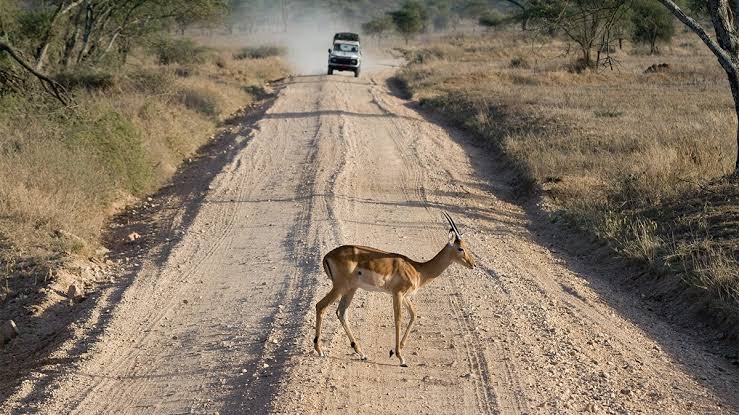
Animals treat park roads as clearings and paths, not as barriers. Elephants, buffalo, hippos, and even lions are regularly encountered on roads — particularly at dawn and dusk. Speed limits inside the Serengeti are 50 km/h on main roads and 25 km/h on game-viewing tracks, but wildlife encounters demand immediate speed reduction to a full stop where appropriate. Never attempt to push an elephant or buffalo off the road. At night, hippos graze far from water and are notoriously dangerous to encounter on a track — night driving is prohibited in the park for precisely this reason.
5. River and Stream Crossings
Seasonal river crossings occur on several routes, particularly in the western and northern zones. Before any crossing, always wade the approach in advance to assess depth and bottom firmness. The rule of thumb: if the water reaches above knee height on a standing adult, do not cross in a standard 4WD without a snorkel. If the bottom is muddy rather than rocky or sandy, risk of bogging significantly increases. Enter crossings at walking pace in second gear low-range, maintaining engine RPM to prevent water backpressure through the exhaust.
Entry Gates & Key Road Sections
Naabi Hill Gate (Main Southern Entry)
Naabi Hill Gate, situated at the boundary between the Ngorongoro Conservation Area and the Serengeti, is the principal entry point for visitors approaching from Ngorongoro or Arusha. The road from Naabi northward to Seronera (approximately 80 km) is the backbone of the park’s southern road network. It is well-maintained for a Tanzanian national park road but is heavily corrugated during peak season. Journey time from Naabi to Seronera should be budgeted at 2 to 2.5 hours accounting for mandatory stops at wildlife sightings.
Ikoma Gate (Western Entry)
Fort Ikoma Gate is the western entry/exit, connecting the park to the Mwanza–Musoma corridor. The approach road from Mwanza via Bunda is paved to Fort Ikoma town, but once inside the gate the road quality deteriorates rapidly. The Ikoma–Seronera road traverses the Dutwa Plains and can be heavily boggy during the wet season. For self-drivers entering from this direction, the Ikoma–Seronera journey can take 3 to 5 hours depending on conditions.
Kleins Gate (Northern Entry, Loliondo/Kenya Direction)
Kleins Gate connects to the Loliondo Game Controlled Area and onward to Kenya. The Loliondo route involves significant sections of rough murram road passing through Maasai community lands before entering the northern Serengeti ecosystem. It offers a spectacular and uncrowded alternative entry but demands a well-equipped vehicle and ideally a local guide familiar with the route’s river crossings.
Practical Self-Drive Tips for Road Safety
Navigation
- Download offline GPS maps — Maps.me (with detailed Africa tiles) and Gaia GPS are both used by experienced self-drivers.
- Purchase the Harms Verlag Serengeti map (1:150,000) — widely available in Arusha.
- Road junctions inside the park are signed but often faded — photograph the map at the visitor centre before departing Seronera.
Timing Your Drives
- Park gates open at 06:00 and close at 19:00 — night driving is strictly prohibited.
- Allow substantially more time than the distance suggests — 50 km in the Serengeti can easily take 2–3 hours.
- Early morning and late afternoon produce the best wildlife sightings and the coolest driving conditions.
- If travelling long distances (e.g., Seronera to Kogatende), depart at gate opening and plan to arrive at your destination by mid-afternoon to allow time for breakdown management.
Tyre Management
- Run highway tyres at standard road pressure on firmer sections but reduce to 28–30 PSI on sandy and corrugated routes.
- All-terrain (AT) tyres are strongly preferred over highway tyres — punctures are significantly more frequent in the park than on tarmac roads.
- Carry a full tyre plug/patch repair kit and a 12V compressor in addition to your spare wheel.
What to Do if You Get Stuck
- Stay calm and do not spin the tyres — this digs the vehicle deeper into soft ground.
- Assess the situation from outside the vehicle before attempting recovery.
- Use recovery boards under the drive wheels for forward momentum.
- If unable to self-recover, wait for a passing vehicle or alert TANAPA via your satellite communicator.
- Remain inside your vehicle at all times if lions, hyenas, or other dangerous game are in the vicinity.
Final Thoughts
A self-drive safari through the Serengeti offers a depth of immersion that guided tours cannot replicate. You move at your own pace, linger at sightings as long as you wish, and develop an intimate understanding of the landscape. But this freedom carries responsibility. Road conditions in the Serengeti are not merely an inconvenience — they determine whether a vehicle breakdown becomes a recoverable inconvenience or a genuinely dangerous situation in one of the world’s most remote ecosystems.
Plan your timing according to seasonal conditions. Choose your vehicle with seriousness. Carry recovery gear suited to your planned route. Inform TANAPA rangers of your intended itinerary each day. These practices, combined with the information in this guide, will ensure that your Serengeti road journey is remembered for all the right reasons — the wildebeest at the Mara, the lions on a kopje at sunrise, the absolute silence of the central plains at dusk.