
Game Drive in Moremi Game Reserve
| In This Guide
What a Moremi game drive is like, from first light to sundowner • The best game-drive areas: Third Bridge, Xakanaxa, Khwai, Mboma Island and more • Wildlife and birds you can expect • Best time to visit, month by month • Guided vs. self-drive game drives • Park fees, rules, and getting there • Where to stay, a sample 3-day itinerary, packing list and FAQs |
Why a Game Drive in Moremi Belongs on Every Botswana Itinerary
Few places in Africa deliver the drama of a Moremi game drive. Picture an open 4×4 rolling out at dawn along a sandy track, mist lifting off a papyrus-fringed lagoon, a pack of African wild dogs trotting past the vehicle, and a leopard draped over the branch of a sausage tree. This is everyday safari life in Moremi Game Reserve, the protected heart of the Okavango Delta in northern Botswana.
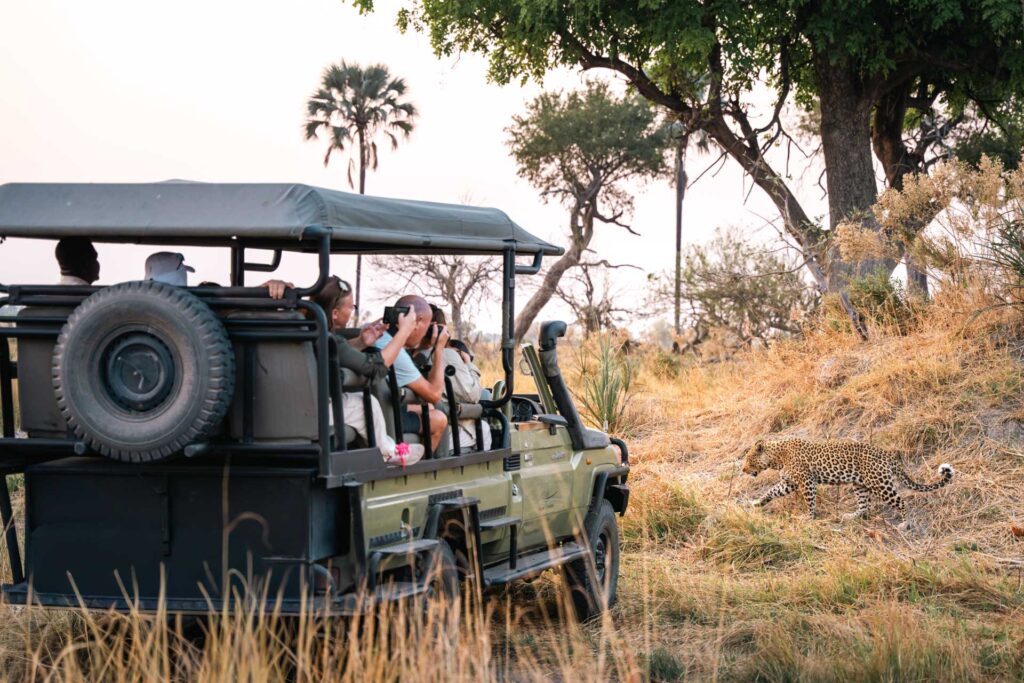
Moremi covers close to 5,000 square kilometres of the eastern and central Okavango, combining permanent water, seasonal floodplains, mopane woodland, and dry sandveld islands. That mix of land and water is exactly what makes game drives here so rewarding: you get the predator density of a classic savannah reserve together with the hippos, waterbirds, and lush scenery of a wetland.
This guide covers everything you need to plan a game drive in Moremi Game Reserve, whether you are joining a guided safari from a luxury lodge or exploring on your own in a self-drive 4×4 with a rooftop tent.
Moremi Game Reserve at a Glance
| Detail | Information |
| Location | Eastern and central Okavango Delta, Ngamiland, northern Botswana |
| Size | Approximately 4,900–5,000 km² (including Chief’s Island) |
| Established | 1963, proclaimed by the Batawana people and named after Chief Moremi III |
| Nearest town | Maun (about 100 km to South Gate) |
| Main entry points | South Gate (Maqwee) and North Gate (Khwai) |
| Signature wildlife | Wild dog, lion, leopard, cheetah, elephant, buffalo, red lechwe, sitatunga |
| Bird species | More than 500 recorded in the wider Okavango region |
| Best time for game drives | July to October (dry season) |
| Vehicle requirement | High-clearance 4×4 essential year-round |
| Managed by | Department of Wildlife and National Parks (DWNP), Botswana |
| A Reserve Founded by Its Own People
Moremi was among the first wildlife reserves in Africa to be created by a local community rather than a colonial government. Concerned about overhunting and cattle encroachment, the Batawana people, led by Mrs. Moremi (widow of Chief Moremi III), set the land aside in 1963. Chief’s Island, the former royal hunting ground, was added later and now forms the reserve’s wild core. |
What Is a Game Drive in Moremi Like?
A game drive is a guided or self-guided excursion by vehicle to find and watch wildlife. In Moremi, drives follow a network of sandy and sometimes waterlogged tracks that link lagoons, floodplains, and woodland. Off-road driving is not permitted inside the public reserve, so all viewing happens from designated roads, which keeps disturbance low and the habitat pristine.
Morning Game Drives
The morning drive is the highlight of most safari days. You leave camp around sunrise, when predators are still active after the night’s hunting and the light is soft and golden. Expect to be out for three to four hours, usually with a coffee and rusk stop at a scenic spot. Mornings are the best time to find lions on a kill, wild dogs setting off to hunt, and leopards returning to their resting trees.
Afternoon and Sundowner Game Drives
After a midday rest, afternoon drives depart around 15:30 to 16:00 and run until the reserve gates close at dusk. Elephants and buffalo come down to drink, antelope herds gather on the floodplains, and the drive often ends with a sundowner drink overlooking a lagoon as hippos begin to grunt and the sky turns orange.
Full-Day Game Drives
Full-day drives with a packed lunch let you reach more distant areas such as Mboma Island or the Third Bridge–Xakanaxa loop without returning to camp. They are especially popular with self-drivers and photographers who want to stay with a sighting as long as it lasts.
Night Drives
Night drives are not permitted inside the public Moremi Game Reserve. However, lodges in the neighbouring private and community concessions, such as the Khwai Community Concession just outside North Gate, can offer night drives with spotlights. These are your chance to see nocturnal species like leopard on the hunt, hyena, serval, African wild cat, genet, porcupine, and the elusive aardvark.
A Typical Game Drive Day
| Time | Activity |
| 05:30 | Wake-up call, light breakfast, tea and coffee by the fire |
| 06:00 | Morning game drive departs as gates open |
| 08:00 | Coffee stop in the bush |
| 10:30 | Return to camp for brunch |
| 11:00 – 15:30 | Rest, swim, or watch wildlife from camp during the heat of the day |
| 15:30 | High tea, then afternoon game drive |
| 18:00 | Sundowner drinks at a lagoon or floodplain viewpoint |
| 18:30 | Return before gate closing (or night drive in a private concession) |
| 19:30 | Dinner around the campfire |
Best Game Drive Areas in Moremi Game Reserve
Moremi’s game-viewing is concentrated on the Moremi Tongue, the dry peninsula of land reaching into the delta from the east. Each area has its own character, and the best safaris combine two or three of them.
Third Bridge
Named after the third of the log-pole bridges that cross the Sekiri River, Third Bridge is one of the most famous game-drive zones in Botswana. The surrounding floodplains and islands hold some of the highest predator densities in the reserve, including lion prides, leopard, and wild dogs. The area around Mboma Island and the Xini Lagoon is reached from here, and red lechwe are almost always on the floodplains. Note that the campsite is unfenced, and wildlife walks through it day and night.
Xakanaxa Lagoon
Xakanaxa (pronounced roughly “Ka-ka-na-ka”) sits on the edge of permanent water and is wonderfully scenic, with tall riverine forest, large lagoons, and a heronry that is spectacular in season. Game drives here combine leopard sightings in the woodland with elephant, hippo, and crocodile along the water. Xakanaxa is also the main launch point for motorboat trips into the deeper delta.
Khwai River and North Gate
The Khwai River forms Moremi’s northern boundary and is one of the best places in the reserve for elephants, especially in the dry season when large herds come to drink and cross the river. Hippo pools, open floodplains, and woodland bring lion, leopard, and wild dog sightings. Across the river, the Khwai Community Concession allows off-road driving and night drives, which makes the North Gate area extremely versatile.
Mboma Island
Reached via a loop road from Third Bridge, Mboma Island is a long tongue of land surrounded by floodplains and papyrus. It is excellent for big herds of lechwe, tsessebe, and zebra, and the open grasslands are good for cheetah. Mboma also has a mokoro station where you can swap the vehicle for a traditional dugout canoe.
Bodumatau, Dead Tree Island and Paradise Pools
These lesser-known routes between Xakanaxa and Third Bridge reward patient drivers. Bodumatau is known for lion prides, Dead Tree Island for its eerie skeletons of drowned trees and raptors, and Paradise Pools for their beautiful reflections and wading birds. Traffic is lighter here, so you may have sightings all to yourself.
South Gate (Maqwee) and the Mopane Tongue
Most visitors arriving from Maun enter at South Gate. The mopane woodland and pans around the gate are good for elephant, giraffe, kudu, impala, and occasionally wild dogs and lions. It is a useful first or last drive before heading deeper into the reserve.
Chief’s Island
Chief’s Island, the largest island in the delta, holds exceptional concentrations of game, including the reserve’s reintroduced rhinos. It is not accessible by road from the public reserve; you reach it by light aircraft to exclusive camps such as Mombo or by mokoro from camps on its fringes. For many travellers it is the ultimate splurge.
| Area | Best For | Road Access | Ideal Season |
| Third Bridge | Lion, leopard, wild dog, lechwe | 4×4, water crossings | May – October |
| Xakanaxa | Leopard, elephant, birds, boating | 4×4 | Year-round |
| Khwai / North Gate | Elephant herds, predators, night drives (concession) | 4×4 | June – October |
| Mboma Island | Plains game, cheetah, mokoro | 4×4 from Third Bridge | June – October |
| Bodumatau / Paradise Pools | Lion, raptors, quiet sightings | 4×4, seasonal flooding | July – October |
| South Gate | Elephant, giraffe, kudu | 4×4 | Year-round |
| Chief’s Island | Rhino, big cats, dense game | Fly-in only | Year-round |
Wildlife You Can See on a Moremi Game Drive
Moremi supports four of the Big Five (lion, leopard, elephant, and buffalo) with excellent reliability, while rhino has been reintroduced to the Okavango and is occasionally seen around Chief’s Island. The reserve is also one of the best places on the continent to see African wild dogs.
| Animal | Likelihood | Where and When |
| African wild dog | Good | Third Bridge, Khwai, Xakanaxa; best June – August during denning |
| Lion | Very good | Throughout, especially Third Bridge, Bodumatau and Khwai |
| Leopard | Good | Riverine woodland at Xakanaxa, Khwai and Third Bridge |
| Cheetah | Fair | Open floodplains such as Mboma Island |
| Elephant | Excellent | Khwai River and South Gate, peaking in the dry season |
| Buffalo | Very good | Large herds on floodplains, often with lions following |
| Hippo and crocodile | Excellent | Lagoons and channels across the reserve |
| Red lechwe | Excellent | Floodplains, especially around Third Bridge |
| Sitatunga | Rare | Papyrus swamps; best seen on boat trips |
| Giraffe, zebra, wildebeest | Very good | Woodland and grassland throughout |
| Spotted hyena | Good | Widespread; often near kills |
| Rhino | Rare | Chief’s Island and surrounding concessions |
Birding on Moremi Game Drives
Moremi is a paradise for birders. Game drives regularly produce African fish eagle, wattled crane, saddle-billed stork, slaty egret, African openbill, lilac-breasted roller, Pel’s fishing owl (along the Khwai and in riverine forest), and the colourful carmine bee-eater. Between November and March, migrant species arrive from Europe and Asia, and the heronries near Xakanaxa fill with nesting storks, egrets, and herons.
| Guide’s Tip: Follow the Alarm Calls
The best guides find predators by listening as much as looking. Barking baboons, snorting impala, chattering squirrels and the urgent alarm of francolins often mean a leopard or lion is nearby. Switch off the engine at intervals and listen. |
Best Time for a Game Drive in Moremi
Moremi offers good game drives all year, but the experience changes dramatically with the seasons. Interestingly, the Okavango floods peak in the dry winter months, because rain that falls in the Angolan highlands takes several months to flow down into the delta.
| Season | Months | What to Expect on Game Drives |
| Early dry / flood arrival | April – June | Floodwaters begin to fill channels; cool, clear days; good game as animals start concentrating; some tracks may close |
| Peak dry season | July – October | Best overall game viewing; animals gather at permanent water; thin vegetation; very busy and highest prices; October is extremely hot |
| Green season | November – March | Rains bring lush scenery, newborn antelope, migratory birds and dramatic storms; lower prices; some roads become muddy or impassable |
Month-by-Month Snapshot
| Month | Game Viewing | Weather | Road Conditions |
| Jan – Feb | Fair–Good | Hot, wet, afternoon storms | Challenging, muddy |
| Mar | Good | Rains easing | Muddy in places |
| Apr – May | Good | Warm days, cool nights | Improving |
| Jun | Very good | Cool and dry, cold mornings | Water crossings deepen |
| Jul – Aug | Excellent | Dry, cold mornings, warm days | Floods peak; some routes closed |
| Sep | Excellent | Dry and warming up | Good |
| Oct | Excellent | Very hot and dry | Good, dusty |
| Nov – Dec | Good | Hot, first rains | Variable |
| Planning Note
Flood levels vary from year to year. In high-flood years, sections around Third Bridge, Bodumatau and Mboma can be cut off or require deep water crossings. Always check current route conditions with DWNP, the campsite operators, or your safari consultant before travelling. |
Guided vs. Self-Drive Game Drives in Moremi
Moremi is one of the few great African reserves that welcomes both fully guided safaris and independent self-drivers. Here is how the two options compare.
| Factor | Guided Safari | Self-Drive Safari |
| Wildlife spotting | Expert guides track animals and read behaviour | Depends on your own skills and luck |
| Comfort | Open safari vehicle with elevated seats | Enclosed 4×4; photography through windows and roof |
| Flexibility | Set drive times | Total freedom over routes and timing |
| Accommodation | Lodges and tented camps | Public campsites, often with rooftop tents |
| Cost | Higher, usually all-inclusive | Lower, but fuel, gear and fees add up |
| Driving challenge | None for you | Deep sand, water crossings, navigation |
| Best for | First-timers, families, photographers wanting top guiding | Experienced 4×4 drivers and adventurous travellers |
Self-Drive Game Drive Tips for Moremi
- Drive a proper 4×4. A high-clearance vehicle such as a Toyota Land Cruiser or Hilux with low-range gearing is essential. Soft-roaders will not cope with the sand and water.
- Book campsites well in advance. Moremi’s campsites at South Gate, Third Bridge, Xakanaxa and Khwai are limited and sell out months ahead for the dry season. You must have a confirmed booking to enter.
- Lower your tyre pressure. Drop to around 1.6–1.8 bar for deep sand and reinflate on tar roads. Carry a compressor.
- Never wade into water crossings. Do not get out to check depth on foot because of crocodiles and hippos. Watch other vehicles, follow established tracks, or take an alternative route.
- Carry offline maps. Tracks4Africa GPS maps or similar are invaluable. Mobile signal is absent across most of the reserve.
- Be self-sufficient. Carry enough fuel (no fuel stations inside the reserve; refuel in Maun), water, food, a recovery kit, and two spare tyres.
- Respect gate times. Plan to be at your campsite before gates close, as driving after dark is prohibited.
- Consider a guide for a day. Some self-drivers hire a local guide or join a lodge activity to boost their sightings and learn the terrain.
Game Drive Rules and Etiquette
Moremi’s rules protect both wildlife and visitors. Breaking them can result in fines or removal from the reserve.
- Stay on designated roads at all times. Off-road driving is prohibited in the public reserve.
- Drive only between sunrise and sunset, within official gate hours (roughly 06:00–18:30 in winter and 05:30–19:00 in summer; confirm on arrival).
- Keep to the speed limit, generally 40 km/h, and slower near animals.
- Remain inside your vehicle except at designated areas and campsites.
- Never feed, call, or harass animals, and keep noise to a minimum.
- Give elephants and other large animals plenty of space and never block their path.
- Limit time at busy sightings so other vehicles can enjoy them, and do not crowd predators on a kill or at a den.
- Take all rubbish out of the reserve with you.
Moremi Game Reserve Park Fees and Permits
Entry fees are paid to the Department of Wildlife and National Parks, either in advance in Maun or Kasane or at the gate. Guided safaris normally include park fees in the package price, while self-drivers pay them separately along with campsite fees charged by private operators.
| Fee Category | Approximate Cost (per day) |
| Non-resident adult (international visitor) | About BWP 270 (approx. USD 20) |
| Non-resident child (8–17 years) | Discounted rate (around half the adult fee) |
| Children under 8 | Usually free |
| Foreign-registered vehicle | Additional daily vehicle fee |
| Botswana-registered vehicle | Lower daily vehicle fee |
| Campsite (privately operated) | Approx. USD 40–70 per person per night |
| Important
Fees are reviewed periodically and may change. Treat the figures above as a guide and confirm the latest rates with DWNP or Marriott Safaris Africa before you travel. Campsites at South Gate, Third Bridge, Xakanaxa and Khwai are run by different private operators, each with its own booking system. |
How to Get to Moremi Game Reserve
By Road from Maun
Maun is the gateway to Moremi. From town, a tar road runs north-east to Shorobe, after which a gravel and sand track continues to South Gate. The 100 km journey typically takes two to three hours depending on conditions. From South Gate, it is roughly another two to three hours of slow sand driving to Third Bridge or Xakanaxa, and a similar time to North Gate and Khwai.
From Kasane and Chobe
Self-drivers combining Chobe and Moremi travel south through Savuti to North Gate. This is a demanding full-day route with deep sand, and should only be attempted in a well-equipped 4×4.
By Light Aircraft
Most lodge-based visitors fly in on short charter flights from Maun or Kasane to airstrips at Xakanaxa, Khwai, Chief’s Island and surrounding concessions. Flights take roughly 20 to 40 minutes and offer a spectacular aerial view of the delta. Soft-sided luggage within a strict weight limit (commonly 20 kg including hand luggage) is required.
Where to Stay for Game Drives in Moremi
Luxury
- Mombo Camp (Chief’s Island) – one of Africa’s most celebrated camps, famous for exceptional predator and rhino sightings.
- Khwai River Lodge – elegant tented suites overlooking the Khwai floodplain on Moremi’s northern edge.
- Sango Safari Camp and other Khwai concession camps – intimate camps offering off-road and night drives just outside North Gate.
Mid-Range
- Camp Xakanaxa – a long-established tented camp on the Xakanaxa Lagoon combining game drives and boat trips.
- Camp Moremi – classic tented camp in tall riverine forest near Xakanaxa.
- Camp Okuti – stylish, family-friendly camp on the Maunachira River.
Budget and Self-Drive Camping
- South Gate, Third Bridge, Xakanaxa and Khwai (North Gate) campsites – unfenced public campsites with basic ablutions. Ideal for self-drivers with rooftop or ground tents.
- Mobile camping safaris – a guided option where a crew sets up a private bush camp, giving the camping experience with professional guiding.
Sample 3-Day Moremi Game Drive Itinerary
Day 1: Maun to South Gate and Xakanaxa
Depart Maun early, stock up on fuel and supplies, and drive to South Gate. After entry formalities, enjoy a game drive through the mopane woodland, looking for elephant and giraffe, then continue towards Xakanaxa. Arrive in time for a sunset over the lagoon. Overnight at Xakanaxa.
Day 2: Xakanaxa, Paradise Pools and Third Bridge
Head out at sunrise on a morning game drive along the Xakanaxa lagoon roads in search of leopard. Optional mid-morning boat trip to the heronries. In the afternoon, drive via Paradise Pools and Dead Tree Island to Third Bridge, watching for lion and wild dog. Overnight at Third Bridge.
Day 3: Mboma Island and Return to Maun
Complete the Mboma Island loop on an early drive for lechwe, tsessebe and possibly cheetah, then exit via South Gate and return to Maun by late afternoon. Alternatively, extend your trip by continuing to Khwai and North Gate for elephant-rich game drives and a night drive in the community concession.
| Make It Longer
Three nights is the minimum to do Moremi justice. Five to seven nights, split between Xakanaxa or Third Bridge and Khwai, gives you the best chance of seeing wild dogs, leopards and lions on the hunt. Moremi pairs beautifully with Chobe National Park, Savuti, and the Makgadikgadi Pans. |
Photography Tips for Moremi Game Drives
- Shoot the golden hours. The first and last two hours of daylight produce the warmest, most flattering light.
- Bring a long lens. A 100–400 mm or 150–600 mm zoom covers most wildlife; a wider lens is useful for landscapes and elephants close to the vehicle.
- Use a beanbag. It provides a stable rest on vehicle doors and roofs and is easier than a tripod in a safari vehicle.
- Protect from dust. Moremi’s fine sand gets everywhere in the dry season. Carry a blower, cloths and a waterproof cover.
- Turn the engine off. Vibration ruins sharp images; ask your guide to cut the engine at sightings.
- Bring spare batteries and memory cards. Charging may be limited at camps and unavailable at public campsites without solar or inverter setups.
What to Pack for a Moremi Game Drive
- Neutral-coloured clothing in khaki, olive, beige or brown (avoid bright colours and dark blue or black, which attract tsetse flies)
- Warm fleece, jacket, beanie and gloves for cold winter morning drives (June to August)
- Wide-brimmed hat, sunglasses and high-SPF sunscreen
- Binoculars, ideally one pair per person
- Camera gear, batteries, memory cards and a dust cover
- Insect repellent and long sleeves for evenings
- Reusable water bottle
- Personal medication, malaria prophylaxis (as advised by your doctor), and a small first-aid kit
- A light rain jacket in the green season
- Soft-sided bag if flying in on a light aircraft
Health and Safety on Moremi Game Drives
Moremi is a malaria area, particularly during and after the rains from November to April. Consult a travel health professional about prophylaxis before you travel, and use repellent and long clothing at dusk. Tsetse flies can be a nuisance in some woodland areas; neutral clothing helps.
Wildlife safety is critical, especially at unfenced campsites. Never walk around camp at night without a torch, keep food sealed inside your vehicle, and stay well away from the water’s edge. On drives, always obey your guide and remain seated and quiet near dangerous animals. Self-drivers should leave a travel plan with someone in Maun and carry a satellite communicator or satellite phone for emergencies.
Other Safari Activities to Combine with Game Drives
- Mokoro excursions – glide silently through the channels in a traditional dugout canoe poled by a local guide (from Mboma and concession camps, water levels permitting).
- Motorboat trips – explore the lagoons and heronries from Xakanaxa and see hippos, crocodiles and water birds at eye level.
- Walking safaris – available with armed guides in private concessions, offering a close-up look at tracks, plants and smaller creatures.
- Scenic flights – helicopter or light aircraft flights reveal the extraordinary patterns of the delta from above.
- Cultural visits – meet the communities of Khwai and Mababe and learn about community-based tourism.
Book Your Moremi Game Drive with Marriott Safaris Africa
Whether you dream of a luxury fly-in safari to Chief’s Island or a self-drive adventure with a rooftop tent through Third Bridge and Khwai, Marriott Safaris Africa can design the right Moremi experience for you.
- Share your travel dates and style: tell us when you want to travel, your group size, budget, and whether you prefer guided or self-drive.
- Receive a tailored itinerary: we propose lodges or campsites, routes and activities, with transparent pricing.
- Confirm and secure bookings: we reserve lodges, campsites, flights, vehicles and park permits early, which is vital for the dry season.
- Pre-departure briefing: receive packing lists, route notes and safety guidance before you leave.
- Enjoy 24/7 support: our team is available throughout your safari.
| Perfection Anytime
Contact Marriott Safaris Africa today to plan your game drive in Moremi Game Reserve and experience the wild heart of the Okavango Delta. |
Frequently Asked Questions
What is the best time for a game drive in Moremi Game Reserve?
The dry season from July to October offers the best game viewing, as animals concentrate around permanent water and vegetation is thin. The green season (November to March) is quieter, cheaper and excellent for birding and newborn animals.
Can I do a self-drive game drive in Moremi?
Yes. Moremi is one of Africa’s top self-drive reserves, but you need a high-clearance 4×4, confirmed campsite bookings, full self-sufficiency, and confidence in sand and water-crossing driving.
Are night drives allowed in Moremi?
No, night drives are not permitted in the public reserve. They are offered by lodges in the adjoining private and community concessions, such as Khwai.
Can I see the Big Five in Moremi?
Lion, leopard, elephant and buffalo are seen regularly. Rhino has been reintroduced to the Okavango and is occasionally seen, mainly around Chief’s Island, so the full Big Five is possible but not guaranteed.
How many days do I need in Moremi?
A minimum of three nights is recommended, but four to six nights across two areas (for example Xakanaxa or Third Bridge plus Khwai) provides a much richer experience.
Is Moremi good for seeing wild dogs?
Yes. Moremi and the surrounding Okavango concessions are among the best places in Africa to see African wild dogs, particularly during the denning season from about June to August.
How far is Moremi from Maun?
South Gate is around 100 km from Maun, roughly a two to three hour drive. A light aircraft flight to the reserve’s airstrips takes about 20 to 40 minutes.
Is Moremi suitable for children?
Yes, many camps welcome families, though some set minimum ages (often 6 to 12) for game drives or activities. Unfenced campsites require constant supervision of children.
What is the difference between Moremi and the Okavango Delta?
The Okavango Delta is the entire inland river delta. Moremi Game Reserve is the official protected area covering a large part of the eastern and central delta, including Chief’s Island.