Okavango Delta Animals
Big Five • Predators • Antelope • Birds • Reptiles • Where & When to See Them
Okavango Delta Animals, the Okavango Delta is one of the few places on Earth where a major river never reaches the sea. Instead, the Okavango River flows south from the highlands of Angola and fans out across the sands of northern Botswana, creating a vast mosaic of papyrus-lined channels, lagoons, floodplains, palm islands and woodland. Every year this seasonal flood transforms a semi-arid landscape into a lush oasis – and the animals come in their thousands.
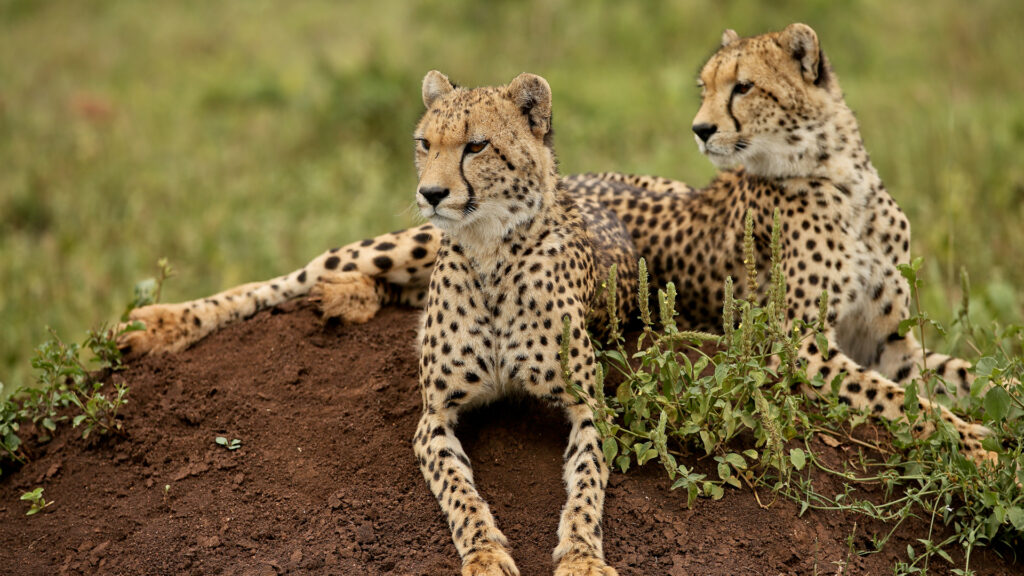
For safari travelers, this means something special: the chance to see elephants wading between islands, lions crossing shallow channels, red lechwe bounding through the floodplains and wild dogs hunting across open grassland, all within a single itinerary. This guide covers the Okavango Delta animals you are most likely to encounter, the rare species worth searching for, where and when to see them, and how to experience the Delta’s wildlife responsibly.
| Okavango Delta Wildlife at a Glance
Location: North-western Botswana, Ngamiland District – the gateway town is Maun. Status: UNESCO World Heritage Site since 2014 (the 1,000th site inscribed on the list). Big Five: All five present – elephant, lion, leopard, buffalo and (reintroduced, rarely seen) rhino. Signature species: Red lechwe, sitatunga, African wild dog, Pel’s fishing owl, wattled crane, hippo. Birdlife: Well over 400 recorded species across the Delta and surrounding woodlands. Peak game viewing: Roughly June to October (dry season in the region, high water in the Delta). Best ways to see animals: Game drives, mokoro (dugout canoe), motorboat, guided walks and scenic flights. |
Why the Okavango Delta Is So Rich in Wildlife
The Delta’s wildlife story is driven by water. Rains fall on the Angolan highlands between roughly November and March, but that water moves slowly – it takes several months to travel down the Okavango River and spread across the Delta’s flat terrain. The result is a remarkable timing mismatch: the floodwaters usually peak in the Delta between about June and August, precisely when the surrounding Kalahari is at its driest.
As the region dries out, animals from the wider landscape are drawn towards permanent and seasonal water. Grazers follow the fresh grass that springs up along receding floodplains, predators follow the grazers, and the islands become natural refuges where wildlife concentrates. This seasonal pulse is why the Okavango supports such a varied mix of land mammals, water-dependent species, fish, reptiles and birds.
The Delta’s Main Habitats
| Habitat | What It Looks Like | Typical Animals |
| Permanent swamp | Deep papyrus-fringed channels and lagoons that hold water year-round | Sitatunga, hippo, crocodile, Pel’s fishing owl, otters, tigerfish |
| Seasonal floodplains | Grassy plains flooded for part of the year, then lush with new grazing | Red lechwe, buffalo, zebra, wattled crane, wild dog, lion |
| Islands | Raised ground with palms, fig and sausage trees, termite mounds | Elephant, leopard, baboon, giraffe, impala, warthog |
| Mopane & dry woodland | Fringing woodland on the Delta’s edges and larger landmasses | Elephant, sable, roan, kudu, giraffe, cheetah, honey badger |
The Big Five in the Okavango Delta
The Okavango is one of the few wetland destinations in Africa where you can realistically see most of the Big Five on one trip. Elephant, lion, buffalo and leopard are regularly encountered; rhino are present but sightings are rare and tightly protected.
African Elephant
Loxodonta africana
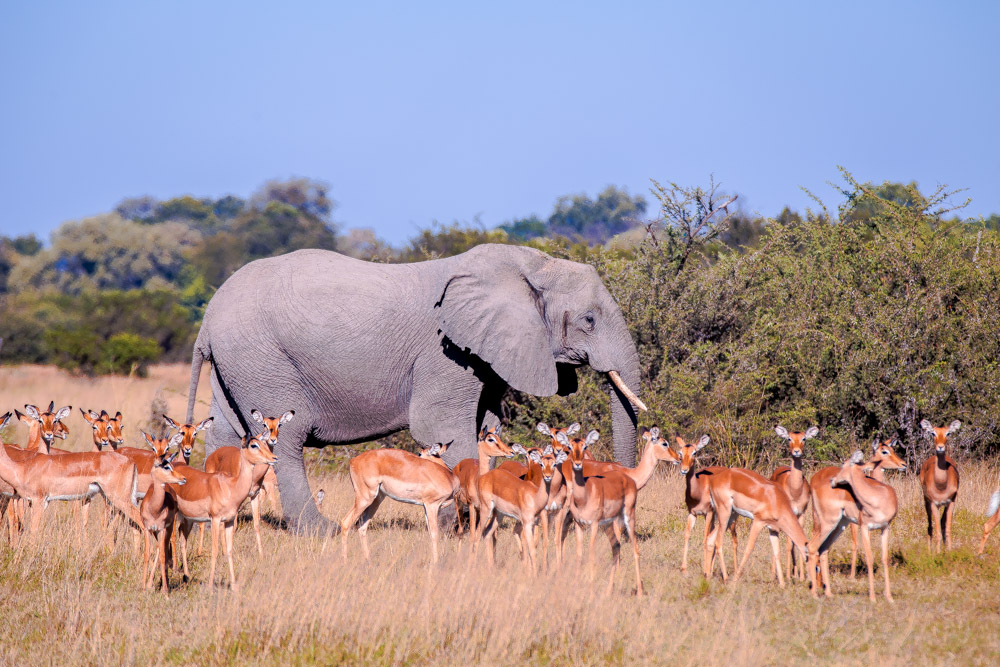
Northern Botswana holds one of the largest elephant populations on the continent, and the Okavango is a vital part of that range. Elephants here are confident swimmers and are often seen crossing channels with only their trunks and backs above the waterline – one of the Delta’s most memorable sights.
Large breeding herds move into the Delta during the dry months, while bulls are present year-round. Their feeding habits shape the landscape: they push over trees, open pathways through reed beds and spread seeds that help create new islands.
Where to look: Moremi Game Reserve (especially Xakanaxa and Khwai), Chief’s Island and the woodland edges of the private concessions. Watch for river crossings from a boat or mokoro.
Lion
Panthera leo
Okavango lions have adapted to a semi-aquatic life. Unlike most lions, which avoid water, prides here regularly wade and even swim between islands while hunting. Some prides in the Delta are known for specializing in buffalo, which demands large, powerful groups.
Lions are most often seen resting in the shade during the day and become active in the cooler hours around dawn and dusk.
Where to look: Chief’s Island, Moremi, the Khwai area and northern concessions such as the Duba Plains and Vumbura areas.
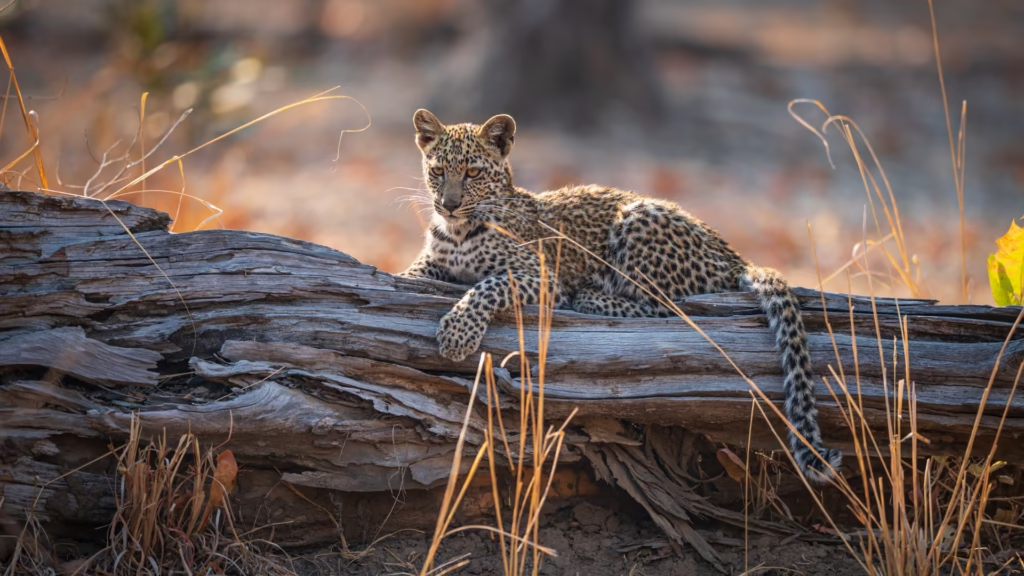
Leopard
Panthera pardus
Leopards thrive in the Delta’s riverine woodland and island forests, where large trees provide shade and safe spots to stash prey. They are solitary and well camouflaged, but the open floodplains surrounding wooded islands make them easier to spot here than in many dense habitats.
Sightings improve in the dry season, when vegetation thins and guides can track fresh spoor in the sand.
Where to look: Wooded islands in Moremi (Mboma Island, Xakanaxa), the Khwai River area and private concessions that permit off-road tracking.
African Buffalo
Syncerus caffer
Large buffalo herds, sometimes numbering in the hundreds, graze the Delta’s floodplains and move between islands as water levels change. Old bulls – often called “dagga boys” for the mud they wallow in – tend to stay near water in small bachelor groups.
Because buffalo are a key prey species for Okavango lions, following a herd can lead to dramatic predator interactions.
Where to look: Northern floodplains and the Moremi floodplain systems; dry-season herds near permanent water.
Rhinoceros
Ceratotherium simum & Diceros bicornis
Both white and black rhino have been reintroduced to the Okavango, particularly around Chief’s Island and Moremi, as part of Botswana’s rhino conservation efforts. Their locations are closely guarded and sightings are uncommon, so travelers should treat any encounter as a bonus rather than an expectation.
Botswana’s anti-poaching work and the remoteness of the Delta make it an important refuge for these species.
Where to look: Locations are not publicised for security reasons. Your guide or lodge will advise if sightings are possible.
| Safari Tip: Managing Big Five Expectations
Elephant, buffalo and lion are seen on most Okavango safaris of three nights or longer. Leopard sightings are good but never guaranteed, and rhino remain rare. Splitting your stay between a “wet” water-based camp and a “dry” land-based camp gives you the best chance of seeing the widest range of animals. |
Predators of the Okavango Delta
Beyond lions and leopards, the Delta is one of Africa’s most rewarding places to watch predators. Its open floodplains suit hunting by sight, and the variety of prey supports a full community of carnivores.
African Wild Dog (Painted Wolf)
Lycaon pictus
The Okavango and the wider northern Botswana region form one of the most important remaining strongholds for the endangered African wild dog. Packs roam huge territories and hunt cooperatively, usually in the early morning and late afternoon, with impressive success rates.
The best time to see wild dogs is during the denning season, roughly June to August, when packs stay close to a den site while raising pups.
Where to look: Khwai, Moremi and the northern and western private concessions. Ask your camp about active dens.
Cheetah
Acinonyx jubatus
Cheetahs are less common than lions or leopards in the Okavango because much of the habitat is wet or wooded. They favour the drier, more open grasslands on the Delta’s edges, where they can sprint after impala and young antelope.
Where to look: Drier open plains on the Delta’s fringes and some northern concessions.
Spotted Hyena
Crocuta crocuta
Far more than scavengers, spotted hyenas are capable hunters that often compete directly with lions. Their whooping calls are a classic sound of Okavango nights, and dens with curious cubs can provide superb viewing.
Where to look: Throughout the Delta; dens are often found in old termite mounds.
Smaller Carnivores
Patient travellers, especially on night drives in private concessions, can find a wide range of smaller predators:
- Side-striped and black-backed jackal – opportunistic hunters and scavengers seen on open plains.
- Serval – a long-legged spotted cat that hunts rodents in tall grass near water.
- Caracal – a shy, tufted-eared cat that is rarely seen but present on drier ground.
- African wild cat – the ancestor of the domestic cat, often spotted on night drives.
- Honey badger – small, famously fearless and always a highlight when seen.
- Spotted-necked and Cape clawless otters – found in channels and lagoons, best spotted from a mokoro or boat.
- Genets, civets and mongooses – several species, including the water mongoose, active at dusk and night.
Antelope and Grazers of the Okavango
Antelope are the backbone of the Delta’s food chain. Some, like the red lechwe and sitatunga, are specially adapted to wetlands and are among the main reasons wildlife enthusiasts visit the Okavango.
Red Lechwe
Kobus leche
The red lechwe is the Okavango’s signature antelope. Its elongated hooves and water-repellent coat help it move through shallow floodwater, and its powerful hindquarters allow it to bound through the water when escaping predators. Herds graze the floodplains and are a familiar sight on almost every Delta safari.
Where to look: Seasonal floodplains throughout the Delta – particularly in the north and around Moremi.
Sitatunga
Tragelaphus spekii
The elusive sitatunga is a true swamp specialist, with long, splayed hooves that let it walk on soft, floating vegetation. When threatened, it can sink into the water with only its nostrils exposed. It lives in dense papyrus and reed beds, which makes it one of the Delta’s hardest animals to see.
Where to look: Permanent swamps in the Panhandle and the northern and western Delta; best chances from a mokoro or boat in the early morning.
Other Antelope to Look For
| Species | Key Features | Habitat in the Delta |
| Impala | Graceful and abundant; males carry lyre-shaped horns | Woodland edges and islands |
| Tsessebe | One of Africa’s fastest antelope; glossy reddish-brown coat | Open floodplain grasslands |
| Greater kudu | Tall and white-striped; males have long spiralling horns | Woodland and thickets |
| Sable antelope | Jet-black males with sweeping curved horns | Mopane woodland on drier fringes |
| Roan antelope | Large, horse-like, tufted ears; uncommon | Drier woodland and grassland edges |
| Waterbuck | Shaggy coat; white ring on the rump | Near rivers and floodplain margins |
| Southern reedbuck | Medium-sized; whistling alarm call | Tall grass and reedbeds near water |
| Bushbuck | Shy, spotted and striped; usually alone | Dense riverine vegetation |
| Blue wildebeest | Dark grey with shaggy beard; often with zebra | Open floodplains and grassland |
| Steenbok & common duiker | Small, solitary antelope | Dry woodland and scrub |
Other Large Mammals
Hippopotamus
Hippopotamus amphibius
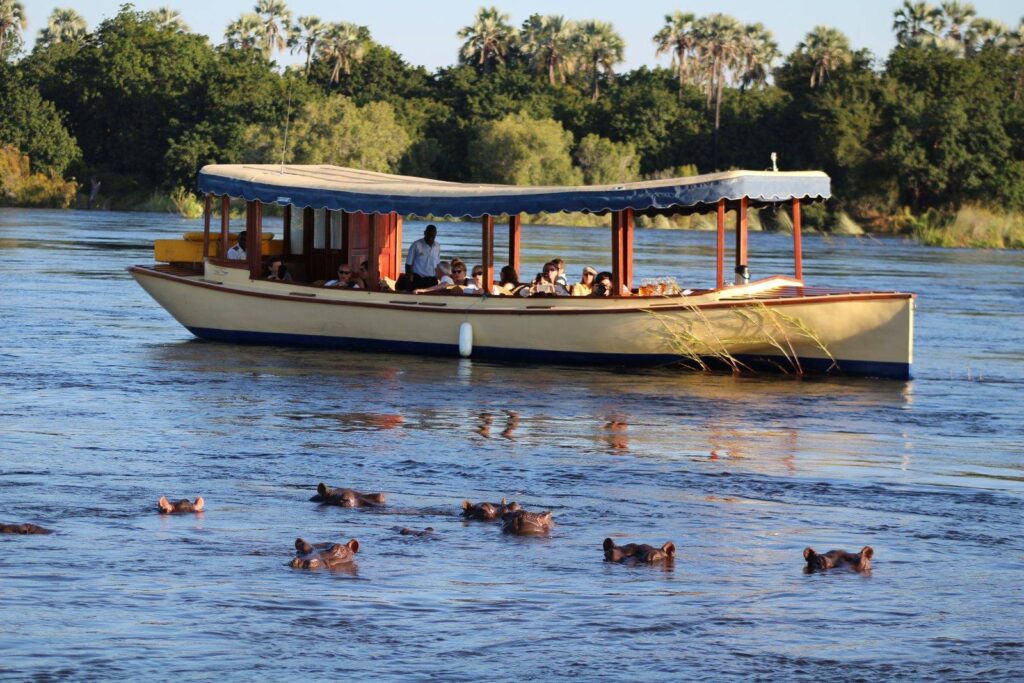
Hippos are central to the Okavango’s ecosystem. Moving between grazing areas at night, they carve paths through reeds and papyrus that help keep channels open and direct the flow of water across the Delta. By day they rest in pools and lagoons, announcing themselves with deep grunting calls.
Hippos are involved in more dangerous encounters than most large animals, which is why mokoro polers steer carefully around pools and keep a safe distance.
Where to look: Deeper lagoons and channels – Xakanaxa, the Khwai River and the permanent waterways.
Giraffe
Giraffa camelopardalis
Giraffes browse acacia and other trees on the Delta’s islands and drier woodland. Watching a group cross a shallow floodplain against a backdrop of palms is a classic Okavango image.
Where to look: Islands, woodland edges and drier concessions.
Plains Zebra
Equus quagga
Zebras graze the Delta’s grasslands, often alongside wildebeest. Northern Botswana is also home to one of Africa’s longest recorded zebra migrations, linking the Chobe and Linyanti region with the Nxai Pan area.
Where to look: Floodplain grassland and drier fringes.
Primates and Other Mammals
- Chacma baboon – large, sociable troops forage on the islands and are often seen near camps.
- Vervet monkey – small, agile and common in riverine trees.
- Lesser bushbaby (galago) – a tiny, nocturnal primate with huge eyes, seen on night drives.
- Warthog – common on floodplains, recognisable by their upright tails when running.
- Aardvark and pangolin – rare and nocturnal; seeing either is a real privilege.
- Porcupine and springhare – regularly encountered on night drives.
Reptiles, Amphibians and Fish
The Delta’s waterways support a hidden world of cold-blooded animals that is easy to overlook but fascinating to discover from the water.
- Nile crocodile – found in deeper channels, the Panhandle and lagoons, and often seen basking on sandbanks.
- Water monitor (Nile monitor) – large lizards that swim well and raid nests for eggs.
- African rock python – Africa’s largest snake, present but seldom seen.
- Painted reed frogs – tiny, brightly coloured frogs whose chorus fills the evenings during the warmer months.
- Tigerfish – an aggressive, sharp-toothed game fish prized by catch-and-release anglers.
- Catfish (barbel) – in the Panhandle, the annual “barbel run” sees catfish hunt in packs, drawing birds and other predators into a feeding frenzy, typically towards the end of the dry season.
- Bream (tilapia species) – important prey for fish eagles, kingfishers and otters.
Birds of the Okavango Delta
With well over 400 bird species recorded, the Okavango is a birdwatcher’s paradise. Wetland specialists, raptors, woodland birds and summer migrants all share the Delta. The warmer, wetter months (roughly November to March) bring migrant species and breeding plumage, while the dry season makes larger birds easier to see along the water’s edge.
Must-See Okavango Birds
| Bird | Why It’s Special | Best Spot |
| Pel’s fishing owl | Large ginger owl that hunts fish at night; a top target for birders | Riverine forest in the Panhandle and northern channels |
| African fish eagle | Iconic call often described as the “voice of Africa” | Throughout the Delta’s waterways |
| Wattled crane | Rare, tall crane; the Okavango is one of its key southern African sites | Open floodplains |
| Slaty egret | Range-restricted heron of the Okavango–Zambezi wetlands | Shallow floodplain pools |
| African skimmer | Skims the water with its lower bill to catch fish | Sandbanks in the Panhandle |
| Saddle-billed stork | Tall, with a striking red, black and yellow bill | Floodplain margins and lagoons |
| Southern carmine bee-eater | Brilliant pink-red colony nester (summer visitor) | River banks, especially in the Panhandle |
| Lilac-breasted roller | Colourful and frequently photographed | Woodland and open areas |
| African jacana | Long toes let it walk on lily pads | Lagoons and quiet channels |
| Malachite kingfisher | Tiny, jewel-coloured kingfisher | Reed beds along channels – great from a mokoro |
Heronries are another highlight. During the breeding season, colonies of storks, herons, egrets and cormorants nest together on islands – Gcodikwe Lagoon in the Moremi area is one of the best known.
Where to See Animals in the Okavango Delta
Wildlife is spread across the entire Delta, but different areas offer different experiences. Your choice of camp has a major influence on what you see and how you see it.
| Area | Type of Experience | Wildlife Highlights |
| Moremi Game Reserve (Xakanaxa, Third Bridge, South Gate) | Public reserve; game drives and boat trips; lodges and campsites | Elephant, lion, leopard, wild dog, hippo, heronries |
| Khwai area | Community area bordering Moremi; night drives and walks permitted in parts | Elephant herds, wild dog, leopard, hippo, birdlife |
| Chief’s Island | Largest island in the Delta; high predator density | Lion, leopard, buffalo, reintroduced rhino |
| Northern private concessions (e.g. Vumbura and Duba areas) | Exclusive camps; off-road driving, night drives, mokoro | Lion and buffalo interactions, wild dog, red lechwe, sable |
| Okavango Panhandle | Deep-water channels; fishing, boating and birding | Crocodile, Pel’s fishing owl, skimmers, bee-eaters, barbel run |
| Western Delta | Remote, water-focused camps | Sitatunga, wetland birds, hippo, mokoro encounters |
| Moremi vs. Private Concessions
Moremi Game Reserve is more accessible and generally more affordable, including for self-drive travellers, but vehicles must stay on designated roads and night drives are not permitted inside the reserve. Private concessions limit visitor numbers and usually allow off-road tracking, night drives and guided walks – ideal for predators and nocturnal species – but come at a higher price. |

Best Time to See Okavango Delta Animals
Wildlife can be seen year-round, but the experience changes with the seasons. Remember that the Delta’s flood peaks during the local dry season.
| Period | Conditions | Wildlife Experience |
| June – August | Dry, cool, clear days; cold mornings; high flood levels | Excellent game viewing as animals concentrate; ideal for mokoro trips; wild dog denning season |
| September – October | Hot and dry; thin vegetation; water receding | Peak predator and big-game viewing; large elephant herds; very hot days |
| November – March | Green season; afternoon storms; lower water | Newborn antelope, predator action, migrant birds, lush scenery, lower rates |
| April – May | Rains ending; flood arriving; mild temperatures | Good value, fewer visitors, rising water and improving game viewing |
| Which Season Suits You?
First-time safari & Big Five focus: July to October. Mokoro & water activities: June to September, when water levels are highest. Birding & baby animals: November to March. Best value: April, May and November, the shoulder months. |
Ways to See Wildlife in the Okavango
Game Drives
Open 4×4 vehicles are the best way to cover ground and find big game and predators. Morning and late-afternoon drives match the times animals are most active. Night drives in private concessions reveal nocturnal species such as genets, bushbabies, servals and hyenas.
Mokoro Excursions
Gliding silently in a traditional dugout canoe (today usually fibreglass) poled by a local guide is the Delta’s signature experience. You will see reed frogs, jacanas, kingfishers, lechwe and possibly elephants at eye level. Polers keep well away from hippos and crocodiles.
Motorboat Safaris
In deeper channels and the Panhandle, motorboats cover longer distances and are excellent for birding, crocodile viewing and searching for fishing owls at dusk.
Guided Walking Safaris
Exploring islands on foot with an experienced guide focuses on tracks, plants, insects and smaller details – and the thrill of approaching big game respectfully on foot.
Scenic Helicopter or Light-Aircraft Flights
Seeing the Delta from above reveals the true scale of the channels and islands, with elephant and buffalo herds visible against the water. Doors-off helicopter flights are popular with photographers.
Horseback Safaris
Specialist operators offer riding safaris for experienced riders, allowing close, quiet approaches to plains game such as zebra, giraffe and lechwe.
Wildlife Safety and Safari Etiquette
- Always follow your guide’s instructions, especially on walks and mokoro trips.
- Stay seated and keep your arms inside open vehicles when near animals.
- Speak quietly and avoid sudden movements around wildlife.
- Never feed animals – including baboons and monkeys around camp.
- Keep a respectful distance from predators at kills or dens, and from mothers with young.
- At unfenced camps, always ask for an escort after dark.
- Do not swim in the Delta’s waters because of crocodiles and hippos.
- Wear neutral-coloured clothing (khaki, olive, beige) and avoid bright colours and strong fragrances.
Conservation in the Okavango Delta
The Okavango’s inscription as a UNESCO World Heritage Site in 2014 recognised it as one of the world’s most important wetland ecosystems. Botswana has long followed a high-value, low-impact tourism model, especially in private concessions, where limited bed numbers help fund conservation, anti-poaching and community programmes.
Key conservation priorities include protecting elephant and rhino from poaching, maintaining wildlife corridors used by species such as zebra and wild dog, managing human–wildlife conflict in communities on the Delta’s edges, and safeguarding the upstream flow of the Okavango River, which rises in Angola and passes through Namibia before reaching Botswana.
By choosing responsible operators and camps that support local employment and conservation, your safari directly contributes to the protection of the Delta’s animals.
Frequently Asked Questions
What animals live in the Okavango Delta?
The Delta is home to elephants, lions, leopards, buffalo, reintroduced rhinos, African wild dogs, cheetahs, hyenas, hippos, crocodiles, giraffes, zebras and many antelope, including the specialised red lechwe and sitatunga. It also supports well over 400 bird species.
Can you see the Big Five in the Okavango Delta?
Yes. Elephant, lion, buffalo and leopard are regularly seen. Rhinos have been reintroduced but are rarely encountered and their locations are kept confidential.
What is the most famous animal in the Okavango Delta?
Elephants are the most iconic, but the red lechwe is the Delta’s signature species, and the region is also renowned for African wild dogs and swimming lions.
When is the best time to see animals in the Okavango Delta?
June to October offers the best overall game viewing, with September and October particularly good for predators and large herds. November to March is best for birds and newborn animals.
Is a mokoro trip safe?
Yes, when conducted by licensed, experienced polers. They read the water carefully and avoid hippo pools and deeper channels where crocodiles are more common.
Where is the best place to see wild dogs?
The Khwai area, Moremi and the northern private concessions are among the best, especially during denning season (roughly June to August).
How many days do I need to see the Okavango’s wildlife?
Three to four nights is a good minimum. Five to seven nights split between a water-based and a land-based camp gives you the widest range of species and activities.
Can I self-drive in the Okavango Delta?
Self-drive is possible in Moremi Game Reserve and the Khwai area with a properly equipped 4×4 and pre-booked campsites. Most of the inner Delta and private concessions are reached by light aircraft and are guided only.
| Plan Your Okavango Wildlife Safari with Marriott Safaris Africa
From mokoro trips among red lechwe to predator tracking in exclusive concessions, our team designs Okavango Delta safaris around the animals you most want to see. We combine water and land camps, time your trip to the right season and handle flights, park fees and logistics from Maun or Kasane. Contact Marriott Safaris Africa today to start planning your Okavango Delta adventure. |