
The Grumeti River
Western Serengeti, Tanzania
Few rivers on earth command the drama, spectacle, and raw ecological power of the Grumeti River. Winding through the western corridor of Tanzania’s Serengeti National Park, this seasonal river is etched into the consciousness of wildlife lovers worldwide — not merely for its scenic beauty, but for the brutal, breathtaking crossings it hosts each year as part of the Great Migration.
Stretching roughly 320 kilometres from its headwaters in the highlands of northwestern Tanzania to its confluence with Lake Victoria, the Grumeti is more than a geographic feature — it is the beating pulse of one of the most biodiverse wildlife corridors on the African continent. Its banks, floodplains, and permanent pools sustain an extraordinary web of life throughout the year, drawing elephants, lions, leopards, hippos, crocodiles, and hundreds of bird species to its waters.
This comprehensive guide explores everything you need to know about the Grumeti River — its geography, ecology, the animals it sustains, the legendary migration crossings, the best times to visit, and practical travel tips for experiencing this wild lifeline firsthand.
Geography and Course of the Grumeti River
Origin and Flow
The Grumeti River rises in the Sukuma highlands to the northwest of the Serengeti ecosystem. From its headwaters, the river flows in a broadly westward direction, cutting through some of Tanzania’s most remote and pristine wilderness before eventually emptying into Speke Gulf at the southeastern corner of Lake Victoria, Africa’s largest lake.
Within the Serengeti, the river forms a wide arc through the park’s Western Corridor — a narrow finger of protected land squeezed between agricultural communities and the main Serengeti plains. The western corridor is characterised by dense riverine forest along the Grumeti’s banks, open woodland, and seasonal marshes that flood during the long rains.
The Western Corridor Landscape
The Western Corridor represents one of the most ecologically distinct zones within the Greater Serengeti ecosystem. Unlike the flat, grassy plains of the central and southern Serengeti, the western corridor is characterised by rolling hills, broken by kopjes (rocky granite outcroppings), broad seasonal floodplains, and dense thickets of Acacia and Combretum trees.
The river itself passes through several distinct habitats as it moves west: narrow gorges with steep-cut banks, wide sandy beds that shrink dramatically in the dry season, and permanent deep pools shaded by towering fig trees and wild date palms. These permanent pools are critical refuges — for hippos and crocodiles year-round, and for the thirsty wildebeest and zebra during the peak dry months.
Wildlife of the Grumeti River
Nile Crocodiles: Guardians of the Grumeti
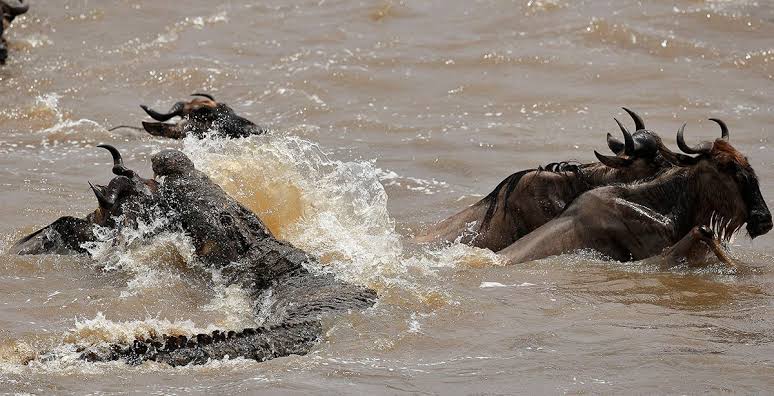
The Grumeti River is famous throughout the safari world for one creature above all others: the Nile crocodile. The river harbours some of the largest individual crocodiles in Africa, with many animals exceeding five metres in length and weighing over 500 kilograms. These ancient reptiles have lived in the Grumeti for thousands of years, and the river’s permanent pools provide them with ideal conditions — warm, shallow water, muddy banks for basking, and an annual feast during the migration crossings.
During the dry season months of June and July, when the migration arrives in the western corridor, the Grumeti’s crocodile population congregates at the crossing points in extraordinary numbers. Dozens of large crocodiles may be visible from a single viewpoint, waiting in almost supernatural stillness for the chaotic crossings to begin. The scenes that follow rank among the most visceral wildlife spectacles on earth.
Hippos: Lords of the Permanent Pools
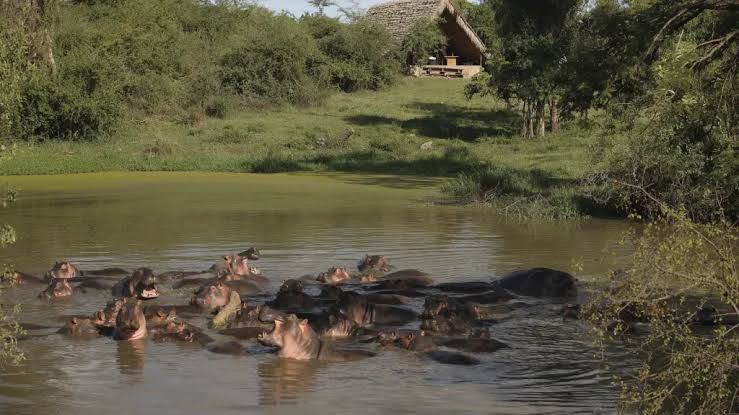
Wherever the Grumeti holds permanent water, hippos are present. The river sustains one of Tanzania’s most significant hippo populations outside of the Selous and Ruaha ecosystems. During the dry season, as seasonal pools evaporate, hippos concentrate in the remaining deep sections of the river in pods that can number fifty or more individuals.
These gatherings create extraordinary spectacles of sound and movement — the deep rumbling calls of territorial bulls echoing across the water, the constant splashing of young calves, and the explosive lunges of competing males. At dawn and dusk, hippos emerge from the water to graze the surrounding grasslands, and their trails through the riverine vegetation have shaped the landscape over centuries.
Lions and Leopards: The Riverine Predators
The Grumeti River corridor supports resident populations of both lion and leopard year-round. The dense riverine forest provides leopards with ideal ambush habitat and secure denning sites, and the western Serengeti’s leopard population is considered one of the healthiest and most visible in Tanzania, partly due to the relatively lower tourist pressure compared to the central Serengeti.
Lions in the western corridor are adapted to the broken terrain and forest margins of the river system. Several resident prides hunt along the Grumeti throughout the year, targeting buffalo, warthog, and topi during the dry months, then pivoting to the abundance of wildebeest and zebra that pour through during the migration period. The ‘Grumeti lions’ have developed specific hunting strategies suited to the riverine ambush environment, often lying in wait along banks and gullies where crossing animals are most vulnerable.
Elephants and Buffalo: Giants of the Corridor
Large elephant herds use the Grumeti as a year-round water source and navigation landmark. The western corridor’s elephant population includes some of the most impressive bulls in the Serengeti ecosystem, with animals carrying heavy ivory that move between the Grumeti’s water sources and the surrounding woodland in well-established daily circuits. Calves and females congregate at the river in the heat of the afternoon, and the sight of a fifty-strong herd crossing the Grumeti in a cloud of red dust is unforgettable.
Cape buffalo, meanwhile, form some of the largest herds in the Serengeti along the Grumeti’s floodplains. Herds of several hundred animals are regularly encountered in the western corridor, and large solitary bulls — the ‘dagga boys’ — are a common feature of the river margins, wallowing in muddy shallows and sparring with rivals.
Birdlife Along the Grumeti
The Grumeti River corridor is a birdwatcher’s paradise. The combination of permanent water, diverse vegetation types — from open grassland to dense riverine forest — and the river’s position as a wildlife highway creates exceptional bird diversity. Over 400 species have been recorded within the western corridor, making it one of Tanzania’s premier birding destinations.
Notable species regularly encountered along the Grumeti include:
- African fish eagle — its haunting call is the soundtrack of the river at dawn
- Giant kingfisher — the largest kingfisher in Africa, hunting along shaded pools
- Goliath heron — towering waders stalking the shallows with prehistoric patience
- Malachite kingfisher — a jewel-bright streak of electric blue along the river margins
- African skimmer — breeding colonies gather on the river’s sandbanks
- Long-toed lapwing — picking insects from the floating vegetation
- Grey-crowned crane — Tanzania’s national bird, nesting in the floodplain marshes
- Pel’s fishing owl — a nocturnal specialist found in the densest riverine forest
- Saddle-billed stork — towering and vividly coloured, feeding along the margins
- Hamerkop — building their enormous nest structures in riverside trees
The Great Migration and Grumeti Crossings
The Migration’s Journey to the Grumeti
The Great Migration is the largest overland movement of animals on earth. Each year, approximately 1.5 million wildebeest, 500,000 zebra, and several hundred thousand Thomson’s gazelle complete a roughly 1,800-kilometre circular journey through the Serengeti-Mara ecosystem, following the rains and the new grass growth that sustains them.
After the calving season on the southern Serengeti plains (January to March), the herds move north and northwest as the dry season takes hold. By May and June, the leading edge of the migration enters the western corridor — and suddenly the Grumeti River stands between the animals and the fresh grasslands to the north. This sets the stage for one of the most anticipated wildlife events of the year.
The Crossings: Nature’s Most Dramatic Spectacle
Grumeti River crossings differ significantly from the more famous Mara River crossings further north. The Grumeti is generally narrower and shallower than the Mara, but it poses its own unique challenges: in many places, the banks are steep, crumbling, and heavily vegetated, making entry and exit difficult. And the Grumeti’s crocodiles — larger and more numerous per unit of water than those in the Mara — transform every crossing into a potentially fatal gauntlet.
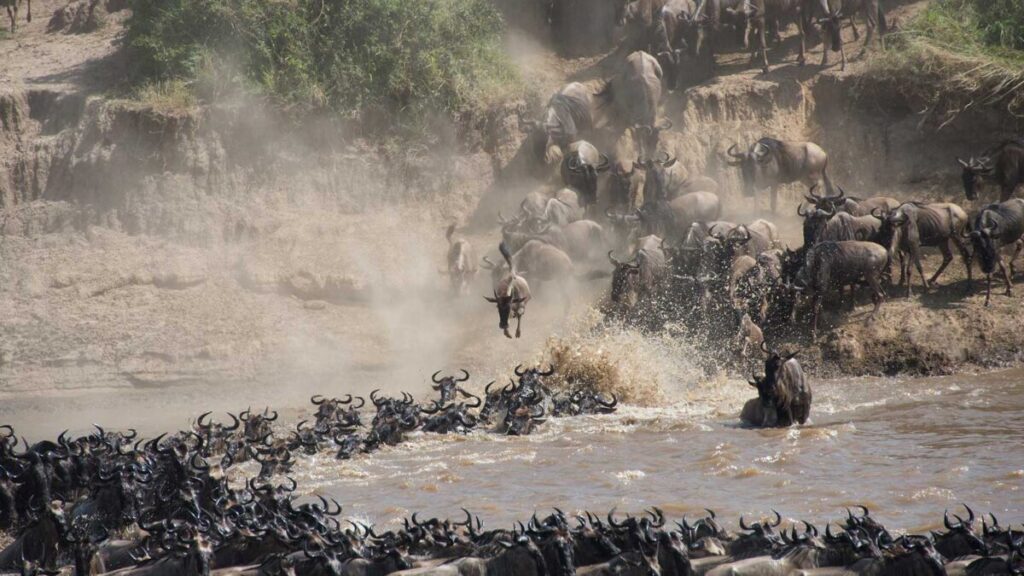
The drama of a Grumeti crossing unfolds in several stages. Thousands of wildebeest and zebra approach the river bank, milling in nervous, agitated groups. For hours — sometimes an entire day — the herds hesitate at the water’s edge, unable to overcome the instinctive fear of what lurks below the surface. Crocodiles position themselves, often motionless as logs, waiting in the shallows downstream of the crossing point.
When the threshold of fear finally tips — triggered by the pressure of masses from behind, or by one brave (or desperate) individual taking the first plunge — the crossing explodes into chaos. Thousands of animals surge into the water simultaneously, pushing, stumbling, calling. Crocodiles burst into action, targeting the weakest — the young, the old, the injured. The crossing may last only fifteen minutes, leaving the river strewn with the carcasses of the unlucky, while the survivors scramble up the far bank and immediately begin to graze, as if nothing had happened.
Timing the Grumeti Crossings
The Grumeti crossings are less predictable than those at the Mara River, but the peak window is well established: late May through July is when the bulk of the migration moves through the western corridor. The exact timing varies year to year depending on rainfall patterns, but June is generally considered the peak month for Grumeti crossings.
Unlike the Mara crossings, which often involve a single broad river with easily identifiable crossing points, the Grumeti has multiple sections where crossings occur, spread over a wider area. This means that locating crossings requires local knowledge and experience — a strong argument for staying at one of the camps or lodges whose guides know the river intimately.
Best Time to Visit the Grumeti River
June to July: Migration Peak
June and July represent the absolute peak of the Grumeti experience. The migration is in full flow through the western corridor, wildlife concentrations are extraordinary, and the dry-season conditions mean vegetation is thinner and game viewing easier. The Grumeti’s permanent pools are at their most crowded, with hippos and crocodiles compressed into shrinking water sources alongside migrating herds of wildebeest and zebra. Days are warm (22–30°C), nights are cool, and there is virtually no rain.
August to October: Dry Season Resident Wildlife
After the migration moves north toward the Mara River and Kenya, the Grumeti enters its quietest season in terms of visitor numbers — but the resident wildlife remains superb. August through October brings outstanding sightings of elephants, buffalo, lions, leopards, and the river’s permanent hippo and crocodile populations without the peak-season crowds. Birding is excellent, and the landscape takes on a stark, golden beauty as the dry season deepens.
November to April: Green Season
The long and short rains (November and March–May) transform the Grumeti corridor into a lush, green landscape. While the migration is absent and some roads become challenging, the green season has its own rewards: extraordinary birdlife including migratory species from Europe and Asia, newborn animals, dramatic skies for photography, and the experience of a truly remote African wilderness with minimal tourist presence. Some camps offer reduced rates during this period.
Camps and Lodges Along the Grumeti River
Grumeti River Camp (Singita)
Singita Grumeti River Camp is widely considered one of the finest safari camps in Africa. Set directly on the banks of the Grumeti River within the private Singita Grumeti Reserves — a 350,000-acre private concession bordering the Serengeti — the camp combines extraordinary wildlife access with exceptional luxury. Ten en-suite tents are set among ancient fig trees overlooking the river, with a resident hippo pod visible from the dining area. The camp offers morning and evening game drives, walking safaris, and boat excursions on the river.
Namiri Plains and Western Corridor Camps
Several other high-quality camps operate in or adjacent to the western corridor, offering access to the Grumeti during the migration season. Options range from ultra-luxury private concession camps to more accessible tented camps within the national park. Many operators run seasonal camps specifically positioned at prime Grumeti crossing points during June and July, allowing guests to be in the right place at the right time for the crossings.
Conservation and the Grumeti Reserves
The private Grumeti Reserves, managed by Singita in partnership with the Tanzanian government, play a crucial conservation role in protecting the western corridor of the migration route. The reserves have invested heavily in anti-poaching operations, community engagement programmes, and habitat restoration projects that have dramatically reduced illegal hunting in the area. Wildlife populations — including lion, elephant, and roan antelope — have recovered significantly under this model, demonstrating the power of conservation tourism done well.
Practical Travel Information
Getting to the Grumeti
The Grumeti River area is accessed primarily through Seronera Airstrip (the main Serengeti airstrip) or through dedicated airstrips in the western corridor, including those serving the Singita Grumeti Reserves. Most visitors fly to the Serengeti from Arusha (approximately 45 minutes) or Kilimanjaro International Airport. The road journey from Arusha to the western Serengeti takes approximately 8–10 hours and is generally undertaken only by overland safari operators.
What to Pack
Essential items for a Grumeti River safari include:
- Neutral-coloured safari clothing (khaki, olive, tan — avoid blue which attracts tsetse flies)
- Layers for cool mornings and evenings (temperatures can drop to 12°C at night in June/July)
- High-quality binoculars (8×42 or 10×42 are ideal)
- Camera with telephoto lens — the Grumeti crossings demand reach (400mm+)
- Dust-proof bags and covers for camera equipment
- Sunscreen, hat, and UV-protective clothing
- Malaria prophylaxis (the western Serengeti is a malaria risk zone)
- Yellow fever vaccination certificate (required for entry to Tanzania)
Health and Safety
The Grumeti area requires standard East African safari health precautions. Malaria prophylaxis is strongly recommended. Tsetse flies are present in the western corridor and can deliver a painful bite, though they do not transmit disease to humans in this area — wearing thick, neutral-coloured clothing helps. Travel insurance covering emergency medical evacuation is essential for remote safari areas.
Park Fees and Permits
Access to the Serengeti National Park requires payment of Tanzania National Parks (TANAPA) entrance fees, which as of recent years are charged per person per day for non-residents. Fees are subject to change and are best confirmed directly with TANAPA or through your safari operator. Visitors staying in private conservancies such as the Grumeti Reserves pay fees directly to the concession as part of their all-inclusive rate.
Conclusion: The Grumeti River as a Safari Destination
The Grumeti River is not simply a backdrop to the Great Migration — it is a world-class safari destination in its own right. Its permanent wildlife, extraordinary birdlife, and the intimate scale of its riverine landscape offer a safari experience that is in many ways more personal and intense than the famous open plains of the central Serengeti.
For those fortunate enough to witness a Grumeti crossing at peak migration, the experience is genuinely transformative — a reminder of the primal, uncompromising force of the natural world in a way that few wildlife encounters can match. For those who visit outside the migration window, the resident wildlife, the birding, and the sheer beauty of the river corridor make the Grumeti a destination worth returning to again and again.
Whether you are planning your first East Africa safari or your fifteenth, the Grumeti River deserves a prominent place on your itinerary. It is wild, ancient, beautiful, and utterly, unforgettably alive.