
Best Time to Visit Arusha National Park – Weather, Wildlife & Travel Guide
Best Time to Visit Arusha National Park ? , When planning your vacation to Arusha National Park, it is essential to consider the season of your visit, since this significantly influences wildlife encounters, activities, and your comfort with the climate. The optimal period to visit Arusha National Park is from June to October, during the dry season, when wildlife is more easily observable as they gather around freshwater sources, precipitation is less, vegetation is less dense, and mosquito populations are diminished.
From November to December and March to May, precipitation alters the terrain, resulting in the emergence of verdant grasses, coinciding with the arrival of migrating birds in the park. Arusha National Park is a concealed treasure of Tanzania, resulting in less crowds. January and February are semi-arid months, positioned between the two rainy seasons, namely the short and long rains. Similar to other wilderness regions in Tanzania, Arusha National Park has wet and dry seasons. The dry season occurs from June to October, while the two rainy seasons are mid-March to May, characterized by extensive rains, and November to December, marked by short showers.
The climate is agreeable throughout the year, featuring milder temperatures during the night and early morning hours. In the dry season, the average daytime temperature is 75°F (24°C), while the average overnight temperature is 50°F (10°C). Warm fleece and long leggings are advisable as you may feel cold during your early morning game drives. The park’s altitude generally results in lower humidity levels compared to other regions of Tanzania, with the average humidity being at its minimum from May to September.
During and between the wet seasons, temperatures are marginally elevated, fluctuating from 79-84°F (26-29°C) during the day to 53-57°F (11-14°C) at night. During the brief rainy season, precipitation does not usually occur continuously throughout the day, hence your Arusha safari activities are unlikely to be impacted. The prolonged rains result in overcast sky, sporadic cooler temperatures, and increased soil moisture, hence potentially impacting road and path conditions, as well as rendering canoeing at Momella Lakes unsafe.
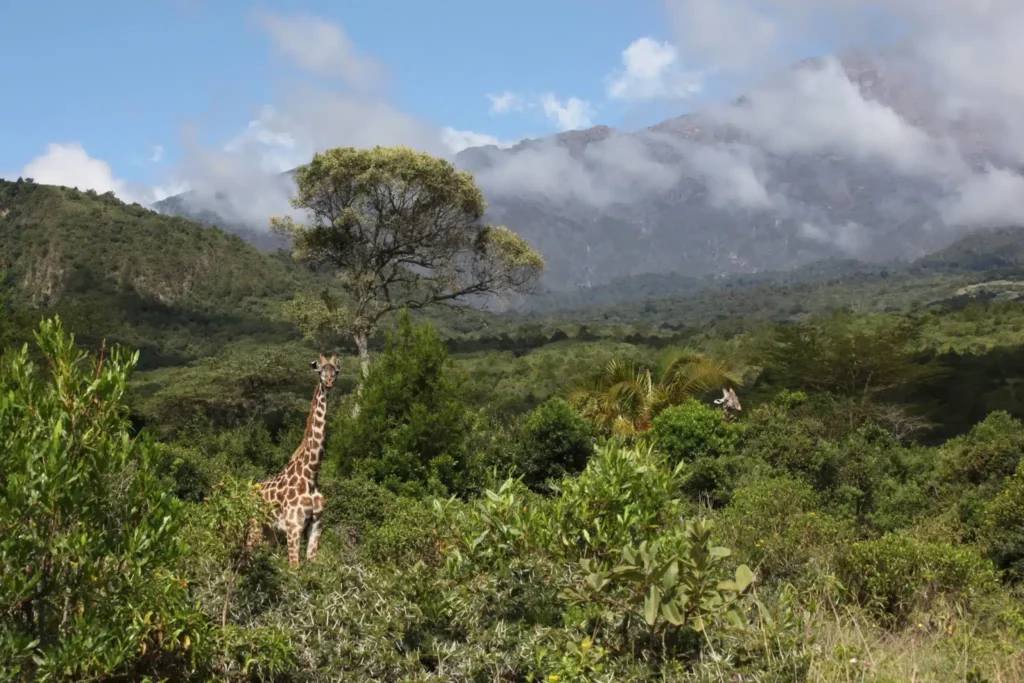
The weather influences both the vistas and the climbing prospects. The unclouded skies from December to February provide superb vistas of Mount Meru and Kilimanjaro. Conquering these renowned mountains necessitates exceptional physical fitness, and climatic conditions may impose additional demands on your capabilities. While the mountain may be ascended throughout the year, the optimal period for trekking Mount Meru and Kilimanjaro is typically during the warm, arid months. Photography safaris in Tanzania attract visitors to Arusha National Park because of its diverse topography and wildlife chances, free from the crowds typical of Ngorongoro Crater.
To obtain spectacular wildlife photographs on your inaugural visit to Africa, the optimal time to explore Arusha National Park is the dry season. In the wet seasons, avian life flourishes, while terrestrial fauna retreat deeper into the vegetation where water and food sources are abundant, necessitating extended stays in the park. Conversely, in the dry season, animals inhabit more open, less dense regions, particularly near water sources.
Directions to Arusha National Park
The Momella entrance in Arusha National Park is approximately a 45-minute to 1-hour drive from Arusha, whereas the journey from Moshi town takes about 3 hours. Arusha National Park is accessible via flights to Kilimanjaro International Airport.
Attractions in Arusha National Park
Attractions in Arusha National Park: Arusha National Park is situated in northern Tanzania and is the nearest national park to Arusha town. Safaris in Arusha National Park provide sights such Mount Meru, the Momella Lakes, Ngurdoto Crater, and a diverse array of avian and mammal species.
Mount Meru
Mount Meru is a dormant stratovolcano located in Arusha National Park. The mountain stands at an elevation of 4,566 meters, making it the second highest peak in Tanzania, following Mount Kilimanjaro, the tallest free-standing mountain in Africa.
Hiking on Mount Meru is an activity conducted on excursions at Arusha National Park. The ascent of Mount Meru requires 4 days, with the trek to the peak potentially taking 3 days.
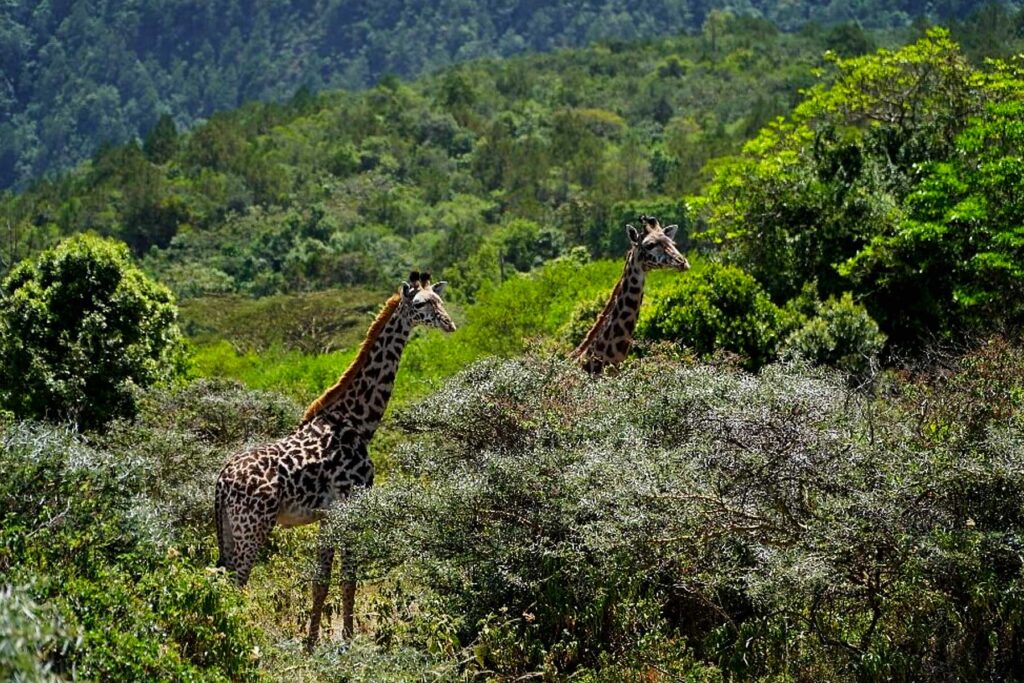
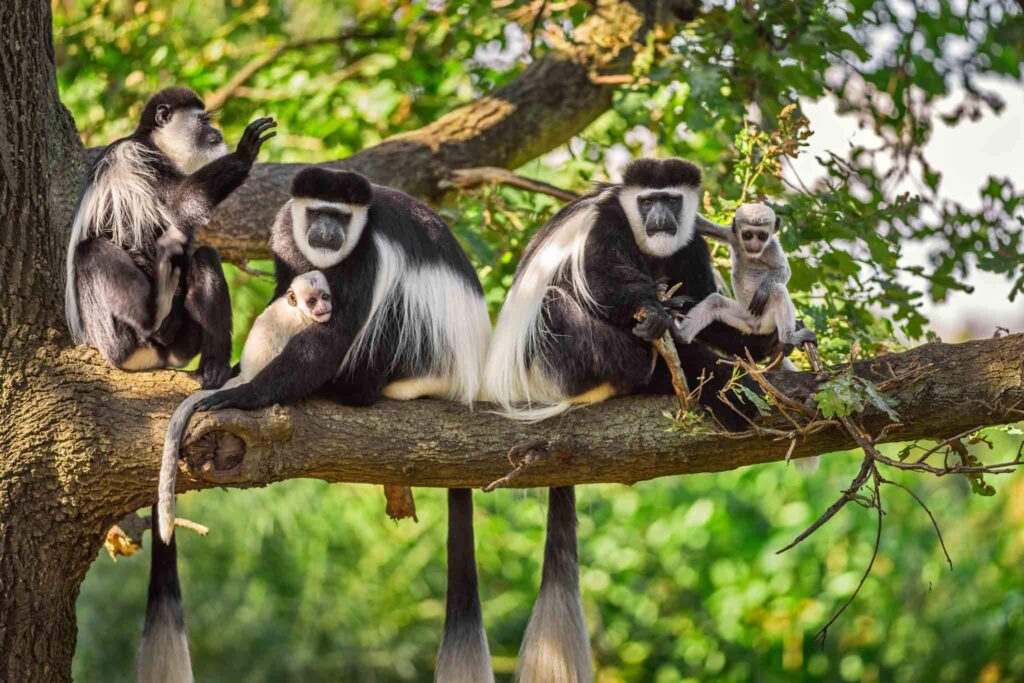
During a trekking expedition on Mount Meru, particularly on the initial day, one can observe several wildlife species, including buffalo, black and white colobus monkeys, waterbucks, giraffes, and zebras. The Momella trail serves for both ascent and descent during the mountain climb in Arusha National Park.
Ascending Mount Meru while touring Tanzania equips trekkers for an expedition on Mount Kilimanjaro, hence enhancing the likelihood of reaching Kilimanjaro’s summit. Rangers, porters, guides, and cooks accompany the climbers during their expedition.
During the ascent of Mount Meru, hikers can find lodging at the Miriakamba Hut and Saddle Hut after a successful day of climbing.
The peak provides stunning vistas during climbs on Mount Meru, including perspectives of the volcanic crater. The hiking expedition on Mount Meru within Arusha National Park commences and concludes at the Momella Gate.
The four-day walk on Mount Meru commences at Momella Gate and concludes at Miriakamba Hut, requiring around four to six hours. The subsequent hike commences at Miriakamba hut and proceeds to Saddle hut, with an estimated duration of 3 to 5 hours along this track. The climbers ascend from Saddle Hut to the top and thereafter return to Miriakamba Hut. On the final day of the trip, the journey commences from Miriakamba hut to Momella gate.
The expense of climbing Mount Meru during a tour in Tanzania is reasonable, benefiting budget-conscious travelers seeking to trek while visiting the country. The optimal period for hiking Mount Meru is during the dry season, specifically from June to October and in January.
Lake Momella
Another feature in Arusha National Park is the Momella Lakes, which comprise seven bodies of water, including the large Momella Lake and the smaller lakes: El Kekhotoito, Kusare, Rishateni, Lekandiro, and Tulusia.
The lakes possess alkaline characteristics, and both lesser and greater flamingos are among the avian species observable in the area. In addition to birdwatching at the Momella lakes, canoeing is also available on the Momella lake.
The canoe safari enhances your proximity to wildlife species in Arusha National Park while allowing you to appreciate the vistas of Mount Meru and Mount Kilimanjaro. The canoe excursion lasts around two and a half hours within the national park.
During the canoe excursion on Momella Lake, tourists are escorted by a guide and a skilled paddler. This practice in Tanzania is also conducted on Lake Duluti and Lake Manyara.
Additional avian species observable during a trip to Arusha National Park are pelicans, African fish eagles, crowned eagles, and falcons, among others. During safaris in Arusha National Park, Tanzania, one may observe several waterfalls, including Tululusia, Mount Meru, Napuru, Cave, Maio, and Napuru waterfalls.
Activities conducted in Arusha National Park during safaris encompass nature walks, hiking, wildlife observation, and birdwatching.
Ngurdoto Crater
The Ngurdoto Crater is an additional attraction observable on safaris in Arusha National Park. Various wildlife species can be observed around the crater, including buffalo, blue monkeys, black and white colobus monkeys, elephants, and antelopes, among others.
The crater is extinct, formed by volcanic activity, characterized by steep walls and comprising both forest and grassland. The Ngurdoto crater has a diameter of 3.6 kilometers and a width of 100 meters.