Moremi Game Reserve Accommodations
The Complete 2026 Guide to Lodges, Tented Camps, Mobile Safaris & Campsites
Moremi Game Reserve Accommodations, Where to stay in the Okavango Delta’s most celebrated wildlife reserve — from luxury island camps on Chief’s Island to self-drive campsites at Third Bridge and Xakanaxa.
Choosing Where to Stay in Moremi
Moremi Game Reserve covers the eastern and central portion of Botswana’s Okavango Delta and is widely regarded as one of the finest wildlife areas in Africa. Proclaimed in 1963 by the BaTawana people on their own ancestral land, it was among the first protected areas on the continent created by a local community. Today it protects close to 5,000 square kilometres of permanent swamp, seasonal floodplain, lagoon, mopane woodland and acacia savannah — a mosaic that supports large lion prides, leopard, cheetah, African wild dog, elephant, buffalo, a small and carefully protected rhino population, and more than 400 bird species.
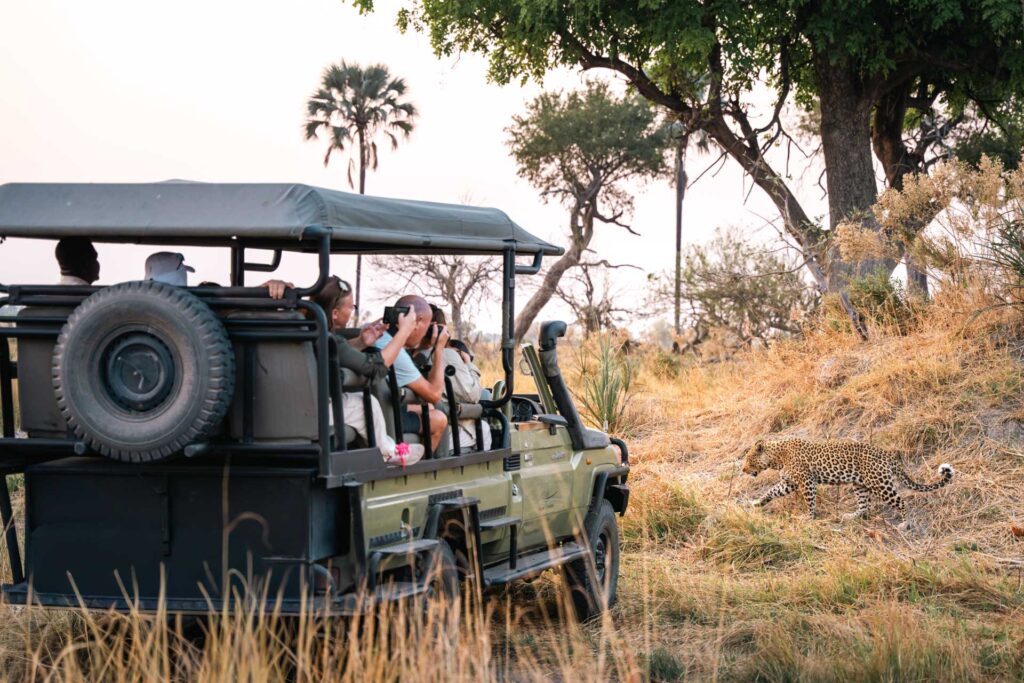
Because Moremi is a government game reserve rather than a private concession, accommodation inside its boundaries is limited and tightly regulated. That scarcity is exactly what makes your choice of lodge, camp or campsite so important. Where you sleep determines which habitats you can explore, whether you can take boat or mokoro excursions, how far you drive each day, and how many other vehicles you are likely to meet at a sighting.
This guide walks you through every type of accommodation in and around Moremi — the luxury island camps of the west, the classic lagoon-side tented camps of Xakanaxa, the private lodges along the Khwai River, guided mobile camping safaris and the four public campsites used by self-drive travelers. You will also find comparison tables, indicative 2026 prices, seasonal advice, booking steps and answers to the questions our safari planners hear most often.
| Moremi at a Glance
Location: North-West District, Botswana — eastern and central Okavango Delta Size: Approximately 4,800–5,000 km², including Chief’s Island Nearest town: Maun, roughly 100 km (about 2.5–3 hours by road) from South Gate Main zones: Chief’s Island & west, Xakanaxa & central, Khwai/North Gate, South Gate & the south-east Accommodation styles: Luxury lodges, classic tented camps, bordering private lodges, mobile camps, public campsites Best time to visit: July–October for peak game viewing; November–March for lower “green season” rates Reserve rules: Game drives on designated roads only; no off-road driving or night drives in the public reserve |
Understanding Moremi’s Accommodation Zones
Before comparing individual lodges, it helps to understand Moremi’s geography. The reserve is not one uniform block: each region has its own character, access route and accommodation style. Most travelers choose a base in one zone — or split a five- or six-night stay between two zones to enjoy both land and water safaris.
| Zone | Landscape & wildlife | Accommodation style | Access |
| Chief’s Island & Mombo (west) | Largest island in the Delta; open floodplains and dense predator and plains-game populations | Ultra-luxury fly-in camps (Mombo, Little Mombo, Chief’s Camp) | Light aircraft only |
| Xakanaxa & Third Bridge (central) | Lagoons, papyrus channels and riverine forest; boating, birding, leopard and lion | Classic tented camps and public campsites | Fly-in, or 4×4 via South Gate |
| Khwai & North Gate (north-east) | Khwai River floodplains; elephant, wild dog, lion and hippo | Public campsite inside; many private lodges just outside in the Khwai concession | Fly-in, or 4×4 from Maun or Savuti |
| South Gate & Gomoti (south-east) | Mopane woodland and Gomoti River floodplains; strong lion numbers | Tawana luxury camp; South Gate campsite | 4×4 from Maun, or fly-in |
| Planner’s Tip
If water activities matter to you, focus on the Xakanaxa area and the western camps — many eastern locations are land-only for much of the year. If big-cat game drives are your priority, Mombo, the Gomoti/South Gate area and Khwai are consistently strong choices. |
Types of Accommodation in Moremi
Moremi offers a surprisingly wide range of ways to stay, from fully serviced suites with private plunge pools to a patch of sand beneath a sausage tree where you pitch your own rooftop tent. The table below summarizes the main categories before we look at individual properties.
| Category | What to expect | Typical guest | Indicative cost (pppn)* |
| Luxury lodges & camps | Spacious suites, private decks or pools, gourmet dining, expert guides, all-inclusive | Honeymooners, photographers, once-in-a-lifetime travellers | USD 1,700 – 4,500+ |
| Classic tented camps | En-suite canvas tents, communal dining, game drives and boating | First-time and mid-range safari-goers | USD 650 – 1,500 |
| Bordering private lodges (Khwai) | Tented lodges outside the reserve with night drives and walks | Travellers wanting flexibility and value | USD 500 – 2,500 |
| Guided mobile camping | Dome or walk-in tents set up by a crew that moves with you | Adventurous travellers and small groups | USD 250 – 700 |
| Public campsites (self-drive) | Numbered pitches with shared ablutions; fully self-sufficient | Experienced 4×4 overlanders | Approx. USD 30 – 70 + park fees |
Luxury Lodges Inside Moremi
The top tier of Moremi accommodation is concentrated on and around Chief’s Island in the west and, more recently, in the south-east along the Gomoti River. These camps combine exceptional wildlife with highly experienced guiding and a level of comfort that rivals any safari destination in Africa. Expect small guest numbers, private-feeling game drives and rates that reflect both the exclusivity and the cost of operating deep in the Delta.
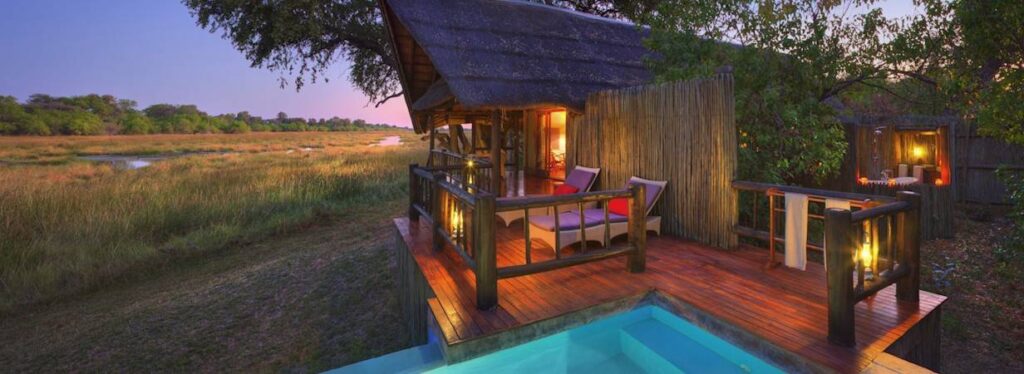
Mombo Camp & Little Mombo
Zone: Mombo Island, northern Chief’s Island | Style: Ultra-luxury fly-in camp | From: approx. USD 3,000+ pppn
Operated by Wilderness, Mombo is arguably the most famous safari camp in Botswana, long nicknamed the “place of plenty”. It sits at the northern tip of Chief’s Island, where floodplains and palm islands support remarkable concentrations of lion, leopard, cheetah, wild dog, buffalo and plains game. The area has also been central to rhino reintroduction efforts in the Delta.
Raised tented suites connected by boardwalks overlook the floodplain, so wildlife frequently passes directly in front of camp. Little Mombo, the smaller sister camp, delivers the same exceptional game viewing with only a handful of suites — a favourite for honeymooners and families who want an especially intimate stay.
Why stay here:
- Some of the highest predator densities in Africa
- Very small guest numbers and highly experienced guides
- Ideal for photographers and once-in-a-lifetime trips
Chief’s Camp
Zone: Chief’s Island | Style: Luxury bush pavilions | From: approx. USD 1,800 – 3,000 pppn
Run by Sanctuary Retreats, Chief’s Camp lies on Chief’s Island, historically the private hunting ground of the BaTawana chiefs — hence the name. Its elegant bush pavilions feature private decks overlooking the floodplain, and the main areas include a pool, lounge and spa.
Activities include game drives across the island’s open plains and, water levels permitting, mokoro excursions through the channels. Helicopter flights can usually be arranged for a dramatic aerial view of the Delta.
Why stay here:
- Prime Chief’s Island location with excellent big-cat viewing
- Land and seasonal water activities
- Spa and pool for relaxed midday downtime
Tawana
Zone: South-east Moremi, Gomoti River | Style: Contemporary luxury suites | From: approx. USD 1,750+ pppn
Opened in May 2024 by Natural Selection, Tawana is the newest luxury camp in Moremi and the product of a partnership with Chief Tawana Moremi, paramount chief of the BaTawana — the community whose forebears founded the reserve. Eight spacious suites, including family units, are strung along the Gomoti River, each with a separate lounge, outdoor sala and private plunge pool.
The south-eastern sector around Tawana is known for high wildlife numbers, particularly lion. Twice-daily game drives explore floodplains, pans and mopane woodland, while the camp offers a spa, lap pool, walk-in wine cellar, a library on Moremi’s history and traditional boma dining. Helicopter flights and birding outings can be added.
Why stay here:
- A new, design-led camp with genuine community roots
- Private plunge pool in every suite
- Excellent base for land-based predator viewing
Classic Tented Camps in the Xakanaxa Area
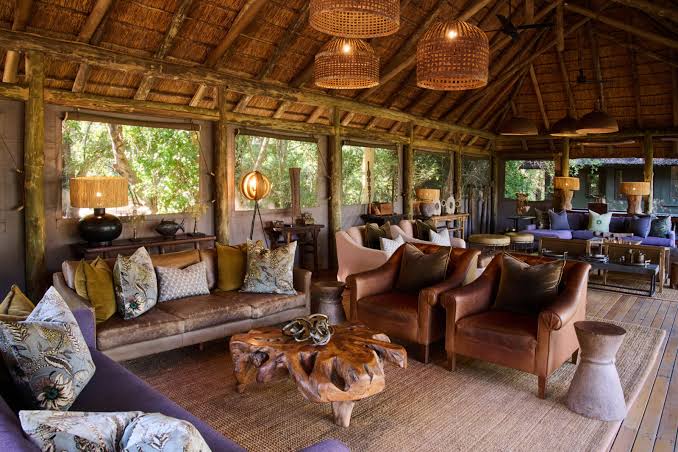
The central Xakanaxa region is the heart of the classic Moremi experience. Here, the Delta’s permanent waters meet dry land, so camps can offer both game drives and boat cruises for much of the year. Rates are well below those on Chief’s Island, and the camps — while comfortable — have a more traditional, sociable atmosphere. Because they sit inside the public reserve, you will share some sightings with vehicles from other camps and campsites.
Camp Moremi
Zone: Xakanaxa Lagoon | Style: Modern thatched safari tents | From: approx. USD 700 – 1,300 pppn
A Moremi institution, Camp Moremi was completely rebuilt in 2018 and now has 12 spacious thatched safari tents (including a family unit) for a maximum of 24 guests. Each tent has a large bathroom with double vanities and a private deck. An elevated dining area connects by boardwalk to a fireplace in front of camp — the perfect spot for evening drinks.
Guests choose between morning and afternoon game drives through varied habitats or boat trips on Xakanaxa Lagoon and its channels, which are especially rewarding for birders.
Why stay here:
- Strong value for an inside-the-reserve location
- Combination of drives and lagoon boating
- Family-friendly layout
Camp Xakanaxa
Zone: Xakanaxa Lagoon | Style: Traditional tented camp | From: approx. USD 650 – 1,200 pppn
One of Moremi’s longest-established camps, Camp Xakanaxa sits on the edge of the vast Xakanaxa Lagoon. Its appeal lies in year-round access to water and land: cruise past papyrus beds and heronries in the morning, then track lion or leopard on an afternoon game drive.
Tents are classic and comfortable rather than flashy, making it ideal for travellers who value location and activities over lavish interiors.
Why stay here:
- Year-round water and land activities
- Prime lagoon setting with outstanding birdlife
- Traditional, unpretentious safari atmosphere
Okuti Camp
Zone: Central Moremi, near Xakanaxa | Style: Contemporary small camp | From: approx. USD 800 – 1,500 pppn
Okuti stands out for its innovative, curving architecture and intimate size. Set in a game-rich part of central Moremi, it offers game drives and boat trips with a relaxed atmosphere and attentive service. It pairs well with a private-concession camp elsewhere in the Delta.
Why stay here:
- Distinctive design and small guest numbers
- Access to both land and water activities
Lodges Bordering Moremi: The Khwai Area
Directly north of Moremi’s North Gate, the Khwai River forms the reserve’s boundary. On the far bank lies the Khwai concession, a community-linked area with a cluster of excellent lodges. Staying here is a popular strategy: you game-view along the same river system, but because you are outside the reserve, camps can usually offer night drives, guided walks, seasonal mokoro trips and more flexible driving — activities not permitted inside Moremi itself.
| Lodge | Style | Highlights | Indicative rate (pppn) |
| Khwai River Lodge (Belmond) | Luxury tented suites | Long-established luxury property overlooking the Khwai floodplain | USD 1,500 – 2,500+ |
| Machaba Camp | Classic 1950s-style tented camp | Faces the Khwai River with Moremi beyond; strong all-round game | USD 800 – 1,600 |
| Little Machaba | Intimate tented camp | Smaller sister to Machaba; great for couples and families | USD 800 – 1,600 |
| Sable Alley | Tented camp on a lagoon | Hippo-filled lagoon in front of camp; good value | USD 700 – 1,400 |
| Khwai Lediba / Hyena Pan | Traditional tented camps | Authentic bush feel with night drives and walks | USD 500 – 1,000 |
| Skybeds | Elevated star beds | Sleep on raised platforms under the stars | USD 500 – 900 |
| Inside vs. Outside the Reserve
Inside Moremi: Prime locations and direct access to the core wildlife areas, but activities are limited to daytime drives on designated roads, plus boating where water allows. Khwai concession: Night drives, walks and more flexible driving, often at lower rates — though you share the river with community campsites and day visitors. Many of our clients combine one camp inside Moremi with one in Khwai to enjoy the best of both. |
Guided Mobile Camping Safaris
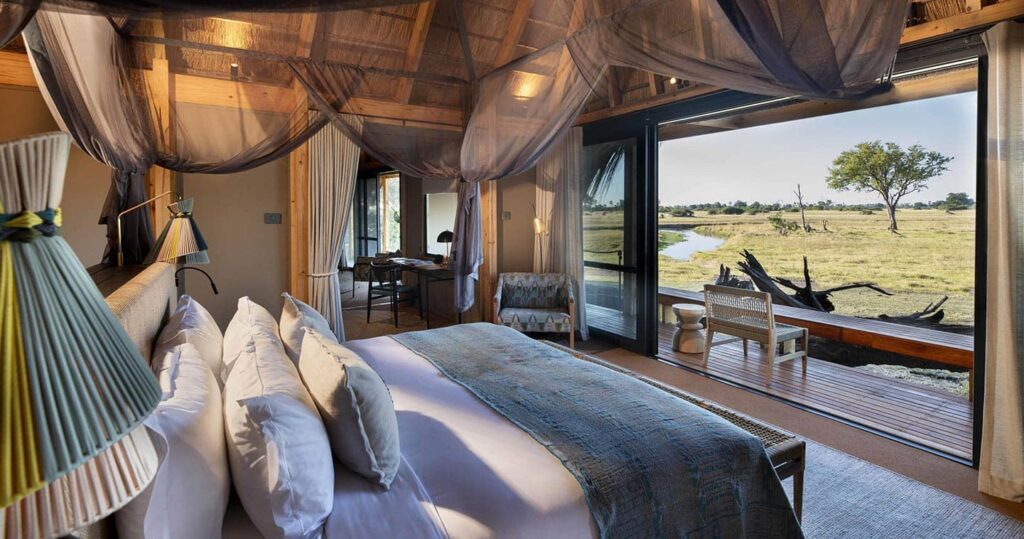
Mobile camping is one of the most rewarding — and affordable — ways to experience Moremi. A professional guide, cook and camp crew travel with you in a 4×4 safari vehicle and set up camp at reserved public campsites or designated mobile sites. You simply enjoy the game drives and arrive each afternoon to a camp that is ready and waiting.
Mobile safaris range from participation trips, where guests help pitch tents, to fully serviced “luxury mobile” camps with walk-in canvas tents, proper beds, bucket showers and private toilets. A typical route spends two or three nights at Third Bridge or Xakanaxa and two nights at Khwai, often continuing north to Savuti and Chobe.
- Participation mobile: USD 250 – 400 pppn — budget-friendly, sociable and hands-on.
- Fully serviced mobile: USD 400 – 700 pppn — camp comforts with the freedom of the road.
- Private mobile camp: priced on request — an exclusive guide, vehicle and camp for your group.
Public Campsites for Self-Drive Travellers
For self-drive safaris in a fully equipped 4×4 with rooftop tent, Moremi has four public campsites inside the reserve. Each is run by a private operator under the Department of Wildlife and National Parks (DWNP), and each is booked separately from your park entry fees. The campsites are unfenced: elephant, hyena, baboons and even lion regularly pass through, so strict camp discipline is essential.
| Campsite | Location | Operator* | Character & notes |
| South Gate (Maqwee) | At the southern entrance gate | Kwalate Safaris | Convenient first or last night from Maun; mopane woodland; less game in the immediate area |
| Xakanaxa | Central Moremi, beside the lagoon | Kwalate Safaris | Large, well-spaced pitches; boat trips nearby; excellent birding and big cats |
| Third Bridge | Central-west, on the Sekiri River | Xomae Group | Popular, scenic riverside pitches; baboons can be a nuisance — store food securely |
| North Gate (Khwai) | Northern gate on the Khwai River | SKL Camps | Riverside pitches under tall trees; superb elephant and wild dog; good link to Savuti |
*Operators as most recently listed; campsite management in Botswana changes periodically, so confirm the current operator when booking.
What Each Campsite Provides
Each pitch is a numbered site with space for one or two vehicles, usually a braai (barbecue) stand and access to a shared ablution block with flush toilets and showers (hot water depends on solar systems and maintenance). There are no shops, fuel stations or restaurants anywhere inside Moremi, so you must carry all food, water, fuel and firewood. Collecting firewood inside the reserve is not permitted.
How to Book a Moremi Campsite
- Confirm your itinerary and dates — campsites for July to October often sell out months in advance.
- Book each campsite directly with its operator (Kwalate, Xomae or SKL) online, by email or at their offices in Maun. Request a specific pitch number if you have a preference.
- Pay the deposit or full amount to secure your pitch and obtain a written confirmation or voucher.
- Pay park entry and vehicle fees to DWNP — at the DWNP office in Maun or at the gate. Gate staff will ask to see proof of your campsite booking.
- Carry printed copies of every voucher; mobile coverage inside the reserve is unreliable.
| Self-Drive Safety Essentials
Reach your campsite before the gates close around sunset — driving inside the reserve after dark is not allowed. Never leave food, rubbish or cool boxes outside or in an open vehicle; baboons and hyenas are skilled thieves. Keep children close at all times and never walk around camp after dark without a strong torch. Carry recovery gear, two spare tyres and extra fuel; deep sand and water crossings are common, and some bridges may be damaged or closed after high floods. |
Community Campsites Outside the Reserve
If the public campsites are full, consider community-run sites just outside Moremi. Kaziikini Community Campsite lies roughly 28–30 km before South Gate on the Maun road, and several community sites operate around Khwai village and the Magotlho area near North Gate. These are generally cheaper, but facilities vary widely — some have no ablutions or water — and you pay daily park fees each time you enter Moremi.
Moremi Accommodation Comparison Table
Use this quick-reference table to compare the main options side by side.
| Property | Zone | Category | Water activities | Night drives / walks | Price level |
| Mombo / Little Mombo | Chief’s Island | Ultra-luxury | Limited | No | $$$$$ |
| Chief’s Camp | Chief’s Island | Luxury | Seasonal mokoro | No | $$$$ |
| Tawana | South-east | Luxury | Limited | No | $$$$ |
| Camp Moremi | Xakanaxa | Mid-range+ | Yes (boat) | No | $$$ |
| Camp Xakanaxa | Xakanaxa | Mid-range | Yes (boat) | No | $$$ |
| Okuti | Central | Mid-range+ | Yes (boat) | No | $$$ |
| Khwai lodges | Outside, north | Varied | Seasonal mokoro | Yes | $$ – $$$$ |
| Mobile camping | Various | Budget–mid | Optional add-on | No (inside) | $ – $$ |
| Public campsites | Four sites | Self-drive | Bookable boat trips | No | $ |
Activity availability depends on water levels, season and operator policy. Confirm specific activities with your safari planner.
How Much Does Moremi Accommodation Cost?
Accommodation is usually the largest single cost of a Moremi safari. Most lodges and camps price on a fully inclusive basis, typically covering your suite or tent, all meals, local drinks, two scheduled activities a day and laundry; park fees are often included but sometimes listed separately. Light-aircraft transfers from Maun or Kasane are normally extra.
| Category | Green season (Nov–Mar) | Shoulder (Apr–Jun) | Peak (Jul–Oct) |
| Ultra-luxury (Mombo) | USD 1,800 – 2,500 | USD 2,500 – 3,500 | USD 3,000 – 4,500+ |
| Luxury (Chief’s, Tawana) | USD 1,000 – 1,700 | USD 1,500 – 2,300 | USD 1,800 – 3,000 |
| Mid-range tented camps | USD 450 – 800 | USD 600 – 1,000 | USD 700 – 1,500 |
| Khwai lodges | USD 400 – 1,200 | USD 500 – 1,600 | USD 500 – 2,500 |
| Guided mobile camping | USD 220 – 450 | USD 250 – 550 | USD 280 – 700 |
| Public campsite pitch | Approx. USD 30 – 70 | Approx. USD 30 – 70 | Approx. USD 30 – 70 |
Indicative per person per night sharing for 2026; exact rates vary by operator and date. Campsite rates exclude park and vehicle fees. Single supplements commonly apply.
Park Entry Fees
Botswana’s Department of Wildlife and National Parks charges daily park fees on top of campsite fees for self-drivers; lodge guests usually pay them within their package. Under the fee structure reported to have taken effect on 1 April 2026, international adult visitors pay around BWP 270 per day at Moremi and Chobe, children aged 8–17 pay half, and children under 8 enter free. Separate daily vehicle fees apply, with foreign-registered vehicles paying more than Botswana-registered ones, and fees are charged per calendar day, so both arrival and departure days count. Because tariffs have changed several times recently, always check the latest DWNP schedule before you travel.
Best Time to Stay in Moremi
Moremi is a year-round destination, but the experience — and your accommodation rates — change markedly with the seasons and with the Okavango’s annual flood, which arrives from the Angolan highlands during the dry winter months.
| Season | Months | Conditions | Accommodation notes |
| Peak dry season | July – October | Floodwaters high early on, bush thins, animals concentrate near water; hot by October | Highest rates; book lodges and campsites 9–12 months ahead |
| Shoulder | April – June | Cooling temperatures, floods arriving, lush scenery | Good value and better availability |
| Green season | November – March | Summer rains, newborn animals, superb birding with migrant species | Lowest rates; some roads become muddy or impassable |
| Flood Watch
High floods (typically June–August) can cut off roads and occasionally damage or close bridges, including around Third Bridge. Self-drivers should check route conditions with campsite operators or DWNP shortly before departure. |
Getting to Your Moremi Accommodation
By Light Aircraft
Most lodge guests fly into Maun International Airport (via Johannesburg, Cape Town or Gaborone) and transfer by light aircraft to an airstrip near their camp. Flights to the Xakanaxa, Khwai and Chief’s Island areas typically take 20–45 minutes and offer spectacular aerial views of the Delta. Soft-sided bags are required, and most charter operators limit luggage to around 20 kg per person including hand luggage.
By Road (Self-Drive)
From Maun, a tarred road runs north-east to Shorobe, after which gravel and sand continue to South Gate — roughly 100 km in total. From South Gate it is around 40–50 km of sandy track to Xakanaxa and a similar distance to Third Bridge, taking two to three hours depending on conditions. North Gate (Khwai) links north to Savuti and Chobe. A high-clearance 4×4 with low-range gearing is essential throughout the reserve.
By Guided Overland Safari
Guided mobile and lodge-based overland safaris usually depart from Maun and travel through Moremi to Khwai, Savuti and Chobe, ending in Kasane or at Victoria Falls. This is an excellent choice if you want the freedom of a road journey without the responsibility of driving and navigating yourself.
Which Moremi Accommodation Is Right for You?
| Traveller type | Our recommendation | Why |
| Honeymooners | Little Mombo, Tawana or Chief’s Camp | Privacy, plunge pools or private decks and exceptional service |
| Wildlife photographers | Mombo or Tawana, plus a Khwai lodge | High predator density, plus night drives outside the reserve |
| Families | Camp Moremi or Tawana family suites; Machaba in Khwai | Family units and varied activities (check minimum age policies) |
| Birders | Camp Xakanaxa, Camp Moremi or Okuti | Lagoon boating, heronries and papyrus specialists |
| Value-conscious travellers | Mobile camping or a Khwai lodge | Lower rates without sacrificing wildlife |
| Adventurous self-drivers | Third Bridge, Xakanaxa and North Gate campsites | Total independence in the heart of the Delta |
Sample Accommodation Combinations
- Classic 5 nights: 2 nights at Camp Moremi or Camp Xakanaxa (boating and drives) + 3 nights at a Khwai lodge (night drives and walks).
- Luxury 6 nights: 3 nights at Mombo or Chief’s Camp + 3 nights at Tawana — Chief’s Island floodplains plus south-eastern predator country.
- Self-drive 6 nights: 1 night South Gate + 2 nights Third Bridge + 1 night Xakanaxa + 2 nights North Gate, then continue to Savuti.
- Budget-friendly 4 nights: A guided mobile camping safari from Maun covering Xakanaxa or Third Bridge and Khwai.
Booking Tips for Moremi Accommodation
- Book early. Inside-reserve camps have very few rooms. For July–October, book 9–12 months ahead — even earlier for Mombo.
- Mix inside and outside. Pairing a reserve camp with a Khwai lodge broadens your activity options.
- Check inclusions. Confirm whether park fees, premium drinks, transfers and mokoro trips are included in the rate.
- Think about water. If boating or mokoro matters, ask how flood levels will affect activities at your camp on your dates.
- Consider green season. November to March brings real savings, dramatic skies and newborn wildlife.
- Use a specialist. An experienced operator can secure scarce rooms, combine camps logically and coordinate flight schedules.
Frequently Asked Questions
How many lodges are inside Moremi Game Reserve?
Only a small number of permanent lodges operate inside the reserve — chiefly on Chief’s Island (Mombo, Little Mombo, Chief’s Camp), in the Xakanaxa area (Camp Moremi, Camp Xakanaxa, Okuti) and in the south-east (Tawana). Many more lodges lie just outside the reserve in the Khwai concession.
What is the best area to stay in Moremi?
It depends on your priorities. Chief’s Island offers the most exclusive, wildlife-dense experience; Xakanaxa combines boating and game drives; Khwai offers flexibility with night drives and walks; and the south-east is excellent for big cats.
Can I do night drives in Moremi?
Night drives are not permitted inside the public reserve. If they are important to you, include a lodge in the Khwai concession or another private concession in your itinerary.
Is it safe to camp in Moremi?
Yes, provided you follow the rules. Campsites are unfenced, so keep food sealed away, stay close to your vehicle after dark, never approach animals and follow instructions from rangers and campsite staff.
Do I need a 4×4 to reach Moremi?
Yes. All routes within the reserve involve deep sand, mud or water crossings depending on the season. A high-clearance 4×4 with low-range gearing and recovery equipment is essential for self-drivers.
Are park fees included in lodge rates?
Often, but not always. Many all-inclusive lodges include park fees, while others list them separately. Self-drive travellers pay park and vehicle fees directly to DWNP in addition to campsite fees.
Can children stay at Moremi lodges?
Many camps welcome children, and some have dedicated family suites, but minimum age policies vary, and boating or mokoro trips may carry separate age limits. Always check before booking.
When should I book?
For peak season (July–October), book lodges and campsites 9–12 months ahead. Green-season trips can often be arranged with three to six months’ notice.
| Plan Your Moremi Safari with Marriott Safaris Africa
Whether you dream of waking up on Chief’s Island, cruising Xakanaxa Lagoon at sunrise or pitching your rooftop tent at Third Bridge, our safari planners can build a Moremi itinerary around your budget, travel dates and wildlife wish list. We secure scarce lodge rooms, combine camps inside and outside the reserve, arrange light-aircraft transfers and fully equipped 4×4 self-drive vehicles, and coordinate seamless connections to Chobe, Victoria Falls and beyond. Contact us today to start planning — Perfection Anytime. |