
Makgadikgadi Pans & Nxai Pan National Park
Stretching across the parched heart of northern Botswana, Makgadikgadi Pans & Nxai Pan National Park is one of the largest salt pan systems on Earth — a place where ancient lakebeds meet grassy savanna, and where one of Africa’s great overlooked wildlife migrations still plays out each year. Together, the two parks cover roughly 7,500 square kilometres, combining the shimmering white expanse of the Ntwetwe and Sua Pans with the greener, game-rich grasslands of Nxai Pan to the north.
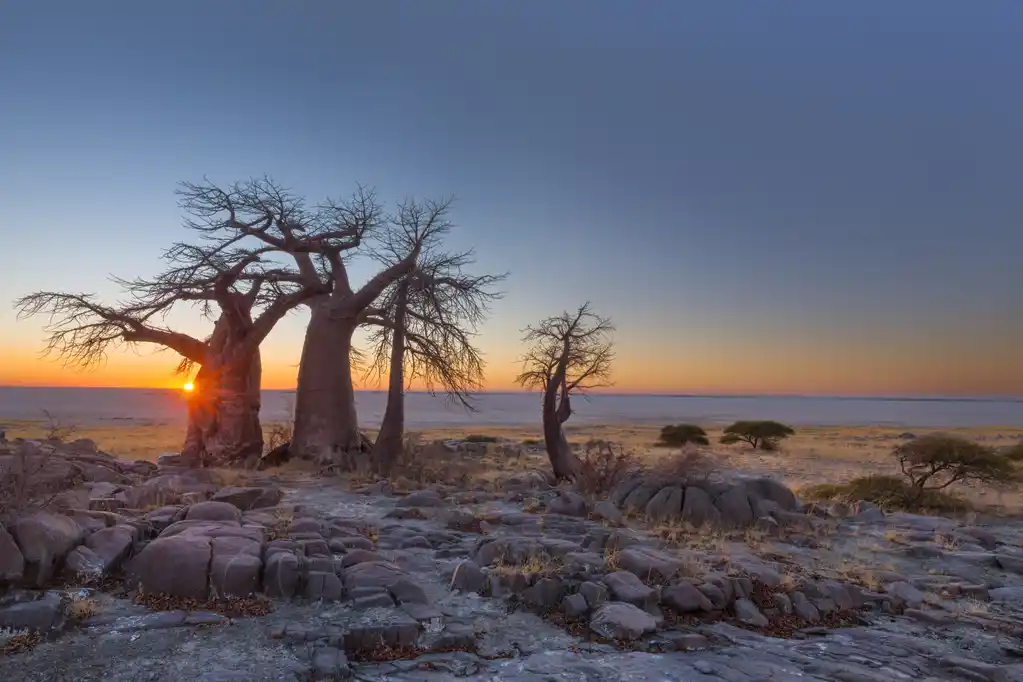
Unlike the reed-lined channels of the Okavango Delta or the riverfront game viewing of Chobe, Makgadikgadi and Nxai Pan offer something rarer in Southern Africa: genuine emptiness. This is a landscape of horizon-to-horizon flatness, star-filled night skies, ancient baobab sentinels, and a sense of scale that few other parks on the continent can match. It is also home to Botswana’s second-largest zebra migration, thousands of flamingos in the wet season, and some of the best meerkat and habituated-lion encounters in the region.
| Quick Facts
• Combined size: approximately 7,500 km² (Makgadikgadi Pans National Park ~3,900 km²; Nxai Pan National Park ~2,578 km²) • Location: Central District, northern Botswana, between Maun and Nata • Best known for: salt pan landscapes, Baines’ Baobabs, zebra and wildebeest migration, habituated meerkats, quad-biking on the pans • Gateway towns: Maun (south/west access) and Nata (east access), with Gweta as the closest village • Managed by: Botswana Department of Wildlife and National Parks (DWNP) |
How to Get to Makgadikgadi Pans & Nxai Pan National Park
Both parks sit directly alongside the tarred Nata–Maun road (A3), which makes them among the more accessible wilderness areas in Botswana compared with the Okavango Delta or Central Kalahari. Even so, once you leave the highway, travel is strictly 4×4 territory.
By Air
The most common approach for international travelers is to fly into Maun Airport (MUB), Botswana’s main safari gateway, which receives daily flights from Johannesburg, Cape Town, and Victoria Falls. From Maun, most lodges arrange light-aircraft charter transfers directly to private airstrips at Nxai Pan, Kubu Island, or the Makgadikgadi salt pan camps — typically a 30–40 minute flight. Kasane/Victoria Falls Airport is a useful alternative if you are combining this trip with Chobe National Park or Victoria Falls.
By Self-Drive
Self-driving is popular and rewarding, but requires a well-equipped 4×4 with high clearance, and ideally two spare tyres. From Maun, Makgadikgadi’s Phuduhudu Gate is roughly 164 km east along the Nata–Maun road (about 2 hours), while Nxai Pan’s entrance gate lies a further 35–40 km north along a signed turn-off. From Nata, the drive to Nxai Pan Gate is around 175 km. Once inside either park, sandy and sometimes waterlogged tracks demand low-range 4×4 and, outside the dry season, can become impassable without a winch or a second vehicle for backup.
| Route | Distance | Approx. Drive Time | Road Type |
| Maun → Phuduhudu Gate (Makgadikgadi) | 164 km | 2 hrs | Tar, then short gravel |
| Maun → Nxai Pan Gate | 140 km | 1.75 hrs | Tar, then gravel |
| Nata → Nxai Pan Gate | 175 km | 2.25 hrs | Tar, then gravel |
| Nata → Phuduhudu Gate (Makgadikgadi) | 141 km | 1.75 hrs | Tar, then gravel |
| Gweta village → either park gate | 35–45 km | 40–60 min | Gravel/sand |
| Getting There With Marriott Safaris Africa
|
• We arrange fully insured 4×4 rental with rooftop tents or ground tents for self-drive travellers
• Chauffeur-driven transfers available from Maun, Kasane, or Victoria Falls • Light-aircraft charter bookings coordinated directly with your lodge of choice • Combined multi-park routing available — pair this trip with Chobe, the Okavango Delta, or Central Kalahari on one seamless itinerary |
||
Things to Do in Makgadikgadi Pans & Nxai Pan National Park
The appeal of this region lies in experiences you simply cannot have anywhere else in Southern Africa. Here are the standout activities.
1. Quad Biking on the Salt Pans
Between roughly May and October, when the pan surface is dry and hard, guided quad-bike excursions head out onto the vast white expanse of Ntwetwe Pan. Riding beyond sight of any landmark, with nothing but flat white salt to the horizon, is one of the most surreal experiences on the African continent.
2. Meerkat Habituation Experience
Near Kubu Island and around the Makgadikgadi camps, several meerkat colonies have been gently habituated to human presence over decades. Guests can sit at ground level while meerkats forage, sunbathe, and use visitors as convenient lookout posts — an activity almost unique to this part of Botswana.
3. Sleep-Outs Under the Stars
With zero light pollution and near-total silence, a night spent on a raised sleep-out deck in the middle of the pan, under one of the clearest night skies in Africa, is a signature Makgadikgadi experience offered by several lodges.
4. Walking Safaris with San Bushmen Guides
Local Zu/’hoasi San guides lead walking excursions that reveal traditional bush skills — tracking, foraging, fire-making, and reading the pan’s subtle signs of life — offering a cultural dimension rare elsewhere in Botswana’s parks.
5. Visiting Kubu Island and Baines’ Baobabs
Rocky islands of ancient granite and centuries-old baobab groves rise unexpectedly from the flat pan surface — covered in detail under Attractions below.
6. Birdwatching and Flamingo Viewing
During and after good rains (typically December–April), the Sua Pan floods and attracts thousands of greater and lesser flamingos, along with pelicans and other waterbirds, in one of the largest flamingo breeding gatherings in Southern Africa.
Game Drives in Makgadikgadi Pans & Nxai Pan National Park
Game drives here differ noticeably between the two component parks, and knowing which to prioritise — and when — makes a real difference to your safari.
Nxai Pan Game Drives
Nxai Pan is the stronger of the two areas for classic game drives, with mixed grassland and mopane woodland supporting healthy resident populations of elephant, giraffe, and springbok year-round, and dramatic predator activity around the pan’s waterholes. Morning and late-afternoon drives from camps such as Nxai Pan Camp or Baines’ Baobabs Camp typically focus on the pan edge and central waterhole, where sightings concentrate especially in the dry season.
Makgadikgadi (Boteti River) Game Drives
In Makgadikgadi Pans National Park proper, game drives centre on the Boteti River corridor near Khumaga, the only reliable water source in the dry season and consequently the park’s best wildlife concentration point from roughly May to October. Expect zebra, wildebeest, elephant, and, increasingly, resident lion and hyena that have adapted to hunting along the riverbank.
Pan-Edge and Open-Pan Drives
Away from the river, drives across the open pan edges are less about density of game and more about landscape and rare sightings — brown hyena, bat-eared fox, aardwolf, and, in season, the tail end of the zebra migration as animals move on and off the pans in response to rainfall.
| Game Drive Tips
• Book a private vehicle if you want flexibility to chase migration movements between the river and open pans • Early morning (05:30–09:00) and late afternoon (16:00–18:30) drives offer the coolest temperatures and best activity • Combine a game drive with a pan walk or sundowner stop for the best all-round experience • During the November–April wet season, some pan-edge tracks close — check with your operator before planning a full-day route |
Animals of Makgadikgadi Pans & Nxai Pan National Park
The parks support a distinctive mix of pan-adapted and savanna wildlife, with seasonal migration adding real drama to the calendar.
| Category | Species |
| Large mammals | Elephant, zebra, blue wildebeest, giraffe, gemsbok (oryx), eland, greater kudu |
| Predators | Lion, spotted hyena, brown hyena, cheetah, leopard, black-backed jackal, bat-eared fox |
| Smaller mammals | Meerkat (suricate), aardwolf, honey badger, springbok, steenbok |
| Birds | Greater and lesser flamingo (seasonal), ostrich, kori bustard, secretary bird, pelicans, raptors |
| Reptiles | Leopard tortoise, rock monitor, various snake species |
The Makgadikgadi Zebra Migration
Each year, tens of thousands of zebra — joined by significant numbers of wildebeest — move between the Boteti River and the Nxai Pan grasslands, tracking rainfall in a round-trip of several hundred kilometres. It is recognised as one of the longest land-mammal migrations in Africa, and while less famous than East Africa’s Serengeti migration, sightings during the movement (roughly December to April, peaking after good rains) can rival it for sheer volume of animals.
Top Attractions
Baines’ Baobabs
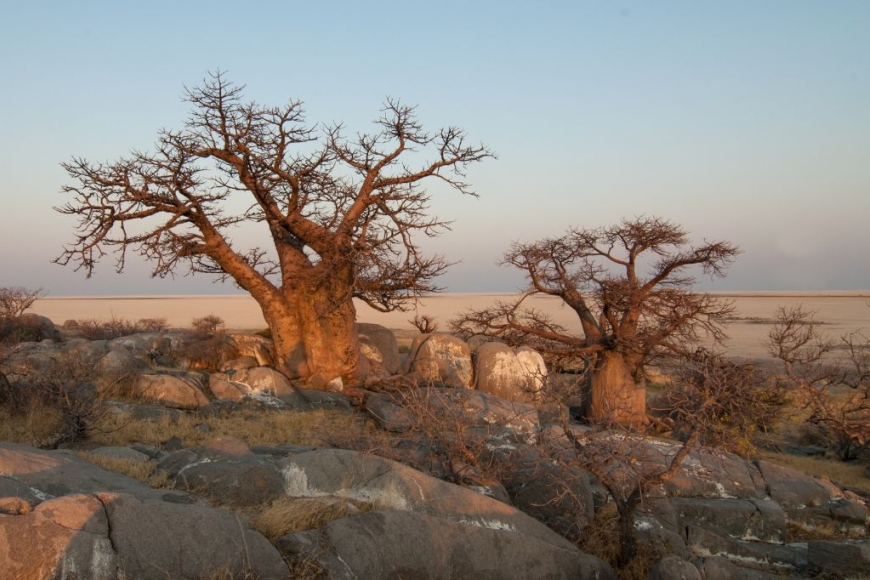
A cluster of seven ancient baobab trees on the edge of Kudiakam Pan, made famous by the 1862 paintings of explorer-artist Thomas Baines. Remarkably, the trees look almost identical today, over 160 years later — a favourite spot for sunrise and sunset photography.
Kubu Island
A rocky, baobab-studded granite outcrop rising from the Sua Pan, considered sacred by local communities and believed to have been a shoreline island when the pans were a vast inland lake thousands of years ago. Best combined with a night’s camping to catch sunrise over the pan.
Chapman’s Baobab
Once thought to be one of the largest and oldest baobabs in Africa (estimated at over 1,000 years old before it split apart in 2016), Chapman’s Baobab remains a striking landmark and historic navigation point once used by early explorers, hunters, and missionaries.
The Great Salt Pans Themselves
Ntwetwe and Sua Pans are, in their own right, the park’s headline attraction — a Mars-like expanse of cracked white salt crust that floods briefly each wet season and dries to a vast mirror-flat plain for the rest of the year.
Best Time to Visit
| Season | Months | Highlights | Considerations |
| Dry season | May – October | Best game viewing along the Boteti River; hard pan surface ideal for quad biking; cooler, comfortable daytime temperatures | Nights can be cold, especially June–July; wildlife concentrated near water |
| Green/wet season | November – April | Zebra and wildebeest migration onto the pans; flamingo breeding on Sua Pan; dramatic skies and lush scenery | Some pan tracks become impassable; hot and humid; malaria precautions needed |
| Shoulder months | April & October | Good balance of scenery, wildlife movement, and access | Book lodges early — popular transition periods |
Overall, May to October is the most reliable window for classic game drives and pan activities such as quad biking, while December to March rewards visitors chasing flamingos, the zebra migration, and the pans at their most photogenic — flooded and mirror-still at dawn.
Accommodation
Options range from ultra-exclusive pan-side camps to simple public campsites for self-drive travellers.
Luxury
- Jack’s Camp — an iconic 1940s-style safari camp on the edge of Ntwetwe Pan, famed for meerkat encounters and quad-bike pan excursions
- San Camp — an elegant, tented sister camp to Jack’s Camp with a similarly classic aesthetic
- Camp Kalahari — a relaxed, family-friendly luxury tented camp near the meerkat colonies
Mid-Range
- Nxai Pan Camp — comfortable tented accommodation overlooking Nxai Pan’s central waterhole
- Leroo La Tau — perched above the Boteti River with strong dry-season game viewing
- Meno a Kwena Tented Camp — a long-established riverside camp on the Boteti with a distinctive rustic-luxury feel
Budget / Self-Drive Camping
- Khumaga Public Campsite — the main self-drive camping option in Makgadikgadi Pans National Park, right on the Boteti River
- South Camp and Baines’ Baobabs Campsite — the two public campsites within Nxai Pan National Park
- Planet Baobab — a characterful, affordable lodge just outside the park near Gweta, popular with self-drivers as a base

| Booking Note
• Public campsites in both parks must be pre-booked through the Department of Wildlife and National Parks (DWNP) or an approved agent — they cannot be booked on arrival • Marriott Safaris Africa can secure campsite and lodge bookings, park permits, and vehicle logistics as a single package |
Park Fees & Practical Information
Entry fees are payable at the Phuduhudu, Khumaga, or South Camp/Nxai Pan gates and are charged per person per day, plus a separate vehicle fee. As of the most recent Department of Wildlife and National Parks tariff, Makgadikgadi and Nxai Pan fall under the standard non-flagship park rate, distinct from higher-traffic parks like Chobe and Moremi — rates are updated periodically, so always confirm current pricing before travel, ideally when your operator secures your park permits.
- A high-clearance 4×4 is compulsory inside both parks; conventional vehicles are not permitted past the gates
- Fuel and supplies should be stocked up in Maun, Nata, or Gweta — there are no fuel stations inside either park
- Malaria risk is present, particularly in the wet season; antimalarial precautions are recommended
- Mobile network coverage is limited to non-existent inside the parks — inform your accommodation of your route and expected arrival time
Itinerary: 5 Days in Makgadikgadi Pans & Nxai Pan
Day 1 — Arrival in Maun & Transfer to Nxai Pan
Fly or drive from Maun to Nxai Pan Camp. Afternoon game drive around the central waterhole, watching for elephant, giraffe, and springbok as the light softens.
Day 2 — Nxai Pan Game Drives & Baines’ Baobabs
Full day exploring Nxai Pan’s grasslands and pan edges, with an excursion to Baines’ Baobabs for a picnic lunch beneath the ancient trees.
Day 3 — Transfer South to Makgadikgadi / Boteti River
Travel south to a Boteti River camp such as Leroo La Tau or Meno a Kwena. Afternoon game drive along the riverbank, prime territory for zebra, elephant, and resident predators.
Day 4 — Quad Biking & Meerkats on the Salt Pans
Full-day excursion onto Ntwetwe Pan for quad biking (dry season) and a visit to a habituated meerkat colony, followed by a sleep-out on a raised pan deck under the stars.
Day 5 — Kubu Island & Departure
Morning visit to Kubu Island for sunrise photography, before transferring back to Maun or onward to your next Botswana destination.
| Extend Your Trip
• Add 3–4 days at the Okavango Delta for mokoro and water-based safari activities • Combine with Chobe National Park for river cruises and dense elephant herds • Link to Victoria Falls (Zambia or Zimbabwe side) as a spectacular finale |
Book With Marriott Safaris Africa
Marriott Safaris Africa specializes in tailor-made safari itineraries across Botswana and the wider Southern and East African region, including Makgadikgadi Pans and Nxai Pan National Park. Our team handles every logistical detail so you can focus on the experience.
What We Arrange
- Lodge, tented camp, and public campsite bookings across every price tier
- Park entry permits and camping fee payments handled in advance
- 4×4 vehicle rental with rooftop or ground tent for self-drive travellers, or chauffeur-driven and guided options
- Light-aircraft charter coordination between Maun, Kasane, and remote bush airstrips
- Seamless multi-park and multi-country itineraries combining Makgadikgadi/Nxai Pan with the Okavango Delta, Chobe, Central Kalahari, or Victoria Falls
How to Book
- Contact our team with your preferred travel dates, group size, and budget
- Receive a tailored itinerary proposal with accommodation and activity options
- Confirm your booking with a deposit; we handle all park permits and logistics
- Receive your final travel documents, packing checklist, and 24/7 support contact ahead of departure
| Why Book With Marriott Safaris Africa
• Local expertise across Botswana’s parks, reserves, and border logistics • Transparent, all-inclusive pricing with no hidden fees • 24/7 in-country support throughout your safari • Flexible itineraries tailored to your travel style and budget — “Perfection Anytime” |

Marriott Safaris Africa | Perfection Anytime