
7 Days Botswana Wildlife Safaris
Chobe National Park • Moremi Game Reserve • Okavango Delta • Makgadikgadi Pans
7 Days Botswana Wildlife Safaris, Botswana is widely regarded as Africa’s premier safari destination — a land of extraordinary contrasts where the world’s largest inland delta floods seasonally to sustain one of the most diverse concentrations of wildlife on the continent. Strict low-volume, high-value tourism policies have preserved Botswana’s wilderness areas in near-pristine condition, offering visitors an exclusive and deeply immersive encounter with Africa’s wildest landscapes.
This 7-day itinerary is meticulously crafted to showcase the very best of Botswana’s iconic ecosystems: the legendary Chobe National Park with its extraordinary elephant populations, the lush Moremi Game Reserve at the heart of the Okavango Delta, the water-world channels and islands of the delta itself, and the haunting salt pans of Makgadikgadi — home to one of Africa’s greatest wildlife spectacles.
Whether you are a first-time safari-goer or a seasoned wildlife enthusiast, this journey delivers encounters that will remain with you for a lifetime — lions stalking the floodplains, herds of thousands of elephants marching to the Chobe River, leopards draped across acacia branches, and flamingos painting the horizon pink at the edge of the Makgadikgadi.
| Safari Philosophy
Botswana operates on a low-impact, high-yield model. National parks and private concessions enforce strict visitor limits, meaning you will rarely share a game drive with another vehicle. This translates to quieter, more authentic wildlife encounters — exactly the kind of raw, undisturbed Africa that discerning travelers seek. |
TRIP OVERVIEW
| Duration | 7 Days / 6 Nights |
| Best Time to Visit | May – October (Dry Season) | Nov – April (Green Season) |
| Destinations | Kasane → Chobe NP → Moremi GR → Okavango Delta → Makgadikgadi |
| Accommodation | Mix of luxury tented camps and lodges |
| Big Five Potential | High — Lion, Leopard, Elephant, Buffalo, White Rhino (Khama Sanctuary) |
| Typical Group Size | 4–6 guests per vehicle (low-volume tourism standard) |
| Starting City | Kasane (fly-in from Maun or Johannesburg) |
| Currency | Botswana Pula (BWP) |
| Language | English & Setswana |
| Visa | Visa-free for most nationalities (check your country’s requirements) |
| DAY 1
Arrival in Kasane & Chobe Sunset Cruise 📍 Kasane • Chobe National Park |
Getting There
Your Botswana safari begins in Kasane, the gateway town on the northern tip of Botswana at the confluence of four countries — Botswana, Zimbabwe, Zambia, and Namibia. Kasane is served by Kasane International Airport (BBK), with direct connections from Johannesburg (OR Tambo) and Maun. Most guests arrive on morning flights to maximize their first afternoon in the bush.
Afternoon: Chobe River Cruise
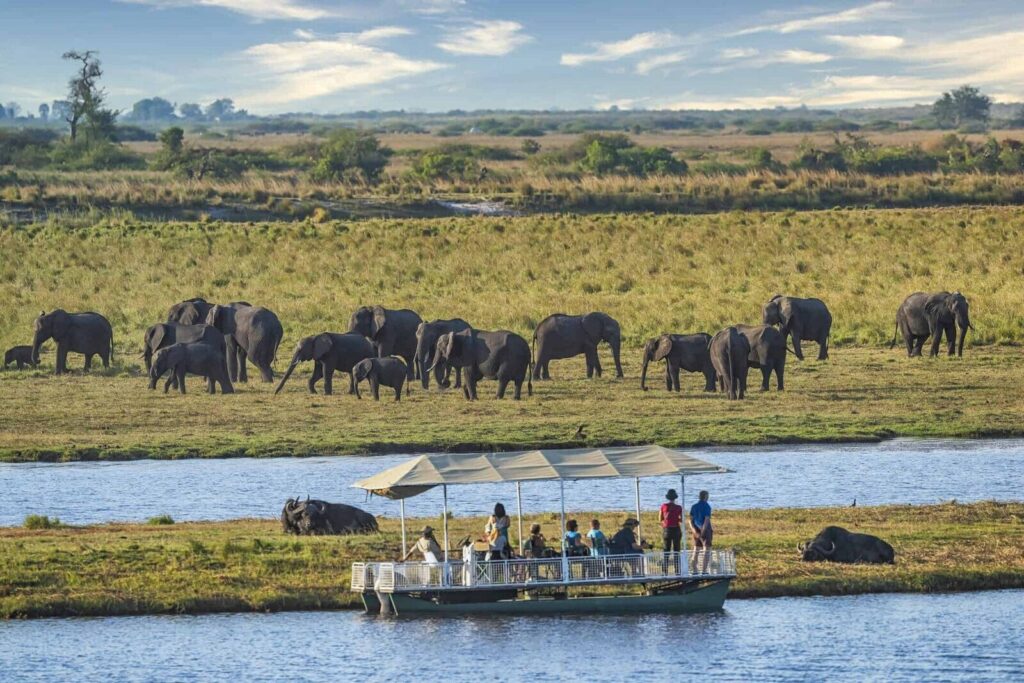
After a welcome lunch at your lodge and a brief orientation by your guide, the afternoon belongs to the Chobe River. Board a custom-designed pontoon boat and drift along one of Africa’s most wildlife-rich waterways. The Chobe River forms the northern boundary of Chobe National Park and acts as a magnet for thousands of animals during the dry season.
The river cruise is arguably Botswana’s most iconic wildlife experience. Enormous herds of African elephants — sometimes numbering in the hundreds — wade into the shallows, swim across the channel, and play in the golden late-afternoon light. Hippos surface lazily in the deeper pools, crocodiles bask on exposed sandbanks, and a bewildering array of water birds populate the reed beds along the shores.
Key Wildlife Highlights
- 🐘 African Elephant — Chobe is home to the largest elephant population in the world, estimated at over 130,000 individuals
- 🐊 Nile Crocodile — ancient giants basking in perfect prehistoric repose
- Hippopotamus — pods of hippos snorting and surfacing in the deeper channels
- 🦅 African Fish Eagle — the iconic call of Africa echoing across the water
- Yellow-Billed Stork, African Spoonbill, Goliath Heron, and dozens of other water birds
Evening
Sundowner drinks on the water as the sun sets over the floodplains in a blaze of amber and crimson. Return to your lodge for a welcome dinner under the African sky — perhaps on an outdoor deck with the sounds of the bush surrounding you.
| Accommodation
Suggested: Chobe Game Lodge, Chobe Chilwero, or Muchenje Safari Lodge — all offering premier river frontage and spectacular sunset views over the Chobe floodplains. |
| DAY 2
Full Day in Chobe National Park — Game Drives 📍 Chobe National Park |
Dawn: Early Morning Game Drive
Rise before the sun and set out into Chobe National Park at first light. The Chobe Riverfront and Serondela areas are best explored in the cooler morning hours when predators are most active and elephants are making their way down to drink. Your guide will navigate the network of dirt roads along the riverfront, scanning the bush for movement and interpreting the signs and tracks that tell the story of last night’s activity.
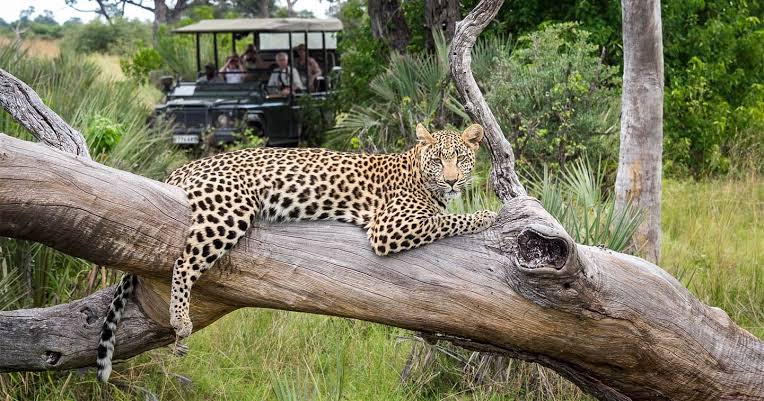
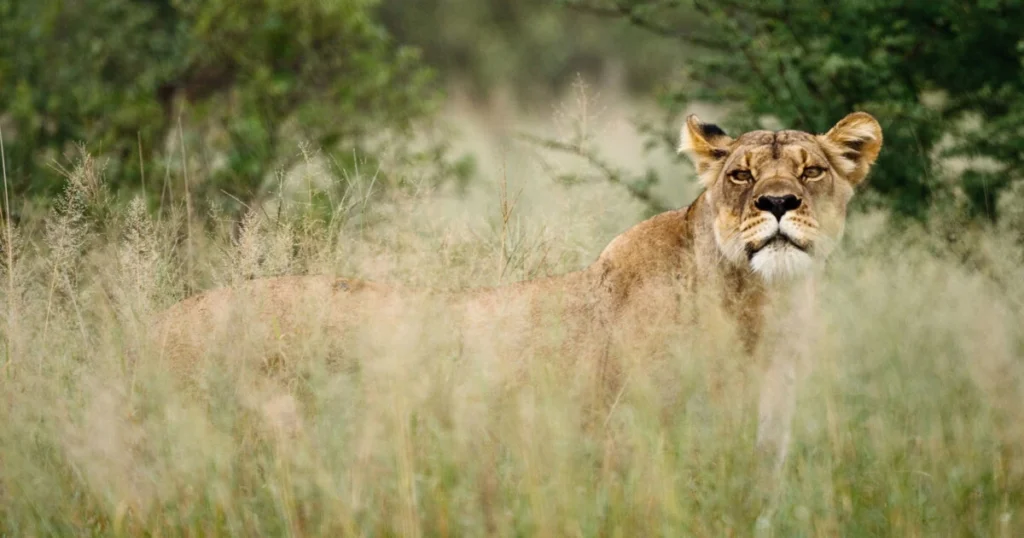
Lions are regularly sighted in Chobe, particularly the Savuti and Linyanti areas, where prides have developed extraordinary hunting techniques — including taking down adult elephants. In the Serondela area, large buffalo herds attract lions and spotted hyena. Leopards favour the riparian forests along the river, draping themselves across sausage trees with their kills safely hoisted above the reach of scavengers.
Midday: Rest & Refresh
Return to the lodge mid-morning for a hearty brunch, a rest, and time to review photographs and share observations with your fellow travellers. The heat of the Botswana midday is best enjoyed from the shade of a camp deck with a cold drink and a pair of binoculars trained on the riverfront below.
Afternoon: Chobe Savannah Drive
The afternoon game drive ventures deeper into the park, away from the riverfront and into the interior mopane woodland. This is elephant country par excellence — mopane is a favourite food, and the damage wrought by thousands of feeding elephants across the landscape is striking, though ecologically important. Watch for breeding herds with tiny calves, young bulls testing their strength, and ancient matriarchs leading their families with timeless wisdom.
As evening approaches, the light becomes extraordinary — low golden rays filtering through the dust raised by marching herds, silhouetting massive forms against a copper sky. Keep cameras ready for one of the great wildlife photography moments in Africa.
Wildlife to Watch For
- 🐘 African Elephant — guaranteed sightings throughout the day in large numbers
- African Buffalo — herds of several hundred common along the Serondela circuit
- 🦁 Lion — regularly sighted; specialist guides know favoured resting spots
- 🐆 Leopard — elusive but present; best sighted at dawn and dusk in riverine woodland
- Sable Antelope, Roan Antelope, and Kudu in the mopane woodland
- Painted Wild Dog — occasionally sighted; Chobe is part of their range
Evening
Bush dinner under the stars or a fireside braai (barbecue) at camp. Your guide shares stories of the park and introduces you to the constellation patterns of the Southern Hemisphere — far from light pollution, the Milky Way blazes overhead in startling clarity.
| ✦ Expert Tip
Chobe is best explored in a customised open 4×4 game drive vehicle and a boat — combining both modes gives you completely different wildlife perspectives. Request a half-day on water and half-day on land from your camp manager. |
| DAY 3
Transfer to Moremi Game Reserve — Heart of the Delta 📍 Kasane → Moremi Game Reserve |
Morning: Scenic Flight or Road Transfer
This morning, depart Kasane and transfer to Moremi Game Reserve — located at the heart of the Okavango Delta in north-western Botswana. Moremi is widely regarded as one of Africa’s finest game reserves, combining the best of the Okavango Delta ecosystem with exceptional year-round wildlife. The transfer is most commonly made by light aircraft (approximately 45 minutes), offering breathtaking aerial views of the delta’s mosaic of channels, islands, and lagoons from above.
If driving from Maun, the route passes through classic Kalahari sandveld before arriving at South Gate — an adventure in itself, with elephants and other wildlife regularly encountered along the road.
Moremi Game Reserve — Africa’s Eden
Moremi Game Reserve covers approximately 4,871 square kilometres and includes a significant portion of the Okavango Delta as well as Chief’s Island — the largest island in the delta. It was the first reserve in southern Africa to be established by an indigenous African community, created in 1963 by the Batawana people to protect their dwindling wildlife populations.
The reserve is defined by its extraordinary diversity of habitat: open floodplains, dense riverine forest, permanent lagoons, dry mopane woodland, and meandering waterways. This habitat mosaic supports exceptional concentrations of both predators and prey — and the relatively small visitor numbers maintained by management ensures that sightings are intimate and unshared.
Afternoon: Afternoon Game Drive in Moremi
Check in to your camp, have lunch, and set out on your first Moremi game drive in the late afternoon. The Xakanaxa and Khwai areas of Moremi are legendary for predator activity. Wild dogs are frequently encountered — Moremi and the adjoining Khwai community area support some of the healthiest wild dog populations in Africa, and sightings of packs with pups are among the most exciting wildlife experiences in Botswana.
Lions are abundant and habituated to vehicles, allowing photographers exceptional access. Leopard sightings around the Xakanaxa lagoon and surrounding woodland are frequent, and cheetah are sometimes seen on the open plains near the South Gate area.
Key Species in Moremi
- 🐕 African Wild Dog — one of the highest-density populations in Africa
- 🦁 Lion — multiple prides inhabit Moremi; encounters are close and unrushed
- 🐆 Leopard — particularly well-sighted around permanent water features
- Cheetah — open grasslands near South Gate offer sighting opportunities
- Sitatunga — a semi-aquatic antelope found in the papyrus swamps of Moremi
- Lechwe — the red lechwe is an icon of the Okavango, seen in huge herds
- 🦅 African Fish Eagle, Pel’s Fishing Owl (nocturnal), Wattled Crane
| ✦ Wildlife Highlight
Moremi is one of the best places in Africa to see African Wild Dogs. These highly social and deeply intelligent predators hunt cooperatively and achieve the highest success rate of any African predator. If your guide receives a radio call about a wild dog sighting, drop everything — it’s a priority encounter. |
| DAY 4
Full Day in Moremi — Predator Plains & Water Channels 📍 Moremi Game Reserve |
Sunrise: Pre-Dawn Game Drive
The most spectacular game drives in Moremi happen at dawn. Set your alarm early and be in the vehicle before first light. Lions make their morning kills in the predawn darkness, and arriving at the scene just as the light improves is a privilege that only guests staying within the reserve can access. Spotted hyena, black-backed jackals, and side-striped jackals are all active at dawn and make for entertaining viewing around kills and den sites.
Morning: Mokoro Excursion on the Delta
Mid-morning, exchange your game drive vehicle for a mokoro (dugout canoe) and glide silently into the waterways of the Okavango Delta. Poled by an experienced local mokoro man whose ancestors have navigated these channels for generations, this is an entirely different way to experience the African bush. Travel at water level through papyrus-lined channels, past hippo wallows and basking crocodiles, and beneath the overhanging branches of sycamore figs and wild date palms.
On foot, your guide will take you on a bush walk on one of the larger islands — tracking lion, reading elephant sign, and learning to identify the remarkable plant life of the delta. Walking in Africa connects you to the landscape in a visceral way that no vehicle can replicate.
Afternoon: Specialist Birding and Predator Search
Moremi supports over 400 bird species, making it one of southern Africa’s top birding destinations. The Xakanaxa lagoon area is particularly productive: African skimmer, rock pratincole, and half-collared kingfisher are among the specialties. The evenings are best for Pel’s Fishing Owl — one of Africa’s most sought-after nocturnal species — as well as the strange, resonant calls of African wood owl and Verreaux’s eagle-owl.
The late afternoon game drive focuses on the Khwai River corridor, where concentrations of game arrive to drink. Elephant family groups, large herds of impala, waterbuck, tsessebe, and the occasional herd of zebra draw in predators. Stay out until the last legal moment as the magic of the Moremi sunset descends over the floodplains.
Key Activities Today
- Pre-dawn predator game drive — lion, hyena, wild dog hunting behaviour
- Mokoro excursion through papyrus channels and lily-covered lagoons
- Guided bush walk on a delta island — tracking and nature interpretation
- Specialist birding at Xakanaxa Lagoon — 400+ species recorded
- Sundowner at a scenic river lookout — gin and tonic with elephant views
| ✦ Did You Know?
The Okavango Delta is a UNESCO World Heritage Site — the world’s largest inland delta. Unlike most river systems, the Okavango does not reach the sea. Instead, it flows into the Kalahari Desert basin, spreading into a vast labyrinth of channels and islands that are absorbed by the sand and evaporated by the sun. This extraordinary system has survived unchanged for millennia. |
| DAY 5
Into the Okavango Delta — Boating, Fishing & Remote Camp 📍 Okavango Delta — Private Concession |
Morning: Fly-In to Private Delta Camp
This morning, a short scenic flight transfers you from Moremi into a private concession deep within the Okavango Delta — a world accessible only by air or boat, and completely free from any shared vehicles or other tourist traffic. These private concessions operate under special use agreements and accommodate very small numbers of guests, ensuring an exclusive and undisturbed bush experience.
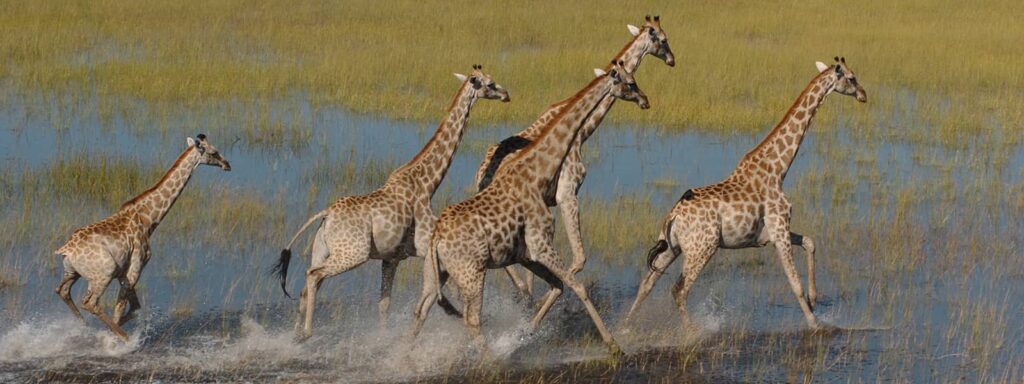
As the small aircraft descends over the delta, the patchwork of waterways, islands, and open grasslands below reveals itself in breathtaking detail. Look out for herds of buffalo and elephant on the floodplains, pods of hippos in the channels, and the neat geometric shapes of termite mounds rising from the grass. The airstrip is often a grass clearing surrounded by wilderness — and stepping off the plane, the silence and space of the true African bush envelops you immediately.
Afternoon: Motorboat Safari on the Channels
Board a motorboat with your guide and navigate the intricate network of permanent water channels in the deeper part of the delta. This is the water-world Okavango — hippos surface alongside the boat, fish eagles launch from their perches to pluck fish from the water, and sitatunga antelopes — specialists of the papyrus swamp — pick their way delicately through the reeds. Brilliantly coloured malachite kingfishers perch on papyrus stems, pygmy geese ride the lily pads, and the African jacana walks on water lilies with extraordinary poise.
Late Afternoon: Fishing on the Delta
The Okavango Delta’s waterways are rich in freshwater fish, and light-tackle fishing for tigerfish is an extraordinary experience — these hard-fighting, razor-toothed predators are among the most exciting freshwater sport fish in the world. Bream, catfish, and pike are also abundant. Your guide provides all tackle; catch and release is standard practice in keeping with the delta’s conservation ethos.
Sunset: Delta Sundowner
There are few places on earth as spectacularly beautiful as the Okavango Delta at sunset. Anchor your boat in an open lagoon, pour a sundowner drink from the cooler box, and watch the sky turn through every shade of pink, amber, and violet as the sun descends behind the distant tree line. Hippos resume their nightly feeding rituals, frogs begin their chorus from every reed bed, and the first stars appear overhead.
Night Drive
After dinner, an optional night drive in the concession offers a completely different wildlife perspective. The beam of a spotlight reveals the reflective eyes of spring hares bounding through the grass, genets slinking through the undergrowth, scrub hares freezing in the light, and possibly even the amber glow of a lion or leopard’s eyes in the darkness.
| ✦ Accommodation
Suggested: Vumbura Plains, Mombo Camp, Abu Camp, or Nxai Pan Camp — all located in exclusive private concessions with strictly limited guest numbers and exceptional guiding. |
| DAY 6
Makgadikgadi Pans — Ancient Landscape, Meerkats & Migration 📍 Makgadikgadi Pans National Park |
Morning: Transfer to Makgadikgadi
Today’s adventure takes you to one of Botswana’s most otherworldly landscapes — the Makgadikgadi Pans. A transfer by light aircraft (or road from Maun) delivers you to the edge of what was once one of the world’s largest lakes, now a vast, glittering expanse of crystalline salt flat extending to every horizon. The Makgadikgadi is part of a huge inland basin that also includes the Nxai Pan National Park, and the two together protect a remarkable and largely misunderstood ecosystem.
The Makgadikgadi Landscape
The pans are utterly vast — Sua Pan alone covers over 5,000 square kilometres — and their scale can be disorienting. During the dry season (April to October), the pans are bleached white and almost completely barren: an abstract landscape of cracked salt and endless sky that feels more like a moonscape than an African wilderness. Yet this apparent emptiness is deceptive — life returns with the rains in extraordinary fashion.
From November to March, the onset of the wet season floods the edges of the pans, creating shallow alkaline lakes that attract thousands — sometimes tens of thousands — of lesser and greater flamingos, which breed on the salt flats. At the same time, the zebra and wildebeest migration begins — one of Africa’s lesser-known but spectacular wildlife events, rivalling the Serengeti in the sheer numbers of animals involved.
Morning Activity: Meerkat Habituation
One of the Makgadikgadi’s signature experiences is a visit to a habituated meerkat colony near Nxai Pan. These extraordinarily social and entertaining small predators have become entirely accustomed to human presence, allowing guests to sit among the colony as the animals go about their daily lives: sentinels standing upright on termite mounds scanning for aerial predators, foragers digging industriously for scorpions, beetles, and gecko eggs, and youngsters wrestling and play-fighting in the early morning sun.
The experience of a meerkat using your head or shoulder as an elevated lookout post is both hilarious and deeply endearing — and the photo opportunities are exceptional.
Afternoon: Quad Biking or Walking on the Salt Pans
The vast open expanse of the Makgadikgadi salt pans is best experienced at speed. Quad biking across the blindingly white surface, with nothing visible in any direction except the curvature of the earth, is a uniquely exhilarating experience. Your guide will lead the way to a baobab island — an ancient tree rising incongruously from the flat whiteness, used for centuries as a navigation landmark by San Bushmen traversing the pans.
Alternatively, walking across the pans with a knowledgeable guide provides an intimate connection with this strangely beautiful landscape. The silence on the pans during dry season is absolute — not a bird, not a insect, just wind and light and space.
Evening: Sundowner on the Pan
Park your vehicle at the edge of the pan as the sun descends through a sky streaked with dust and colour. The reflection of the sunset on any remaining surface water creates a mirror effect of incomparable beauty. Star-gazing on the Makgadikgadi is exceptional — the flat horizon in every direction and the complete absence of artificial light makes this one of the best places in Africa for astronomy.
| ✦ Wildlife Highlight — Zebra Migration
Between November and March, over 25,000 zebra and associated wildebeest undertake a 300 km round trip across the Makgadikgadi — one of Africa’s greatest wildlife spectacles. If travelling during this period, ask your guide about accessing the migration routes for a truly unforgettable experience. |
| DAY 7
Final Morning Game Drive & Departure from Maun 📍 Maun — Departure |
Final Dawn Drive
No Botswana safari is complete without one final pre-dawn game drive. Wrap up in warm layers against the chilly morning air — desert nights are cold year-round — and head out for a last, leisurely exploration of whichever reserve you are departing from. Morning is a time for reflection as much as for wildlife: the extraordinary experience of the past week begins to settle, and the sights, sounds, and smells of the African bush have left an indelible impression.
Your guide will take you to favorite spots and viewpoints, share parting wisdom about Botswana’s conservation challenges and triumphs, and give you time to simply sit in the bush and absorb the peace of a landscape where wildlife still moves freely and in abundance.
Return to Maun — The Safari Capital
The short flight to Maun delivers you to Botswana’s most famous small town — the safari capital of southern Africa and the gateway to the Okavango Delta. Maun’s main street is lined with safari operators, curio shops, and cafés, and the town has a wonderfully relaxed frontier atmosphere. If time permits, a brief stop to browse locally made crafts and pick up a final sundowner at one of the riverside bars makes for a perfect farewell to Botswana.
Departure
Maun International Airport (MUB) has direct connections to Johannesburg, Cape Town, Windhoek, and Nairobi, as well as charter connections throughout the region. For guests wishing to extend their adventure, Maun is also the jumping-off point for day trips into the delta and multi-day houseboat or mokoro expeditions.
As your aircraft climbs above the Okavango Delta and banks towards the south, look down one last time at the extraordinary landscape below — the gleaming channels, the green islands, the red dust roads threading through the bush — and know that Botswana has given you something very few travellers in the world have truly experienced.
| ✦ Departure Tip
Allow at least 2 hours at Maun airport before international connections. Botswana immigration and security processes are efficient but charter-to-main-airport connections can occasionally experience weather-related delays. Build in a buffer and you will depart relaxed. |
PRACTICAL SAFARI INFORMATION
Best Time to Visit Botswana
Botswana’s safari seasons are broadly divided into dry and wet, each offering distinct and equally compelling wildlife experiences.
- May to October (Dry Season) — Peak safari season. Wildlife concentrates around permanent water sources, vegetation thins out improving visibility, and excellent dirt roads become accessible. July–September is the absolute peak for game viewing and predator activity. Temperatures are warm to hot during the day (25–35°C) with cool to cold nights (5–15°C).
- November to April (Green/Wet Season) — The bush transforms dramatically. Migratory birds arrive, flamingos flock to the Makgadikgadi, the zebra migration occurs, and newborn animals abound. Prices are lower, crowds are smaller, and the landscape is lush and photogenic. Some camps close for the season (Dec–Mar). Expect afternoon thunderstorms.
Health & Vaccinations
- 💉 Yellow Fever — Required if arriving from a yellow fever endemic country; recommended otherwise
- Malaria prophylaxis — Strongly recommended for all Botswana wildlife areas. Consult your travel doctor 4–6 weeks before departure for the most suitable option (Malarone, Doxycycline, or Lariam)
- Routine vaccinations — Ensure Hepatitis A, Typhoid, and Tetanus are up to date
- Travel insurance with emergency medical evacuation — Essential in remote safari areas
- Pack a basic personal first aid kit including rehydration salts, antiseptic cream, and sunscreen SPF 50+
What to Pack
Clothing
- Neutral-coloured, lightweight clothing (khaki, olive, beige, grey) — avoid bright colours and white in the bush
- Warm fleece or light down jacket for early morning and evening drives
- Wide-brimmed sun hat and UV-protective sunglasses
- Comfortable, closed-toe walking shoes or lightweight hiking boots
- Swimwear for camps with plunge pools
- Smart-casual outfit for final evening dinners in Maun or Kasane
Equipment
- Binoculars (8×42 recommended) — one of the most important items you can bring
- Camera with zoom lens (200–400mm for wildlife photography)
- Universal power adapter (Botswana uses Type D/G plugs)
- Headlamp or torch for walking between camp tents at night
- Dry bags for boat activities on the delta
Getting to Botswana
Botswana’s primary international gateway is Sir Seretse Khama International Airport in Gaborone, though most safari travellers fly into Maun or Kasane via connections through Johannesburg (OR Tambo), Cape Town, Nairobi, or Addis Ababa. Airlines serving Botswana include South African Airways, Air Botswana, FlySafair, and Kenya Airways. Charter operators including Mack Air, Wilderness Air, and CAA provide inter-camp flights within the delta and to the national parks.
Accommodation Guide
| Chobe Area | Chobe Game Lodge, Chobe Chilwero, Muchenje Safari Lodge, Ngoma Safari Lodge |
| Moremi / Khwai | Camp Moremi, Xakanaxa Camp, Khwai River Lodge, Khwai Bush Camp |
| Okavango Delta | Vumbura Plains, Mombo Camp, Jao Camp, Abu Camp, Little Vumbura |
| Makgadikgadi | Jack’s Camp, San Camp, Meno a Kwena, &Beyond Nxai Pan |
| Budget Option | Maun-based lodges with fly-in day trips (significantly less immersive) |
| Luxury Option | Private concession camps (1–8 guests): completely exclusive wilderness access |
CONSERVATION & COMMUNITY
Botswana’s commitment to wildlife conservation is among the most progressive in Africa. A blanket hunting ban, enforced since 1983 (with a brief and controversial lifting in 2019), combined with the establishment of a low-volume, high-value tourism model, has resulted in some of the most pristine wilderness areas on the continent.
Botswana’s Conservation Model
- Tourism revenues fund both government conservation departments and community-based natural resource management (CBNRM) programmes
- Botswana was the first African country to grant communities formal rights over wildlife in their areas — creating a powerful economic incentive for local people to protect rather than poach
- The KAZA Trans-frontier Conservation Area (Kavango-Zambezi) — of which Chobe is a core component — covers 520,000 sq km across five countries and represents one of the world’s most ambitious transboundary conservation efforts
- Chobe’s elephant population of 130,000+ is the largest in the world — a conservation success story of global significance
How Safari Tourism Helps
Every bed-night you spend in a safari camp in Botswana directly contributes to the conservation and community development ecosystem that keeps these wilderness areas alive. Premium lodge rates include substantial levies that support national park management, anti-poaching operations, and community development funds. Choosing responsible, award-winning operators ensures that your travel spending achieves maximum conservation impact.
We encourage all guests to ask their camp managers and guides about the specific community and conservation programmers their camp supports. The answers are invariably inspiring — and they give real meaning to the extraordinary wildlife experiences you are having.