4 Day okavango delta safari
The Okavango Delta is one of the world’s most extraordinary ecosystems — a vast inland delta in northern Botswana where the Okavango River fans out across the Kalahari Basin, creating a labyrinth of crystal-clear lagoons, reed-lined channels, palm-studded islands, and seasonal floodplains. Unlike most river systems, the Okavango never reaches the ocean; it simply disappears into the sands of the Kalahari, sustaining an astonishing web of life before evaporating into the African sky.
Declared a UNESCO World Heritage Site in 2014, the Delta covers approximately 15,000 square kilometres and supports some of the highest concentrations of wildlife on the African continent. It is home to the Big Five, endangered African wild dogs, vast elephant herds, and over 550 species of birds — all sustained by annual floods that transform the landscape from arid savanna into a shimmering inland sea.
This 4-day safari itinerary takes you deep into the heart of the Delta, combining mokoro (dugout canoe) expeditions, game drives, guided bush walks, and night safaris for a comprehensive and deeply immersive wilderness experience. Each day is thoughtfully structured to offer different encounters with the Delta’s ecosystems, from its watery heart to its open floodplains and dense riverine forests.
AT A GLANCE
| Destination | Okavango Delta, Botswana |
| Duration | 4 Days / 3 Nights |
| Safari Style | Fly-in luxury camp experience |
| Best Months | June – October (peak dry season & flood season) |
| Activity Level | Moderate — suitable for most fitness levels |
| Group Size | 4 – 12 guests (private charters available) |
| Accommodation | Luxury tented camps in the Delta |
| Key Activities | Mokoro, game drives, bush walks, night safaris, birdwatching |
| Notable Wildlife | African elephant, lion, leopard, hippo, African wild dog |
| Nearest Gateway | Maun International Airport, Botswana |
BEST TIME TO VISIT THE OKAVANGO DELTA
The Okavango Delta offers remarkable wildlife experiences throughout the year, but each season brings a distinctly different character to the landscape. Understanding the seasonal rhythm is key to planning the perfect safari.
DRY SEASON: May – October (Peak Season)
The dry season is widely considered the best time to visit the Okavango Delta. Vegetation thins out as the rains fade, making wildlife easier to spot. Animals congregate around remaining water sources, resulting in dramatic and frequent sightings. Temperatures are pleasantly cool from June to August (10–25°C), rising to warm in September and October (25–35°C).
- June – August: Peak flood season. Mokoro activities are at their finest as the Delta fills with crystal-clear Angolan floodwaters. Expect spectacular birdlife and prolific hippo activity.
- September – October: Water levels recede slightly, but game viewing intensifies as animals gather at remaining water sources. Lion and leopard sightings become more frequent.
GREEN SEASON: November – April (Shoulder Season)
The green season transforms the Delta into a lush, verdant paradise. While wildlife can be harder to spot through thick vegetation, this period offers outstanding birdwatching (migratory species arrive), newborn animals in abundance, dramatic skies for photography, and significantly lower rates at camps.
- November – March: Rains arrive, bringing new life. Resident bird species are joined by thousands of migratory birds from Europe and Central Africa.
- April – May: Rains fade, the Delta begins to fill with the annual Angolan floodwaters. A transitional season with excellent value.
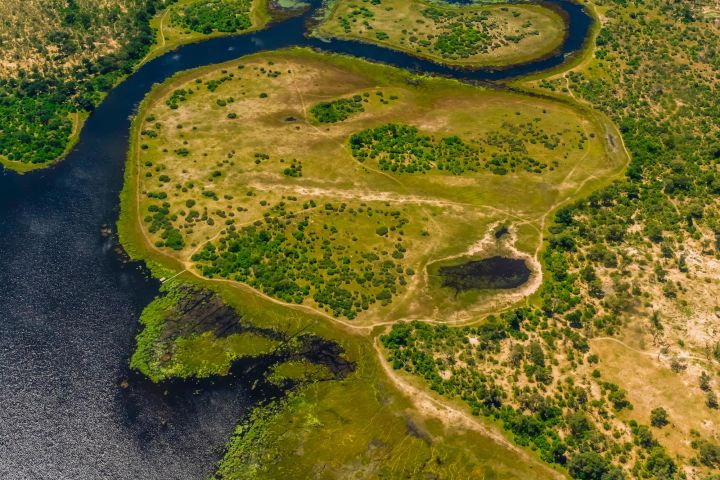
| DAY 1 | Arrival & Orientation — Welcome to the Delta
Fly-in | Camp Orientation | Sunset Boat Cruise |
Morning: Arrival at Maun International Airport
Your Okavango Delta adventure begins at Maun International Airport — the gateway to the Delta and one of Africa’s busiest light aircraft hubs. The excitement is palpable as you check in for your light aircraft charter transfer to your remote tented camp, a scenic 30-45 minute flight that offers your first bird’s-eye perspective of the extraordinary Delta landscape below.
From above, the Delta reveals itself as an intricate tapestry of sinuous waterways, scattered islands covered in palm trees and riparian forest, and vast papyrus reed beds that stretch to every horizon. Keep your camera ready — aerial views of elephant herds crossing floodplains, hippo pods in the channels, and the shimmering reflections of the sky in the water are common during the flight.
| ✈ FLIGHT TIP
Light aircraft weight restrictions are strictly enforced. Pack soft-sided luggage only. Maximum luggage allowance is typically 15 kg (33 lbs) including hand luggage. Leave hard-sided suitcases in storage at Maun. |
Mid-Morning: Camp Arrival & Welcome
Upon landing on the camp’s private airstrip — often a simple grass runway carved from the bush — your guide and camp team will greet you warmly. The transfer to camp by open 4×4 vehicle often produces immediate wildlife encounters; it is not uncommon to encounter a herd of zebra, a giraffe browsing on an acacia, or a monitor lizard sunning itself within the first few minutes of arrival.
After settling into your luxurious tented suite — a spacious canvas-walled room raised on a deck platform, complete with en-suite bathroom, outdoor shower, and views of the surrounding bush — you will be invited for a welcome briefing with your lead guide. This orientation covers camp etiquette, safety protocols (walking on your own outside the camp perimeter is never permitted), activity schedules, and the all-important rules for mokoro excursions.
A light brunch is served in the open-air dining area, where the sounds of birdsong, distant hippo calls, and rustling reeds create an atmosphere unlike anything else on earth.
Afternoon: Mokoro Excursion — Exploring the Waterways
The quintessential Okavango Delta experience, and the perfect introduction to the Delta’s intimate character, is the afternoon mokoro excursion. The mokoro (plural: mekoro) is a traditional dugout canoe, originally hollowed from the trunk of a sausage tree or jackalberry tree, though modern camps increasingly use fibreglass replicas to protect these slow-growing trees.
Poled by an expert local guide known as a poler — a man or woman who stands at the stern and uses a long wooden pole to navigate the shallow channels — the mokoro glides silently through papyrus tunnels and across open lagoons at eye level with the waterline. This extraordinarily peaceful mode of travel brings you into direct contact with the Delta’s aquatic world.
During your mokoro excursion you may drift past:
- 🦛 Hippopotamus submerged in the shallows, their eyes and nostrils just visible above the surface — always approached with great caution and respect
- 🦅 African fish eagle perched on a dead tree above the waterline, its distinctive cry echoing across the lagoons
- 🐦 Malachite kingfisher — one of Africa’s most jewel-like birds — perching on papyrus stems beside the boat
- 🌸 Water lilies in purple, white, and yellow carpeting the open lagoon surfaces
- Reed cormorants and darters drying their wings on submerged branches
- 🦌 Sitatunga antelope — a semi-aquatic species uniquely adapted to the Delta’s wetland environment — wading through the shallows
| 🛶 POLER KNOWLEDGE
Your poler is not merely a navigator — they are a encyclopaedia of Delta knowledge. Most have grown up in the communities surrounding the Delta and possess an intimate understanding of the ecosystem, plant uses, water signs, and animal behaviour passed down through generations. Ask them about the medicinal plants you pass and the traditional fishing techniques of the Bayei people. |
Evening: Sunset from a Floating Deck & Bush Dinner
As the afternoon light turns golden, return to camp for sundowners — cold drinks and snacks served from a raised viewing deck or the bow of a pontoon boat as the sun descends over the Delta. The Okavango sunsets are legendary; the flat landscape allows the full spectacle of the African sky to reveal itself, with flamingo-pink and deep amber reflected in every waterway.
Dinner is served around a blazing campfire beneath a canopy of stars. The Southern African night sky, unpolluted by artificial light, is one of the great visual experiences of any wilderness visit. Your guide will point out constellations used by the San people to navigate this landscape for tens of thousands of years.
Menu tonight: Botswana-style braaied (grilled) meats with roasted sweet potato, a traditional pap and relish, and fresh seasonal salads sourced from the camp’s kitchen garden.
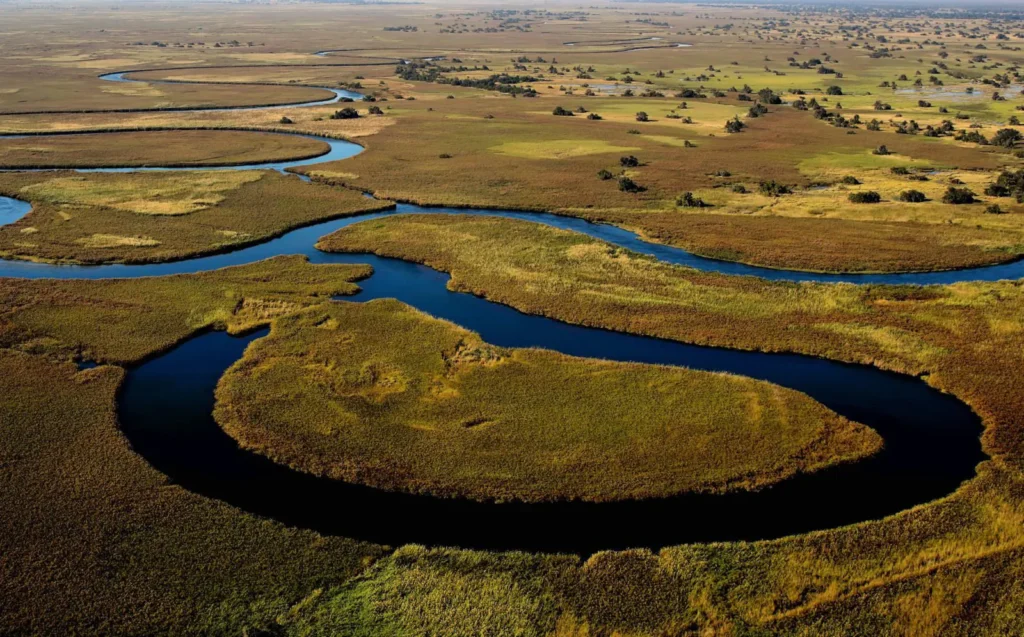
| DAY 2 | Game Drive & Bush Walk — Into the Wild
Morning Game Drive | Guided Bush Walk | Night Safari |
Pre-Dawn: Early Morning Wake-Up Call
A gentle knock on your tent door at 5:00 AM — accompanied by a tray of hot coffee, rusks, and fresh fruit — signals the start of one of Africa’s most exhilarating daily rituals: the early morning game drive. The Delta’s wildlife is most active in the hours just after dawn, when temperatures are cool, predators are still hunting or feeding, and the light for photography is at its most beautiful.
Morning: Open 4×4 Game Drive — The Floodplains
Board your open-sided Land Cruiser and set off into the surrounding concession, a vast private wilderness area that may span hundreds of thousands of hectares depending on your camp’s location within the Delta. Your guide drives slowly, windows open, engine often switched off for periods of observation, as you scan the bush for movement.
The Okavango Delta’s game drive areas transition between distinct habitat types within short distances — a feature that makes game viewing here exceptionally diverse:
- 🌾 Open floodplains: Home to large herds of red lechwe (a semi-aquatic antelope that bounds through shallow water with extraordinary grace), zebra, wildebeest, and warthog. These plains are prime hunting ground for cheetah.
- 🐘 Mopane woodland: Dense stands of mopane trees, the elephant’s favourite food source. Elephant herds are frequently encountered here, including matriarch-led breeding herds with calves.
- 🌳 Riparian corridors: Fig trees, ebony groves, and sycamore fig forest along the waterways. Leopard rest in these trees during daylight hours; baboon troops move through them in the morning.
- 🐺 Acacia savanna: On the Delta’s margins, open acacia bush supports lion prides and the highly endangered African wild dog.
Your guide will stop at significant sightings and give detailed explanations of animal behaviour, ecology, and the relationships between species. A good guide reads the bush like a living text — fresh tracks in the sand, alarm calls from birds, the behaviour of vultures circling above — and translates it into a coherent and thrilling narrative.
| 🦟 HEALTH NOTE
Malaria is present in the Okavango Delta throughout the year. Consult your doctor about antimalarial prophylaxis well in advance of travel (at least 4–6 weeks). Pack a high-DEET insect repellent, wear long sleeves and trousers after dusk, and ensure your tent is zipped at all times. |
Mid-Morning: Field Picnic Breakfast
After approximately two hours of game driving, your guide will pull over at a scenic location — the edge of a lagoon, beneath an ancient leadwood tree, or on a raised termite mound offering panoramic views — for a bush breakfast. Fresh fruit, pastries, boiled eggs, and hot beverages are served as you watch the morning unfold around you. This is one of the most cherished rituals of the African safari.
Late Morning: Guided Bush Walk — The Delta on Foot
Return to camp for a brief rest before setting out on foot with your armed professional guide and an assistant tracker. The guided bush walk is the most intimate form of safari — on foot, at ground level, every sense heightened, you experience the Delta’s ecosystems with an immediacy that no vehicle can provide.
Walking safaris in the Okavango are not about covering distance. They are about seeing small things — the perfectly camouflaged bark mantis on a mopane trunk, the intricate construction of a weaver bird’s nest, the distinctive spoor of a honey badger in the dust. Your guide will reveal the Delta’s ecology layer by layer:
- 👣 Tracking: Learn to identify the tracks of all major Delta species from fresh prints in the sand, including the distinctive rounded pugmark of a lion, the elegant pointed track of a leopard, and the W-shaped print of a jackal.
- 🌿 Ethnobotany: Discover which trees provide medicine, which bark was used to make rope, and which berries sustained the San hunter-gatherers who lived in this landscape for 70,000 years.
- 🐜 Insect ecology: The Delta’s insect life is astonishing in its diversity — from the dung beetle, the ecosystem’s most important recycler, to the safari ant columns that carve highways through the forest floor.
- 🗺 Reading the landscape: Your guide explains how termite mounds create elevated dry islands that define where trees grow, how elephants dig for water in dry riverbeds, and how the annual flood pulse reshapes the entire Delta.
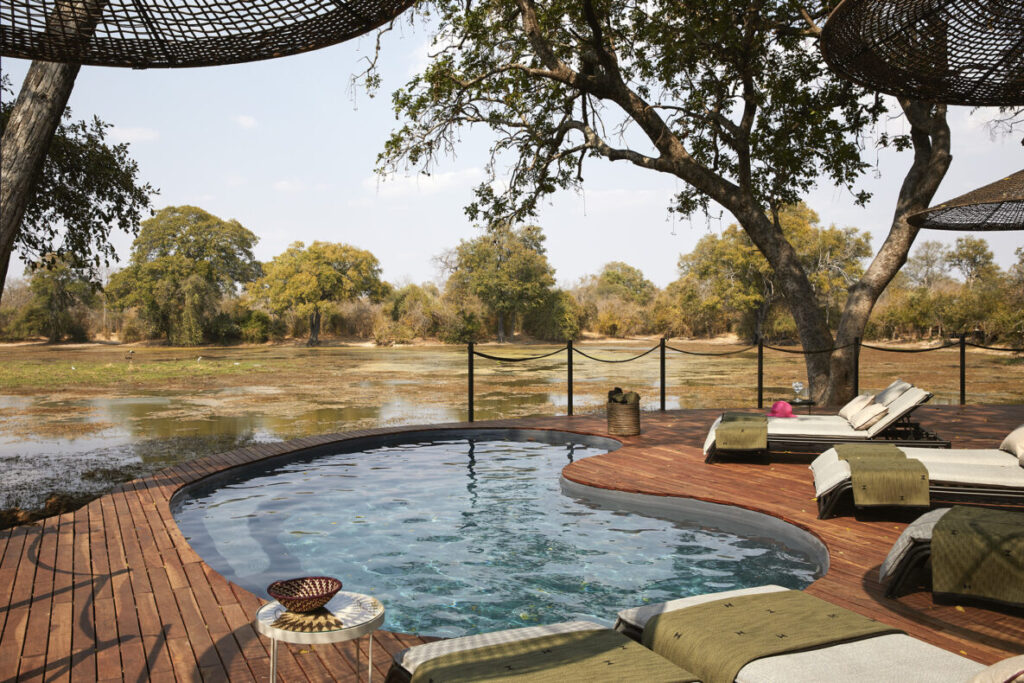
Afternoon: Rest, Pool, and Siesta
The African midday is hot and wildlife activity diminishes as animals seek shade. Return to camp for a leisurely lunch, and take advantage of the camp’s swimming pool, library, or simply rest in your tent. Many guests find this the ideal time for journalling, reviewing the morning’s photographs, or simply lying in a hammock listening to the orchestral soundscape of the Delta.
Evening: Night Safari — A Different World
As darkness falls — and it falls fast in Africa, with little twilight — the Delta transforms. Many of the Delta’s most extraordinary creatures are nocturnal, and the night safari opens a window into a world rarely seen. Armed with powerful spotlights, your guide scans the bush from the open vehicle.
Potential nocturnal sightings include:
- 🐆 Leopard: The Delta holds a healthy leopard population, and these supremely secretive cats become more active after dark, often patrolling well-used trails between territories.
- 🐱 Serval: An elegant medium-sized cat with extraordinarily large ears, the serval hunts rodents and birds in the long grass with a spectacular leaping pounce.
- African civet: A striking, stocky creature resembling a cross between a cat and a raccoon, the civet follows established scent trails through the bush.
- 🦡 Honey badger: Widely considered Africa’s most fearless animal, the honey badger forages at night with seemingly reckless energy.
- 👀 Bush baby (Galago): Tiny nocturnal primates whose reflective eyes gleam bright orange in the spotlight beam.
- White-tailed mongoose: Africa’s most commonly encountered nocturnal mongoose species, often seen trotting down dirt roads.
- 🌙 Spotted hyena: Clans move enormous distances at night; their distinctive whooping call is one of the great sounds of the African night.
| DAY 3 | Deep Delta Immersion — Water & Wilderness
Extended Mokoro | Island Walk | Fishing | Birdwatching |
Dawn: Birdwatching from Camp
Day 3 begins with an optional early morning birdwatching session from the camp’s elevated viewing deck or along the water’s edge. The Okavango Delta is considered one of Africa’s premier birdwatching destinations, with over 550 species recorded. Spend an hour with binoculars and your guide’s expertise, identifying the remarkable diversity of species that animate the Delta at first light.
Species commonly observed at dawn include:
- 🦅 African fish eagle (Haliaeetus vocifer): The most iconic sound of the African waterways. Its haunting cry, often delivered from a prominent perch above the water, is one of the most evocative sounds on the continent.
- 🦉 Pel’s fishing owl: One of Africa’s rarest and most sought-after birds. This enormous tawny owl hunts fish from overhanging branches above deep channels — a flagship species of the Okavango.
- Slaty egret: A globally vulnerable species found almost exclusively in the Okavango and Chobe systems. This small, distinctive egret with yellow-orange feet is an Okavango speciality.
- Wattled crane: Africa’s tallest crane and a vulnerable species. Pairs perform elaborate dancing displays on the floodplains at first light.
- 🎨 Malachite kingfisher, giant kingfisher, pied kingfisher, half-collared kingfisher, pygmy kingfisher: The Delta is home to no fewer than eight kingfisher species — a record-breaking diversity.
- African jacana: Walking on lily pads with extraordinarily long toes, the jacana is a quintessential Delta bird. The female maintains a harem of males, who raise the chicks alone.
- ❤️ Carmine bee-eater: In October and November, huge colonies of these vivid scarlet-and-blue birds nest in sandbank colonies, creating one of Africa’s great ornithological spectacles.
| 🔭 BIRDING GEAR
Pack a quality pair of 8×42 binoculars for the best birdwatching experience. A copy of Newman’s Birds of Southern Africa or Roberts Birds of Southern Africa is invaluable. Most camps have field guides in the library. Your guide will gladly help identify any species that puzzle you. |
Morning: Extended Mokoro Journey to a Remote Island
Today’s central activity is a longer, more exploratory mokoro excursion covering several kilometres of waterways to reach a remote island deep within the Delta — the kind of location accessible only by water, where the silence is absolute and wildlife encounters feel completely unmediated.
The journey takes you through a series of increasingly wild and remote channels, moving from the wider lagoons near camp into narrower, papyrus-choked tunnels where the papyrus fronds form a cathedral arch overhead. The water here is extraordinarily clear, the result of filtration through millions of reed roots — visibility to the bottom in some channels reaches several metres.
Watch for the following as you travel:
- 🦛 Hippopotamus pods: The Delta supports one of the largest hippo populations in Africa (an estimated 100,000 individuals). On this extended journey you will likely encounter multiple pods. Your poler knows their established territories and navigates safely around them.
- 🐊 Nile crocodile: Ancient, unchanged in form for 65 million years, the Nile crocodile inhabits every permanent waterway in the Delta. They are typically shy and will slip into the water well before your mokoro approaches.
- 🐘 African elephant swimming: One of the great sights of the Okavango — elephant herds crossing deep channels, their bodies largely submerged, trunks raised like periscopes. Young calves are often carried on their mothers’ backs through the deepest water.
- 🦦 Otter activity: Spotted-necked otters and Cape clawless otters hunt in the clearer channels, diving beneath your mokoro with playful ease.
Late Morning: Island Walk & Lunch
Arriving at the remote island, your poler beaches the mokoro on a sandy shore and you disembark for a guided walk across the island’s interior. Islands in the Okavango are elevated land masses created over centuries by termite activity and sediment accumulation — some are ancient, supporting trees hundreds of years old, while others are more recent formations still being colonised by vegetation.
On larger islands you may encounter:
- 🐘 Breeding herds of elephant using the island’s forest for shade and browsing on its abundant vegetation
- 🐃 Buffalo herds grazing on the grass plains that form at the island’s margins
- 🦌 Impala in large bachelor or breeding herds — the Delta’s most numerous antelope and the primary prey item for most of the Delta’s predators
- Tsessebe: One of Africa’s fastest antelopes and a species strongly associated with the Delta’s floodplain edges
Lunch is served on the island — a bush picnic laid out under the shade of an ancient jackalberry tree, accompanied by cold drinks from the camp’s cool box. There are few more magical lunches anywhere on earth.
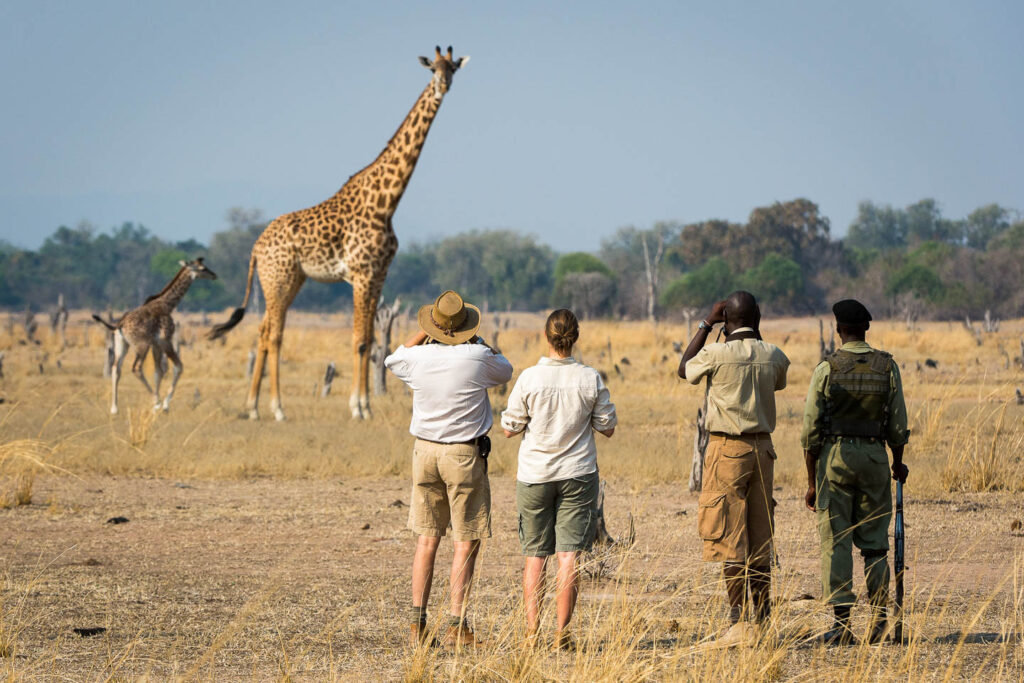
Afternoon: Delta Fishing (Optional)
For those who wish to try it, the afternoon offers an opportunity for catch-and-release fishing in the Delta’s channels. The Okavango system supports extraordinary freshwater fish diversity — over 80 species — and fishing here is a genuinely exciting experience.
Target species include:
- 🎣 Tiger fish (Hydrocynus vittatus): Africa’s most prized freshwater game fish and the Delta’s supreme angling target. Fast, aggressive, acrobatic, and equipped with formidable teeth, the tiger fish fights with extraordinary power. Fly fishing for tigerfish is considered one of the world’s great angling challenges.
- 🐟 African pike (Hepsetus odoe): A ferocious ambush predator found in the papyrus-fringed channels, the pike strikes artificial lures with explosive aggression.
- Largemouth yellowfish: A beautiful, hard-fighting species found in the faster-flowing channels, much prized by fly fishermen.
- 🌊 Bream: Several bream species inhabit the Delta’s shallower waterways and provide excellent sport on light tackle.
All fishing in the Okavango Delta is strictly catch-and-release, and fishing is conducted under the supervision of your guide. Botswana fishing licences are arranged through the camp.
Sunset: Traditional Mokoro Sundowner
Return to camp via a different route, pausing mid-channel as the sun descends to enjoy sundowner drinks in the mokoros, rafted together in the middle of a lagoon. The sound of a hippo surfacing ten metres away, a fish eagle’s cry overhead, and the sky turning crimson as the first stars appear is a moment that guests invariably describe as the highlight of their entire safari.
| DAY 4 | Final Morning & Farewell — Last Light in the Delta
Dawn Game Drive | Breakfast | Departure |
Pre-Dawn: Final Early Morning Safari
Your last morning in the Okavango Delta is often the most cherished. The first three days have attuned your senses to the rhythms of the wilderness — you hear things you didn’t hear on arrival, see things that would have been invisible before. Use this final game drive to consolidate your experience and, with luck, achieve the sightings that have eluded you during the safari.
Guides will make specific efforts based on your wishlist — whether that is a lion kill, a wild dog pack on the move, a leopard in a tree, or a particular bird species. Share your hopes with your guide the evening before; they will have strategies and locations in mind.
| 📸 PHOTOGRAPHY NOTE
The last morning typically offers the best photography light of the whole safari. Golden hour — the first hour after sunrise — produces warm, directional light that is magic for wildlife photography. Position yourself with the sun behind you wherever possible, and set your camera to burst mode for moving subjects. If you can achieve a low angle from the vehicle, do so. |
Mid-Morning: Farewell Bush Breakfast
Your final bush breakfast is served at a scenic location chosen by your guide for its particular beauty or significance — perhaps the floodplain where you watched the lion pride on Day 2, or the lagoon’s edge where the elephant family came to drink on Day 3. Take time to sit quietly and simply absorb the sounds, smells, and light of this extraordinary place before it becomes a memory.
After breakfast, your guide will present you with a personalised safari record — a written log of all wildlife species observed during your stay, complete with dates, locations, and any notable behaviours witnessed. This is a valued keepsake of the experience, and one that rewards detailed reading months and years after the safari.
Late Morning: Camp Farewell & Departure
Return to camp for final packing and a farewell gathering with the camp team. It is customary at many Okavango camps for the entire staff to line up and sing a traditional Motswana farewell song — a deeply moving experience that underlines the warmth and genuine connection that defines the best of African safari hospitality.
Your light aircraft transfer to Maun Airport departs late morning, giving you one final aerial perspective on the Delta that sustained you and thrilled you for four extraordinary days. Many guests find themselves already planning their return.
ACCOMMODATION OPTIONS
The Okavango Delta offers a range of accommodation styles, from ultra-luxury private reserves to more affordable community-based camps. All options listed below include full board, twice-daily game activities, and light aircraft transfers from Maun.
Ultra-Luxury Tented Camps (from USD 1,500 per person per night)
The Delta’s top-tier camps offer an uncompromising combination of remote wilderness location, exceptional guiding, and superb food and facilities. Highlights include private plunge pools, butler service, and access to exclusive private concessions spanning hundreds of thousands of hectares. Representative properties include Mombo Camp, Jao Camp, and Duba Plains Camp — all operated by renowned safari companies with decades of Delta experience.
Premier Luxury Camps (USD 800–1,500 per person per night)
A notch below the ultra-luxury tier in price but not significantly in experience, premier camps offer beautifully designed tented suites, high-quality guiding, and excellent food in spectacular locations. These properties often provide more personalised service due to their small size (typically 8–16 guests maximum).
Mobile Camping & Bushcamp Experiences (USD 400–800 per person per night)
Smaller, more intimate camps with a genuine bush atmosphere. Many mobile camps are unfenced and set up in remote locations rarely visited by larger camps. The wildlife experience can be exceptional, though facilities are more basic. This style is popular with experienced safari travellers who prefer authenticity over luxury.
WHAT TO PACK
Clothing
- 👕 Neutral colours (khaki, olive, beige, brown, grey) — avoid blue (attracts tsetse flies), bright whites, and camouflage patterns
- Light, breathable long-sleeved shirts and trousers for evening insect protection
- 🧥 A fleece or lightweight down jacket for early morning game drives (temperatures can drop sharply)
- ☀️ Wide-brimmed sun hat and sunglasses with UV protection
- 👟 Comfortable, broken-in walking shoes or lightweight hiking boots for bush walks
- 🩱 Swimwear for the camp pool
- 🌧️ A lightweight waterproof jacket (essential during green season, useful year-round)
Equipment
- 🔭 Binoculars (8×42 or 10×42 recommended) — do not forget these
- 📷 Camera with telephoto lens (200mm minimum, 300–500mm ideal for wildlife)
- 🔋 Extra memory cards and batteries (no charging in the field during game drives)
- 🔦 Head torch (essential for navigating camp at night)
- ⚡ Power bank and universal adapter (most camps offer charging at meals)
- 🧳 Soft-sided, collapsible luggage bag (hard-sided cases cannot be transported in light aircraft)
Health & Personal
- 💊 Antimalarial medication as prescribed by your doctor
- 🧴 High-DEET insect repellent (30–50% DEET concentration)
- ☀️ High-SPF sunscreen (SPF 50+ recommended)
- 💉 Personal medication supply with copies of prescriptions
- 🩹 Hand sanitiser and basic first aid kit
- 📋 Travel insurance documents (comprehensive cover including emergency medical evacuation is essential)
HEALTH & SAFETY
Malaria
The Okavango Delta is a high-risk malaria zone throughout the year, with peak transmission during and immediately after the rainy season (November–April). Consult a travel health clinic at least 6–8 weeks before departure to discuss prophylaxis options. In addition to medication, apply insect repellent at dusk, wear long sleeves and trousers in the evenings, sleep under a mosquito net (provided by all camps), and ensure your tent is zipped at all times.
Wildlife Safety
All wildlife in the Okavango Delta is wild and potentially dangerous. Follow your guide’s instructions at all times — they have years of experience reading animal behaviour and will keep you safe. Never leave the vehicle during game drives unless instructed to do so by your guide. On walking safaris, stay close to your guide, move quietly, and never run. The ‘big five’ (lion, leopard, elephant, buffalo, and rhinoceros) all present serious danger if approached carelessly. Hippos are statistically responsible for more human fatalities in Africa than any other large mammal.
Sun & Heat
The Botswana sun is powerful even in the cooler winter months. Apply sunscreen generously before game drives, wear a hat and sunglasses, and drink at least 3–4 litres of water daily. Heat exhaustion can develop quickly in open vehicles; tell your guide immediately if you feel unwell during any activity.
CONSERVATION & RESPONSIBLE TRAVEL
The Okavango Delta’s survival as a wilderness is inextricably linked to the safari tourism industry. Botswana has long pursued a high-value, low-volume tourism model that charges premium prices and strictly limits the number of visitors, thereby generating maximum economic benefit for local communities and conservation while minimizing environmental impact.
As a guest in this extraordinary wilderness, you can contribute to its long-term conservation by:
- 🤝 Choosing camps that employ local community members and return a percentage of revenue to community trusts
- 🚫 Refusing to purchase any wildlife products — ivory, skins, shells, or live animals
- 📞 Reporting any suspicious activity to your camp manager or the Botswana Department of Wildlife and National Parks
- 📏 Respecting the ‘5-metre rule’ — never pressure your guide to approach wildlife more closely than is ethical
- ♻️ Reducing single-use plastic consumption — bring a reusable water bottle
- 🌱 Participating in the carbon offset programmes offered by many camps to mitigate your flight emissions
| 🌍 COMMUNITY IMPACT
Many camps in the Okavango Delta are built on land leased from local communities under Botswana’s Community Based Natural Resource Management (CBNRM) programme. By choosing these camps, you ensure that local families earn a direct income from wildlife conservation — creating a powerful economic incentive for communities to protect their wildlife heritage rather than convert land to agriculture. |
| BEGIN YOUR OKAVANGO JOURNEY
The Okavango Delta does not merely impress — it transforms. Those who travel here return changed, carrying with them a deepened understanding of the natural world and a profound sense of what remains possible when wilderness is protected and respected. Let us help you experience it. Marriott Safaris Africa info@marriottsafarisafrica.com | www.marriottsafarisafrica.com |