
Masai Mara National Reserve
Situated in southwestern Kenya, Masai Mara National Reserve is the premier attraction for safari enthusiasts visiting the country. The Mara, commonly referred to as Maasai Mara, is located in Narok, Kenya, adjacent to Tanzania’s Serengeti National Park. The reserve is named for the Maasai tribe, the area’s ancient inhabitants who originated from the Nile Basin. The term “Mara” signifies “spotted” in the indigenous Maasai language, indicating visibility from a distance. The Mara is one of Africa’s most renowned and important wildlife conservation regions, celebrated for its extraordinary populations of the African big five, large felines, and diverse ungulates. The national reserve additionally has the Great Annual Wildebeest Migration, which has garnered recognition as one of Africa’s Seven Natural Wonders.
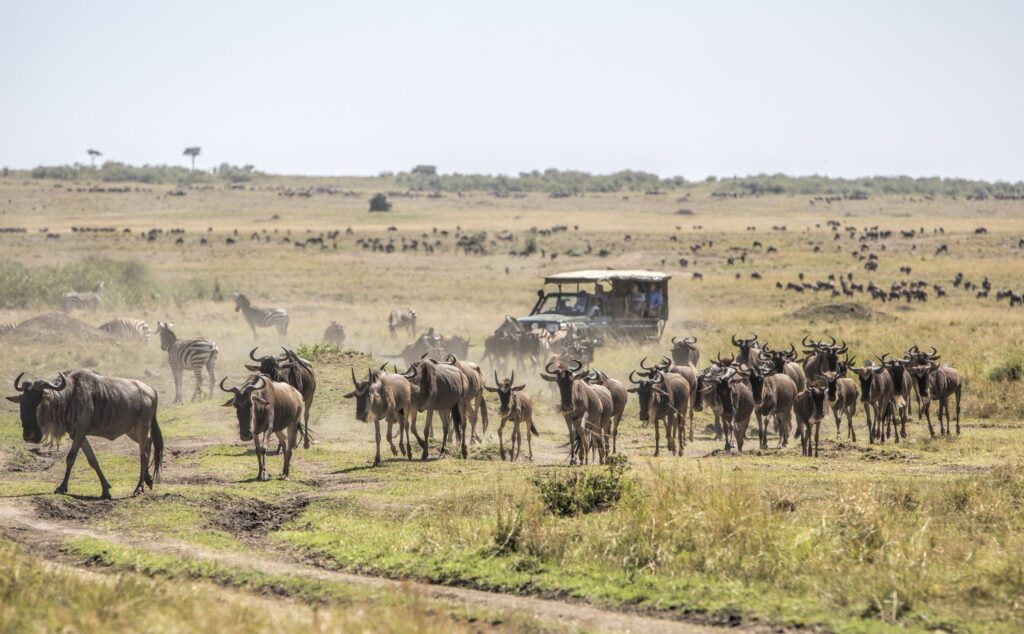
The Masai Mara National Reserve spans 1,510 square kilometers and is situated at an elevation of 1,500 to 2,170 meters above sea level, having served as a wildlife reserve for almost 50 years. The national reserve was established in 1961 as a wildlife refuge, including a total area of 520 square kilometers, which included the Mara Triangle. By 1974, the sanctuary expanded and was classified as a National Reserve, encompassing around 1,872 square kilometers. A segment of the area has been allocated to the Maasai tribal communities, and the Mara ecosystem currently encompasses 1,510 square kilometers. The Maasai have historically relied on their land for cattle rearing and sustenance, successfully preserving their lifestyle through the establishment of the reserve as a protected area for wilderness conservation and the designation of certain sections as conservancies. The northern section of the Mara stretches into Tanzania’s Serengeti National Park, thereby forming the Mara-Serengeti ecosystem, one of Africa’s most diverse and remarkable ecosystems.
Masai Mara features a striking topography characterized by undulating hills, expansive savannahs, riverine woodlands, and scattered short bushy trees. The national reserve has three rivers: the Sand River, the Talek River, and the Mara River. The park is divided into two sections: the inner area, characterized by pristine wilderness, and the outside area, which includes conservancies and allows for Masai cattle grazing.
Masai Mara Conservancies
The Greater Masai Mara conservation region comprises the Masai Mara National Reserve, an unfenced reserve allowing unrestricted movement of wildlife, along with various conservancies. The conservancies are privately held by Maasai families. The conservancies were established to provide the Maasai with sufficient land for livestock grazing, and Maasai farmers can occasionally be observed cultivating and grazing their animals within these areas. Numerous safari hotels and camps lease land from Maasai families, enabling them to participate in community engagement through the sponsorship of educational or developmental initiatives. The creation of these conservancies has produced a mutually beneficial outcome for both the reserve and the Maasai, as land previously subjected to overgrazing by livestock is now undergoing rewilding. Furthermore, the Maasai may allocate resources to their villages because to the revenue generated by the conservancies from tourism. The conservancies within the Masai Mara Conservation Area are Lemek, Siana, Ol Chorro Oirowua, Koiyaki, Olkinyei, Oloirien, Naikara, Ol Derkesi, Maji Moto, Kerinkani, and Kimintet.
Attractions in Masai Mara National Reserve
Wildlife
The Masai Mara National Reserve is renowned for its diverse array of wildlife, including many predator species. The park hosts around 95 animal species and more than 500 documented bird species. The Mara is among Africa’s premier safari locales. It is renowned for holding the Big Five: elephants, rhinos, buffaloes, leopards, and lions, and it is the habitat of the indigenous black rhino population. Alongside the big five, the reserve hosts grazers like impalas, duikers, hartebeests, roan antelopes, zebras, giraffes, topi, wildebeest, and Thomson’s gazelles. The substantial wildebeest migration from the Serengeti and Loita Plains causes the number of certain ungulates to fluctuate seasonally. Additional wildlife species in the Mara encompass crocodiles, hippopotamuses, jackals, cheetahs, hyenas, servals, and foxes, among others.
The Great Migration of Wildebeests
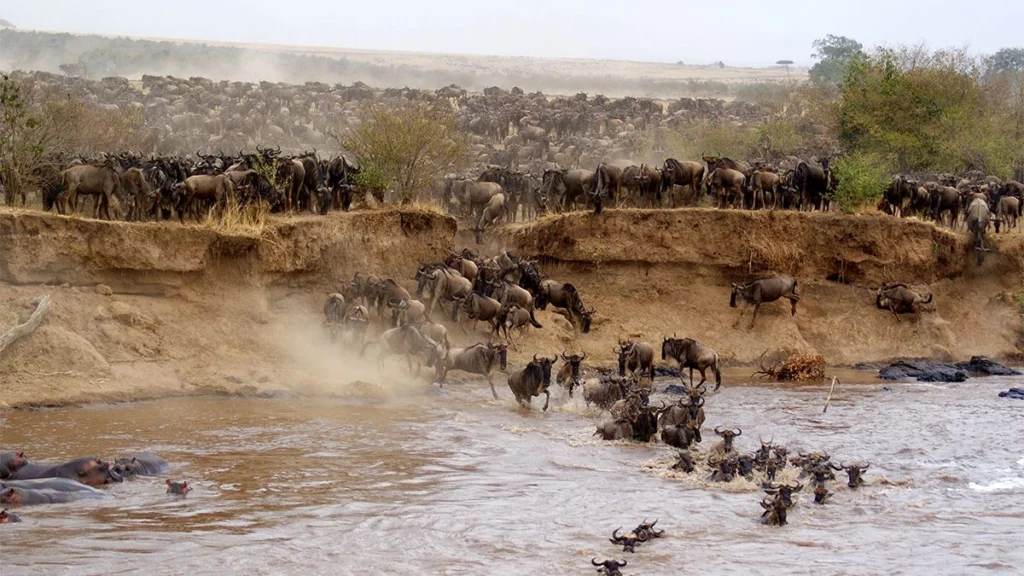
The Great Wildebeest Migration is the premier safari attraction in Mara. Annually, from July to October, the Masai Mara hosts one of the most extraordinary animal spectacles globally — the Great Migration. The sunburnt grasslands of the rolling savannah accommodate about 1.5 million zebras, wildebeests, and antelopes migrating from the Serengeti in Tanzania to the Mara in pursuit of more abundant pastures and water. The Great Wildebeest Migration transpires in the Serengeti and Masai Mara, unparalleled by any other wildlife display globally. Sightings of the migration are not frequently certain, but if you wish to witness the event, please monitor the following patterns of their movements;
The continuous influx of migrating prey entices the large felines with an abundance of feeding options. At this time of year, it is common to observe predators like lions, leopards, and cheetahs pursuing robust young prey for sustenance. Nevertheless, the Mara possesses a limited number of lion prides, with female lions being permanent members, whilst the males are frequently expelled by other male lions.
In mid-July, the herds reach the Masai Mara and commence their treacherous crossing of the Mara River. Crocodiles and hippos along the banks of the Mara River pose significant risks to wildebeest and zebras during their river crossings.
From September to October, the wildebeest briefly graze on the verdant savannah grasslands of the Mara, providing travelers the opportunity to witness these remarkable animals.
Birds in Masai Mara
Masai Mara is a sanctuary for avian aficionados, featuring over 500 documented bird species, including 47 raptors. The avian species of Masai Mara encompass the world’s largest bird, the ostrich, as well as diminutive sunbirds. The park is home to several savannah species, including Ground Hornbills, Kori Bustards, Secretary Birds, Jaunty Crowned-Plovers, and flocks of White Storks, among others.
The riverine ecosystems of the Park host remarkable populations of Grey-Crowned Cranes, Sacred Ibis, Goliath Heron, Black-headed Heron, Saddle-Billed Storks, Yellow-Billed Storks, Grey Heron, and Great White Egret, among others. The Mara River is inhabited by various kingfisher species, while the adjacent woodland is home to species like the Ross’s Turaco and Schalow’s Turaco. The premier birdwatching location in Masai Mara is Musiara Marsh, the sole site in Kenya where the Rufous-bellied Heron breeds. The Madagascar Squacco Heron is indigenous to this region. The avian predators of Masai Mara National Reserve comprise the Martial Eagle, Bateleur, and Pygmy Falcon.
Things To do in Masai Mara National Reserve
Game Drives/Game Observation
Game drives in Masai Mara are highly rewarding due to its remarkable biodiversity and stunning landscapes. Embarking on a 4×4 open-roof safari vehicle, game drives in the Masai Mara will provide unobstructed views of wildlife while complying with regulations. Game drives in the Mara are often organized in three sessions: morning from 6:30 a.m. to 10:30 a.m., late afternoon from 3:30 p.m. to 6:30 p.m., and nighttime from 7 p.m. to 10 p.m. The morning game drives are the most gratifying, as this is when the majority of wild animals are actively hunting, foraging for sustenance, and returning to their shelters (for the predators). Moreover, it is the optimal moment to witness the African sunrise.
The evening game drive commences at 4 PM and concludes at 6:30 PM, optimal for observing predators emerging from concealment, herbivores rejuvenating at water sources, and grazing in groups beneath tree canopies. Night game drives, commencing at approximately 7 PM and concluding at 10 PM, provide optimal opportunities to observe nocturnal fauna. This is the optimal period to observe lions, leopards, hyenas, and other predators pursuing their prey. All game drives are conducted under the supervision of professional guides; however, for night game drives, an armed ranger accompanies you for protection in the wilderness. Nighttime game drives utilize a spotlight torch to illuminate nocturnal creatures.
Travelers may choose for a full-day game drive, departing from the hotel with a picnic lunch. They would remain in the park throughout the day, returning only after the evening game drive. If this aligns with your preferences, feel free to choose it.
Bird Watching in Maasai Mara National Reserve
The Masai Mara National Reserve provides exceptional bird-watching opportunities, featuring over 500 documented bird species. The reserve’s diverse avian population inhabits various environments, including broad savannahs, riverbanks, the Great Rift Valley escarpment, and rocky slopes. The Masai Mara is home to numerous bird species, including a substantial population of Maasai Ostriches. Other significant species in the park comprise the Rufous-bellied Heron, Hamerkop, Sacred Ibis, Secretary Bird, Sooty Chat, African Fish Eagle, Tawny Eagle, Long-tailed Cormorant, Kori Bustard, among others. The optimal period for avian observation in the Mara is from November to April, coinciding with the presence of migratory birds from Europe and Northern Africa. This occurs during the rainy season, when the majority of birds exhibit breeding plumage.
Watching the Great Wildebeest Migration
This is the most coveted safari activity conducted in Masai Mara National Reserve. At this time, millions of wildebeest and other ungulates move from Serengeti National Park to Maasai Mara in pursuit of fresh pastures and water, subsequently returning. In addition to wildebeests, one can also anticipate observing several other creatures, including zebras and antelopes. Moreover, now is the optimal period to observe Mara’s predators actively hunting for plentiful prey. To appreciate this remarkable natural occurrence, it is advisable to make reservations as early as possible, as the park becomes inundated with people during this season who visit the Mara particularly to witness the migration.
Escorted Walking Safari
Guided safari hikes in the Masai Mara occur within the conservancies, presenting an exhilarating experience! The safari walks provide intimate interactions with wildlife. A guided safari walk can be experienced on foot with the support of a native guide and an armed escort who will navigate the walking pathways. Anticipate observing fauna include elephants, giraffes, antelopes, buffaloes, and numerous others throughout the park. Additionally, guided safari excursions along the Mara River provide exhilarating views of crocodiles, hippos, and several aquatic bird species. Due to its nature as a walking safari, guests get the opportunity to encounter and engage with the Maasai local populace.
Cultural Explorations
The Masai Mara is encircled by the indigenous Maasai people, renowned as one of Africa’s most distinguished cultures. The Maasai are pastoralists with a unique culture unlike anywhere in the world. They possess fascinating cultural norms and customs due to their longstanding presence near the reserve. Cultural excursions to the Maasai communities in the Mara will enable you to investigate their original culture. Explore their unique Maasai traditional dwellings and gain insight into their peculiar lifestyle and household routines, including milking cows and collecting fresh blood from animals, among others. Enjoy observing their dance style as they rhythmically ascend and descend to the melody, among other aspects.
Hot Air Balloon Expeditions
This is a picturesque expedition in the Mara that involves rising early to witness the sunrise while gliding over the stunning grasslands of Maasai Mara. Hot air balloon safaris in the Mara commence at 6 a.m. and conclude with sumptuous bush breakfasts. Safaris provide the optimal means to see Mara’s breathtaking terrain and the remarkable fauna it harbors. Travelers may relish spectacular overhead vistas of wildebeest herds, among herds of buffalo, elephants, and birds of prey, including eagles.
Cultural tour
The Masai Mara National Reserve is one of the few renowned locations in Africa where one can traverse the bush on horseback. Horseback riding in the Mara occurs within the conservancies, providing intimate views of the countryside as one traverses diverse wildlife while relishing the refreshing natural breeze. The majority of visitors to the Mara favor horseback safaris over game drives due to the open-air nature of the activity, which facilitates closer encounters with wildlife. The expeditions are conducted by a qualified game ranger.
What is the optimal period for visiting Masai Mara National Reserve?
The Masai Mara National Reserve is accessible year-round, while optimal visitation is from late June to October, coinciding with the dry season. Wildlife observation is facilitated during these months due to reduced vegetation and the congregation of animals along rivers and water holes. The rainy seasons (March to May and October to November) render the park’s roads challenging to traverse, and wildlife observation is restricted due to the precipitation.
Accessing Masai Mara National Reserve
Masai Mara National Park is accessible by both aerial and terrestrial routes. The most expedient means of reaching the Mara is via flight travel. Charter flights operate from Nairobi’s Jomo Kenyatta International Airport and Wilson Airport to various airstrips in Mara. A flight to the Mara requires roughly 45 minutes. Upon arriving at any airport within the park, typically located near your reserved resort, you will be conveyed by road to your designated camp or lodge.
Maasai Mara is located roughly 280 km west of Nairobi, requiring an estimated 5 to 6 hours of driving time. The journey may appear lengthy, although you will traverse breathtaking landscapes of the Great Rift Valley, beside Mount Suswa and Mount Longonot. The route from Narok to the reserve is somewhat uneven; thus, it is advisable to utilize a 4×4 safari vehicle designed for such terrain. Upon arrival in the Mara, one can enter through various entrance gates, including Sand River, Musiara, Talek, Sekenani, and Oloololo.