Mweya Peninsula
Mweya Peninsula, Nestled in the heart of Queen Elizabeth National Park in southwestern Uganda, Mweya Peninsula stands as one of East Africa’s most captivating wildlife destinations. Jutting dramatically into the confluence of the Kazinga Channel and Lake Edward, this narrow strip of land offers an extraordinary concentration of biodiversity rarely matched anywhere on the African continent. It is the most visited location in Queen Elizabeth National Park — itself Uganda’s most popular national park — and for very good reason.
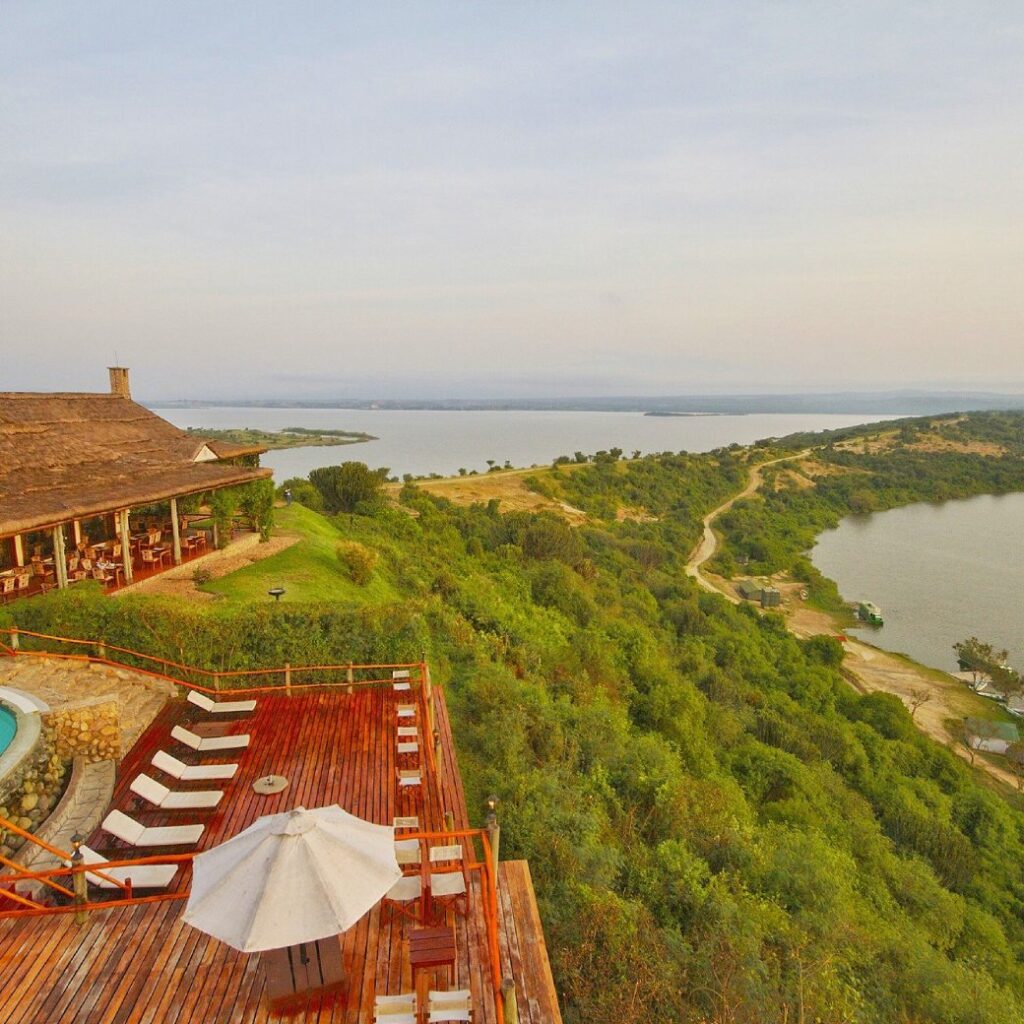
Rising approximately 980 metres (3,220 feet) above sea level and located about 400 km southwest of Kampala, Mweya Peninsula is where the savanna meets the wetlands, where the mountains meet the lakes, and where Uganda’s exceptional natural heritage is on full, breathtaking display. Whether you arrive to cruise the hippo-filled Kazinga Channel, track mongooses on foot, scan the skies for one of over 600 bird species, or simply absorb a golden sunset over the Rwenzori Mountains, Mweya delivers an experience that stays with every visitor long after they leave.
This comprehensive guide covers everything you need to know about Mweya Peninsula — its geography, wildlife, activities, accommodation options, best times to visit, and practical travel tips — to help you plan the ultimate Queen Elizabeth National Park safari.
Geography and Location
Mweya Peninsula occupies a unique geographic position within Queen Elizabeth National Park in Kasese District, Rwenzururu sub-region, Western Uganda. The peninsula is defined by water on three sides: the Kazinga Channel forms its southern boundary, Lake Edward stretches to the west, and the confluence of the two creates its tip. To the north and east, dense acacia woodland and open savanna grasslands transition into the broader national park landscape.
The Kazinga Channel
The Kazinga Channel is the defining geographical feature of Mweya Peninsula and arguably the single most important wildlife corridor in Uganda. This natural freshwater waterway stretches approximately 32–35 kilometres, connecting Lake George to the northeast with Lake Edward to the southwest. Unlike many African channels, the Kazinga flows in both directions depending on water levels in the two lakes, creating a dynamic aquatic ecosystem of exceptional richness.
The channel teems with life. An estimated 2,000 or more hippos call its waters home, making it one of the highest concentrations of hippopotamuses on Earth. Nile crocodiles bask on its banks in the hundreds. During boat cruises, it is entirely normal to cruise within metres of these prehistoric giants. Shoals of tilapia and other fish attract a staggering array of water birds, and elephants regularly wade into the shallows to drink and bathe — often just metres from the safari boats.
Lake Edward
Lake Edward — historically known as Lake Rutanzige — is one of Africa’s Great Lakes, located in the Western Rift Valley on the border between Uganda and the Democratic Republic of Congo. The international border runs through the middle of the lake. At its northeastern tip, where the Kazinga Channel enters, the lake forms the western horizon of Mweya Peninsula, offering spectacular views especially at dawn and dusk when the sky erupts in colour and silhouettes of hippos dot the shoreline.
On clear days, particularly in the early mornings, the snow-capped peaks of the Rwenzori Mountains — the legendary ‘Mountains of the Moon’ — are visible rising above the horizon to the north. Few safari experiences rival watching the sun rise over these ancient peaks while hippos chorus in the channel below.
Terrain and Vegetation
The terrain of Mweya Peninsula is a mosaic of distinct habitats that contributes directly to its exceptional biodiversity. Along the channel and lake shores, dense papyrus beds and emergent aquatic vegetation provide critical nesting and foraging habitat for waterbirds. Thickets of euphorbia trees and candelabra cactus rise from the rocky slopes, offering cover for leopards and smaller predators. Acacia woodland transitions into open savanna grassland, where Uganda kobs, waterbucks, and buffaloes graze in full view.
This diversity of habitats within a small geographic area explains why Mweya Peninsula consistently delivers exceptional wildlife viewing. Within a single morning, a visitor can watch hippos in the channel, track a herd of elephants across the grassland, and identify a dozen different bird species on a single acacia tree — an experience that epitomises the magic of Uganda’s natural heritage.
History and Conservation
The area around Mweya Peninsula has been inhabited and utilised by humans for thousands of years, with the Bakonzo, Banyankole, and other Bantu-speaking peoples drawing on the resources of Lake Edward and the Kazinga Channel for generations. Fishing communities relied on the channel’s abundant tilapia, while pastoral communities grazed livestock on the surrounding grasslands.
Establishment of the National Park
The area was formally gazetted as a protected wildlife area in 1952 under British colonial administration, initially named Kazinga National Park — a nod to the channel that defines its character. The park was renamed Queen Elizabeth National Park just two years later in 1954, following a royal visit by Queen Elizabeth II and Prince Philip during their tour of Uganda. The visit brought international attention to the park and established its reputation as one of Africa’s premier wildlife destinations.
The headquarters of Queen Elizabeth National Park were established at Mweya, cementing the peninsula’s central role in the park’s management and tourism infrastructure. Today, the Uganda Wildlife Authority (UWA) continues to operate its park headquarters from Mweya, overseeing an area of approximately 1,978 square kilometres.
Conservation Challenges and Successes
Like many African protected areas, Queen Elizabeth National Park and Mweya Peninsula have faced significant conservation challenges over the decades. During Uganda’s turbulent political period in the 1970s and 1980s, wildlife populations were devastated by poaching and civil conflict. Elephant numbers in particular suffered dramatic declines. However, since the restoration of stability and the strengthening of the Uganda Wildlife Authority, wildlife populations have largely recovered.
Today, UWA rangers conduct regular patrols to prevent illegal fishing, hunting, and encroachment. Tourism revenue generated through park fees, accommodation, and guided activities is channelled back into conservation programmes, including wetland restoration and community development projects in villages surrounding the park. The Mweya community itself has grown to over 400 residents, many of whom are employed in the tourism and conservation sector.
Wildlife of Mweya Peninsula
Mweya Peninsula and the surrounding Queen Elizabeth National Park constitute one of the most biodiverse areas in Africa. The unique combination of wetland, savanna, and woodland habitats supports a remarkable diversity of mammals, birds, and reptiles that few safari destinations can rival.
Large Mammals
Hippopotamus
The hippopotamus is undoubtedly the star attraction of Mweya Peninsula. The Kazinga Channel hosts approximately 2,000 hippos — one of the greatest concentrations on Earth — and they are impossible to miss. By day, pods of hippos lounge in the shallows, their barrel-shaped bodies barely breaking the surface as they snort, yawn, and jostle for the best positions. By night, they emerge to graze on the surrounding grasslands, following ancient pathways worn smooth by generations of their predecessors.
African Elephant
African elephants are a constant and majestic presence around Mweya Peninsula. Herds frequently come to drink and bathe in the Kazinga Channel, often approaching remarkably close to the boats during cruises. On game drives, it is common to encounter elephants browsing along the Channel Track and other vehicle routes across the peninsula. Despite their size, they move with surprising grace through the bush, and encounters with large bulls or herds with young calves are genuinely thrilling.
African Buffalo
Cape buffalo, known locally as the African buffalo, roam the grasslands around Mweya in substantial numbers. These formidable animals often gather in large herds of hundreds of individuals, creating spectacular sights on the open plains. Old solitary bulls — known as ‘dagga boys’ — are frequently encountered along the channel banks and in areas of dense bush. Buffalo are considered one of Africa’s ‘Big Five’ and are regarded as among the continent’s most dangerous animals when threatened.
Uganda Kob and Waterbuck
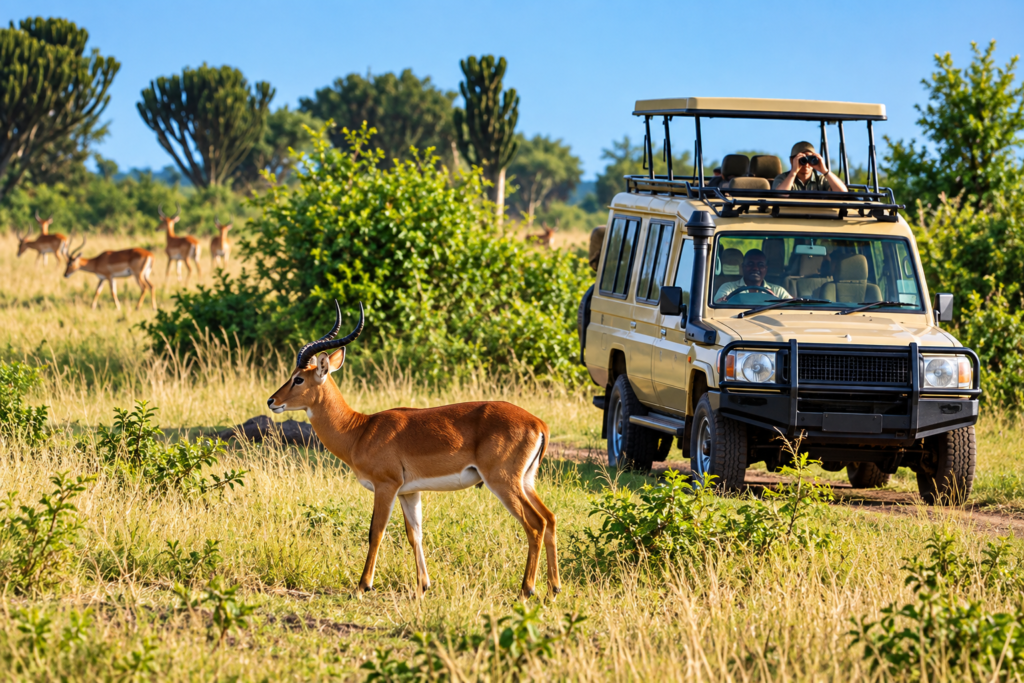
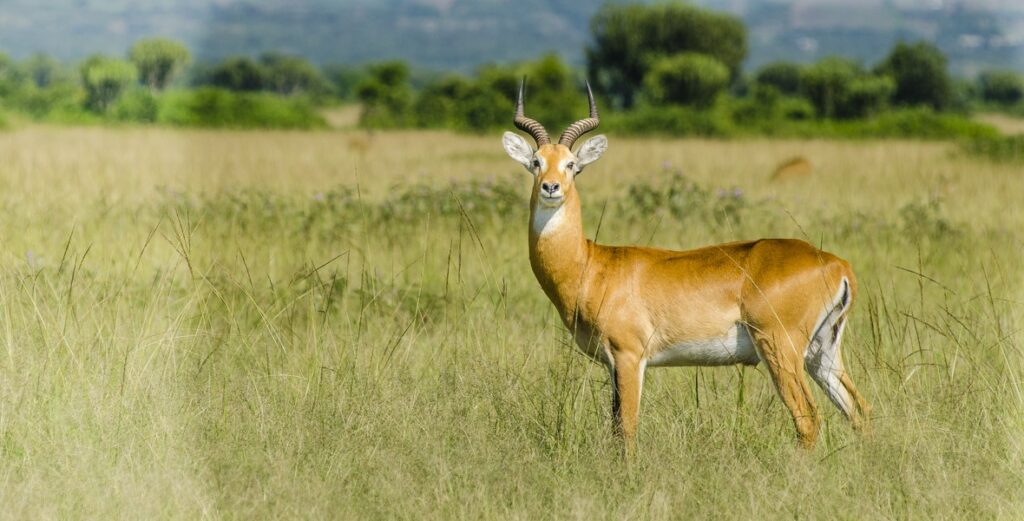
The Uganda kob — a medium-sized antelope with elegant curved horns in the males — is the national animal of Uganda and appears on the country’s coat of arms. Queen Elizabeth National Park holds one of its largest populations, and Mweya Peninsula is an excellent place to observe these graceful animals. Males establish lek territories in the grasslands where they compete for females through displays and combat. Waterbucks, with their distinctive white ring on the rump, are equally common and are often seen in family groups near the water’s edge.
Lions and Leopards
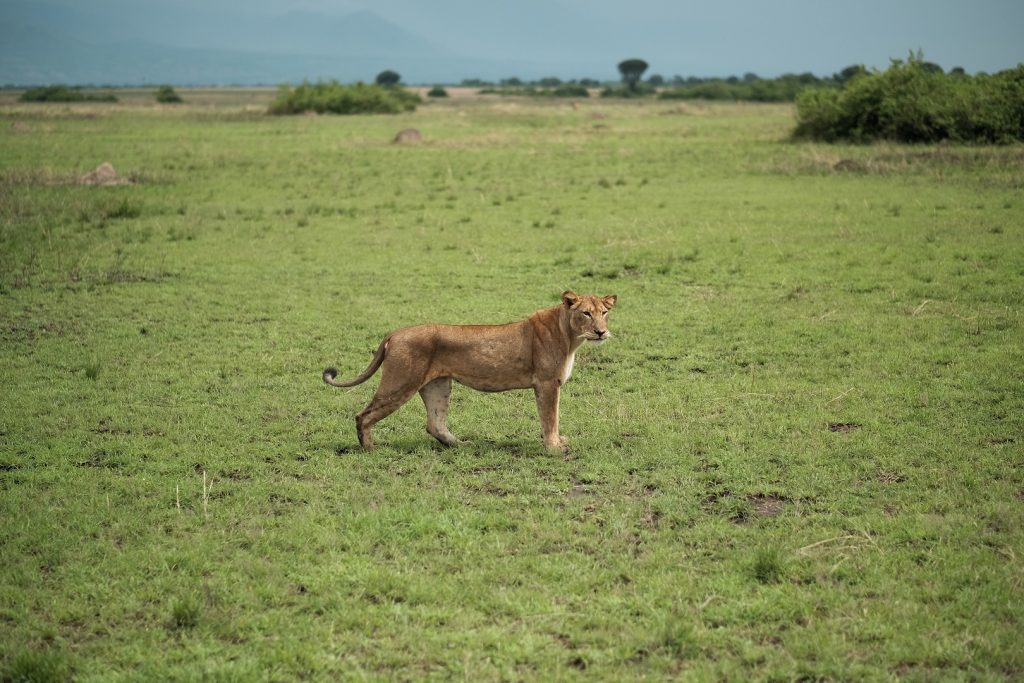
Lions are present in the Queen Elizabeth National Park ecosystem, though sightings around Mweya itself are less predictable than in some other areas of the park. The park is particularly famous for the tree-climbing lions of the Ishasha sector in the southern section, where lions have developed the unusual habit of resting in large fig trees. Leopards, by contrast, are resident on Mweya Peninsula itself, where they hunt in the scrubby thickets and rocky outcrops. These elusive cats are most active at dawn and dusk, and night drives offer the best opportunities for sightings. Spotted hyenas, jackals, and warthogs complete the predator-prey dynamics of the peninsula.
Banded Mongoose
One of Mweya Peninsula’s most distinctive and endearing wildlife experiences is the banded mongoose population. The peninsula hosts over 400 banded mongooses living in extended family groups that have become remarkably habituated to human presence through years of research. A dedicated mongoose tracking experience allows visitors to follow a group throughout their morning routine — foraging for insects, interacting socially, and caring for young — in remarkable proximity. This experience, guided by researchers who know individual animals by name, provides an intimate insight into the complex social lives of these fascinating small carnivores.
Nile Crocodile
The Kazinga Channel is home to a large population of Nile crocodiles, Africa’s largest reptile. These ancient predators bask motionless on sandbanks and mudflats along the channel banks, often lying so still that they can be mistaken for logs at first glance. During boat cruises, it is common to pass within metres of crocodiles of truly impressive size. They play a vital ecological role in the channel ecosystem, and their presence adds an edge of primordial drama to every cruise.
Birdlife
Queen Elizabeth National Park has been recorded as hosting over 600 species of birds — more than the entire species counts of many European countries — making it one of Africa’s premier birdwatching destinations. Mweya Peninsula and the Kazinga Channel are at the heart of this extraordinary avian diversity.
The channel’s waters attract vast numbers of water birds, including African fish eagles, whose iconic call echoes across the water, pied and malachite kingfishers that flash like jewels along the banks, great white pelicans that circle in soaring flocks, African skimmers that drag their lower mandible through the water surface, and yellow-billed storks that wade in the shallows. Herons of multiple species — grey, goliath, purple, squacco — stand sentinel along the banks, while African jacanas trip lightly across floating vegetation.
For the dedicated birder, the nearby Kyambura Gorge and Maramagambo Forest add forest species including hornbills, sunbirds, and the rare African green broadbill. The shoebill stork — one of the most sought-after birds in Africa, with its prehistoric appearance and extraordinary shoe-shaped bill — can sometimes be found in the papyrus swamps around Lake George and the Kazinga Channel. During the wet season (October–May), the park receives vast influxes of migratory birds from Europe and northern Africa, adding waders, terns, and migratory raptors to the resident species.
Activities and Experiences
Kazinga Channel Boat Cruise
The Kazinga Channel boat cruise is unquestionably the signature experience of Mweya Peninsula and ranks among the finest wildlife encounters in Africa. These two-to-three-hour excursions depart from the landing stage below Mweya Safari Lodge and venture along the channel, offering unobstructed views of the wildlife concentrated along its banks.
Uganda Wildlife Authority operates motorised flat-bottomed boats accommodating up to 20 passengers on two or three departures daily. Mweya Safari Lodge operates its own vessel, the Kingfisher, which offers a more comfortable experience with shade canopies and refreshments. The recommended time for the cruise is mid-morning or late afternoon, when wildlife activity along the banks is at its peak and the light is ideal for photography. The price is approximately USD 30 per person for the standard UWA cruise.
On a typical cruise, visitors encounter hippos submerged in pods just metres from the boat, crocodiles basking on banks, enormous herds of buffalo and Uganda kob drinking at the water’s edge, elephants bathing and drinking with their young, and an extraordinary parade of water birds. The Rwenzori Mountains, when visible, provide a magnificent backdrop to the entire experience. It is genuinely difficult to overstate how remarkable a good cruise on the Kazinga Channel can be — it is, by most accounts, one of the greatest wildlife spectacles on Earth.
Game Drives
Game drives on and around Mweya Peninsula offer excellent wildlife viewing across a network of well-maintained tracks. The Channel Track runs along the northern bank of the Kazinga Channel toward Katunguru, offering continuous wildlife encounters with buffalo, kob, waterbuck, warthog, mongoose, and various bird species. Other routes extend northward toward Kabatoro Gate and into the broader Kasenyi Plains, which is one of the best areas for lion sightings in the northern sector of the park.
Game drives are most productive in the early morning (departing around 6:00–7:00 AM) and late afternoon (departing around 4:00–5:00 PM), when large mammals are most active and the temperatures are cooler. Mid-day drives are still worthwhile but wildlife tends to shelter in shade during the hottest hours. A knowledgeable guide is strongly recommended — the dense vegetation in parts of the peninsula can make navigation tricky, and an experienced guide will find wildlife that an untrained eye would miss entirely.
Night game drives, operated under special UWA permits, offer entirely different experiences: leopards, civets, bushbabies, hyenas, and other nocturnal species that are rarely encountered during daylight hours become active after dark. Night drives are conducted in specially equipped vehicles with powerful spotlights and are led by experienced UWA rangers.
Mongoose Tracking
One of Mweya’s most unique and intimate wildlife experiences is banded mongoose tracking, a guided walking activity conducted with the habituated mongoose groups that have been the subject of long-term scientific research on the peninsula. This approximately three-hour morning excursion follows a family group of mongooses through their daily routine at close range — typically within just a few metres — as they forage, socialise, and go about their complex family lives.
The researchers who guide these walks know individual animals by their distinctive markings and can explain the intricate social dynamics of mongoose society — from cooperative pup-rearing to the surprisingly sophisticated communication calls they use to coordinate foraging and warn of predators. Along the way, there are excellent opportunities to observe associated bird species, warthogs, baboons, and other wildlife. This activity is particularly popular with families and those seeking something beyond the conventional vehicle-based safari.
Guided Nature Walks and Birdwatching
Guided nature walks along the Kazinga Channel banks and through the peninsula’s diverse habitats offer a completely different perspective on the ecosystem compared to vehicle-based activities. Walking at ground level, with senses fully engaged, visitors appreciate the smaller details of the ecosystem — animal tracks, dung, medicinal plants, insects, reptiles, and the subtle signs of nocturnal wildlife activity — that are invisible from a vehicle.
For birdwatchers, guided morning walks along the channel are exceptionally productive. The combination of open water, papyrus beds, acacia woodland, and open grassland within a short walking distance creates ideal conditions for adding significant numbers of species to a checklist. Expert UWA birding guides can identify species by call alone and know the specific locations where target species are most reliably found. The area around the channel is particularly good for kingfishers, herons, storks, and raptors.
Community Walks and Cultural Experiences
Beyond the wildlife encounters, Mweya Peninsula offers opportunities to engage with the local communities that have coexisted with the park for generations. Guided community walks take visitors into the adjacent village, where they can meet local families, learn about traditional fishing practices, observe traditional crafts and cooking methods, and gain insight into the relationship between local communities and the national park. These walks are conducted with English-speaking guides and provide a genuine connection to the human story of this remarkable landscape.
Day Trips to Nearby Attractions
Mweya Peninsula serves as an excellent base for day trips to other extraordinary attractions within and around Queen Elizabeth National Park. The Katwe Explosion Craters — a dramatic landscape of volcanic craters, some of which contain brine lakes exploited for traditional salt production for centuries — are located just a short drive from Mweya and offer a fascinating geological and cultural diversion. Lake Katwe itself was the setting for the acclaimed film about Ugandan chess prodigy Phiona Mutesi.
Kyambura Gorge, known as the ‘Valley of Apes,’ lies approximately 25 km northeast of Mweya and is home to a habituated chimpanzee community that can be tracked on guided walks descending into the dramatic river gorge. Chimpanzee trekking here offers a very different experience from the larger communities at Kibale — the smaller group size and dramatic gorge setting create an intensely intimate encounter. Maramagambo Forest, a large tract of montane forest to the east of the park, offers additional chimpanzee trekking and an extraordinary cave system inhabited by thousands of bats.
Where to Stay: Accommodation at Mweya Peninsula
Mweya Peninsula offers accommodation options across the full range of budgets, from a historic luxury lodge to eco-friendly budget options, all with the common advantage of being inside the national park itself — allowing for early morning and late evening wildlife encounters that are impossible from outside-park lodges.
Mweya Safari Lodge — Luxury
Perched at the northern tip of Mweya Peninsula, Mweya Safari Lodge is the flagship accommodation at Queen Elizabeth National Park and one of Uganda’s most iconic safari properties. Operated by Marasa Africa (a Aga Khan Development Network brand), the lodge commands breathtaking views over the Kazinga Channel, Lake Edward, and the Rwenzori Mountains from virtually every corner of its impeccably maintained grounds.
The lodge offers luxuriously appointed cottages and deluxe rooms, all with private terraces overlooking the channel or surrounding parkland. The infinity swimming pool, perched above the channel, is one of Uganda’s most photographed settings — watching hippos in the water below while floating in the pool is an experience that defies easy description. The lodge’s restaurant serves excellent cuisine with an emphasis on locally sourced ingredients, and the Saturday evening barbecue with traditional dancers has become a beloved institution among regular visitors.
Wildlife routinely wanders through the lodge grounds. Warthogs graze on the lawns, mongooses forage around the buildings, and elephants sometimes pass through during the night
Bush Lodge and Hippo Lodge — Mid-Range
For visitors seeking a comfortable but less formal experience, mid-range options on the peninsula include Bush Lodge, which offers en-suite tented accommodation and cottages in a more intimate setting, and Hippo Lodge, located closer to the channel with straightforward but comfortable rooms. These properties offer excellent value and retain the essential benefit of being located inside the park, with all the associated wildlife access that entails. Hippo Lodge in particular has a loyal following among birders and repeat visitors who appreciate its unpretentious character and channel proximity.
Mweya Hostel — Budget
The Mweya Hostel — also known as the Mweya Institute of Ecology — provides affordable, eco-friendly accommodation for budget-conscious travellers, students, researchers, and backpackers. Offering basic dormitory-style rooms and a simple canteen serving meals, the hostel is a no-frills option that nonetheless provides the same extraordinary wildlife access as the more expensive properties. It has long been popular with researchers and university groups conducting fieldwork in the park, and its communal atmosphere creates opportunities to exchange information and experiences with like-minded visitors.
Pumba Safari Cottages and Simba Safari Camp
Additional budget accommodation options on the peninsula include Pumba Safari Cottages and Simba Safari Camp, both of which offer basic but functional rooms with shared facilities. These properties cater primarily to independent travellers and overland groups looking to minimise accommodation costs while still staying within the park boundary. The settings remain spectacular regardless of budget — waking up inside Queen Elizabeth National Park is an experience that transcends accommodation category.
Getting to Mweya Peninsula
By Road from Kampala
The most common way to reach Mweya Peninsula is by road from Kampala. The journey covers approximately 400 kilometres and takes between 5 and 8 hours depending on road conditions, traffic, and vehicle type. The standard route travels southwest from Kampala through Masaka to Mbarara, then continues west to Bushenyi before turning north toward Kasese and entering the park at Kabatoro Gate or Katunguru Gate.
The road journey is entirely feasible in a standard 4WD vehicle outside of heavy rain, though a high-clearance 4WD is strongly recommended for the park tracks and for any journey during the wet season. The drive itself passes through some of Uganda’s most scenic countryside — the rolling tea estates of western Uganda, the crater lakes of the Rift Valley escarpment, and the dramatic landscapes of the western highlands. Many operators build an overnight stop in Mbarara into their itineraries to break the journey.
By Charter Flight
Mweya has its own airstrip — Mweya Airport (or Mweya Airstrip) — served by scheduled and charter flights operated by AeroLink Uganda from Entebbe International Airport and Kajjansi Airfield near Kampala. The flight takes approximately 45 minutes to one hour and dramatically reduces journey time for those with limited time or who prefer to avoid the long road drive. The airstrip is small and grass-surfaced; flights typically operate in small propeller aircraft carrying 5–12 passengers.
Flying to Mweya is particularly recommended as part of a multi-park itinerary — flying between Bwindi Impenetrable Forest, Mweya, and other parks saves considerable time and allows more of the trip to be spent in the field. The flight also offers spectacular aerial views of the Rift Valley, the crater lakes, and the Kazinga Channel on approach.
Connections from Other Parks
Mweya Peninsula sits at the crossroads of Uganda’s most popular safari circuit and is conveniently positioned relative to the country’s other major parks. Bwindi Impenetrable Forest — Uganda’s gorilla trekking destination — is approximately 4 hours by road to the south. Kibale National Park — the best destination for chimpanzee trekking — is approximately 2 hours to the north. These connections make Queen Elizabeth National Park and Mweya Peninsula a natural and logical component of any Uganda safari itinerary.
Best Time to Visit Mweya Peninsula
Mweya Peninsula can be visited year-round, and each season offers distinct advantages. Understanding the seasonal patterns helps visitors choose the timing that best suits their priorities.
Dry Season: June–September and December–February
The two dry seasons — the long dry season from June to September and the short dry season from December to February — are generally considered the best times to visit Mweya Peninsula. Temperatures range from a comfortable 20°C to 28°C (68–82°F), rainfall is minimal, and road conditions in and around the park are at their best.
During the dry season, wildlife congregates more predictably around permanent water sources, making the Kazinga Channel boat cruise even more spectacular as thirsty animals gather in large numbers. Game drives are more productive as vegetation is lower, improving visibility across the savanna. The drier skies also increase the likelihood of seeing the Rwenzori Mountains clearly. This is peak safari season and accommodation should be booked well in advance.
Wet Season: March–May and October–November
The wet seasons — the long rains from March to May and the short rains from October to November — transform the landscape. The savanna turns vivid green, wildflowers bloom across the grasslands, and the light takes on a dramatic quality that photographers prize. The Kazinga Channel and surrounding wetlands swell, bringing different wildlife patterns and dramatically increasing the numbers and diversity of water birds, including large numbers of migratory species arriving from Europe and northern Africa.
The wet season also brings lower visitor numbers, reduced accommodation rates, and a more tranquil atmosphere. For birdwatchers, the wet season is in many ways the best time to visit. The main drawbacks are muddy tracks that can limit game drive routes and the occasional heavy downpour, though rain often comes in the afternoons and mornings remain clear. Packing waterproof clothing and ensuring good ground clearance in your vehicle are essential wet-season considerations.
Practical Travel Tips
Park Fees and Entry
Queen Elizabeth National Park is managed by the Uganda Wildlife Authority (UWA). Park entry fees apply to all visitors and must be paid at the gate. Foreign non-residents pay USD 40 per person per day; East African community members and Ugandan citizens pay significantly less. Boat cruise fees, game drive vehicle fees, and activity-specific fees such as mongoose tracking and chimpanzee trekking in Kyambura Gorge are charged separately. All fees should be verified with UWA or your tour operator before travel as rates are subject to change.
What to Pack
For game drives and boat cruises, neutral-coloured clothing in green, khaki, or brown is recommended. For the boat cruise specifically, bring a light jacket as mornings on the water can be cool, and sun protection including sunscreen, sunglasses, and a hat for the midday heat. Binoculars are essential — a minimum of 8×42 is recommended for bird and wildlife viewing. A camera with a telephoto lens will enable wildlife photography from both vehicle and boat. Insect repellent is important, particularly at dawn and dusk. For wet season visits, waterproof layers and walking shoes or boots with good grip are advisable.
Health and Safety
Malaria is present in the Queen Elizabeth National Park area, and anti-malarial prophylaxis is strongly recommended for all visitors. Long-sleeved clothing, insect repellent containing DEET, and sleeping under a mosquito net are additional precautions. Yellow fever vaccination is required for entry to Uganda for all travellers. All visitors should have comprehensive travel insurance that includes medical evacuation cover. Drinking bottled or purified water is essential — tap water in the park is not reliably safe for consumption.
Wildlife safety is primarily managed by UWA rangers and guides who are trained to maintain safe distances from dangerous animals. Visitors should always follow their guide’s instructions, never leave their vehicle during game drives unless specifically authorised to do so, and exercise extreme caution around hippos — which are responsible for more human fatalities in Africa than any other large mammal. On the boat cruise, the professional crew maintain safe distances from wildlife, but visitors should remain seated and follow crew instructions at all times.
Connectivity and Communications
Mobile network coverage at Mweya Peninsula is available on MTN Uganda and Airtel Uganda networks, though signal strength varies. Mweya Safari Lodge offers Wi-Fi connectivity, while the more basic accommodation options may have limited or no internet access. Visitors should download offline maps before arrival and ensure they have UWA and accommodation contact numbers saved in advance. The nearest banks and ATMs are in Kasese town, approximately 55 km northeast of Mweya, so it is important to carry sufficient cash for park fees, tips, and any additional activities.
Conclusion
Mweya Peninsula is, in the truest sense, one of Africa’s wildlife treasures. Its combination of extraordinary wildlife density — hippos, elephants, buffaloes, Uganda kobs, leopards, mongooses, and over 600 bird species — with spectacular scenery, varied activities, and the intimate setting of a relatively compact peninsula makes it one of the continent’s most rewarding safari destinations.
Whether you spend a single night or a full week, whether you stay in the luxury of Mweya Safari Lodge or the simplicity of the hostel, whether you are a first-time safari visitor or a seasoned Africa traveller — Mweya Peninsula will deliver experiences that exceed expectations and memories that endure for a lifetime. The Kazinga Channel boat cruise alone — that extraordinary procession of hippos, crocodiles, elephants, and birds against a backdrop of the Rwenzori Mountains — is worth the journey to Uganda all on its own.
Uganda has long been underrated as an African safari destination, overshadowed by the more famous parks of Kenya and Tanzania. Mweya Peninsula and Queen Elizabeth National Park represent Uganda at its finest — wild, authentic, and utterly magnificent. Plan your visit, pack your binoculars, and prepare to be astonished.