Central Kalahari Game Reserve Accommodation
Where to Stay in the Central Kalahari?
Covering roughly 52,800 square kilometres of fossil river valleys, grass-covered pans and endless acacia scrub, the Central Kalahari Game Reserve (CKGR) is Botswana’s largest protected area and one of the biggest game reserves on Earth – larger than Switzerland, the Netherlands or Denmark. It is home to black-maned Kalahari lions, cheetahs, brown hyenas, gemsbok, springbok and, in the rainy season, some of the most spectacular plains-game gatherings in southern Africa.
That immense scale is exactly what makes choosing accommodation in the Central Kalahari so important. There are no towns, shops, fuel stations or tarred roads inside the reserve. Only a handful of permanent camps exist, the closest gateway town can be several hours away on deep sand, and your choice of base will shape everything from the wildlife you see to how much time you spend driving.
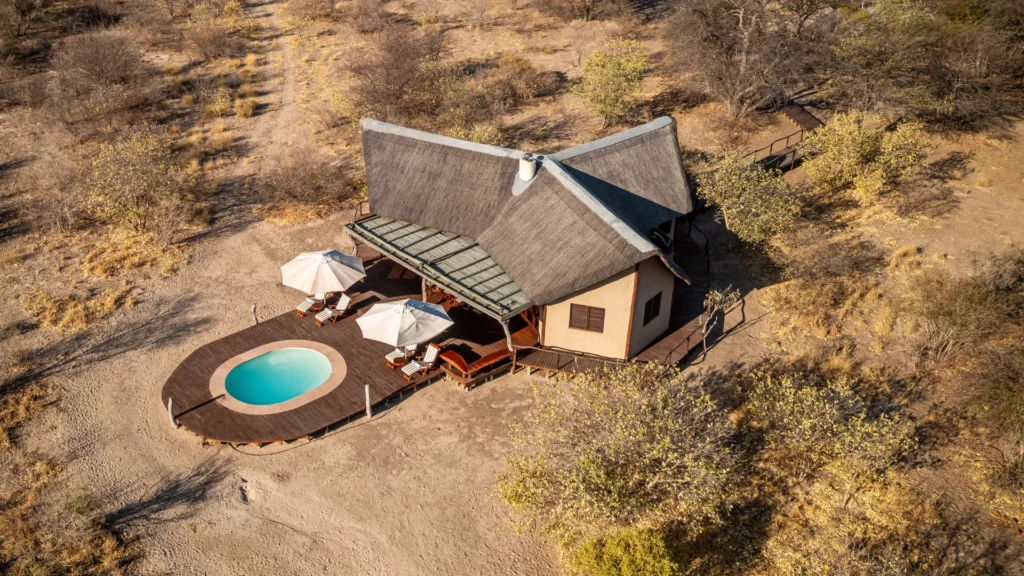
This guide walks you through every type of Central Kalahari Game Reserve accommodation – the two permanent camps inside the reserve, the luxury lodges on private reserves along its northern boundary, guided mobile camping safaris, the wild public campsites used by self-drive travellers, and the gateway towns of Maun, Rakops and Ghanzi. You will also find comparison tables, seasonal advice, cost guidance, booking tips and answers to the most common questions.
| CKGR Accommodation at a Glance
Location: Central Botswana, roughly 160–300 km south of Maun depending on gate Size: About 52,800 km² – one of the largest game reserves in the world Permanent camps inside the reserve: Two – Tau Pan Camp and Kalahari Plains Camp Boundary lodges: Several, on fenced private reserves along the northern edge (e.g. Gham Dhao, Dinaka, Deception Valley Lodge) Self-drive camping: Designated wild campsites only – advance booking is mandatory Best wildlife season: December to April (green season), when herds gather on the pans Access: Light-aircraft charter from Maun (about 45–60 minutes) or 4×4 self-drive |
Understanding Your Accommodation Options
Before comparing individual lodges, it helps to understand the five broad categories of accommodation in and around the Central Kalahari. Each offers a very different experience, price point and level of access to the reserve itself.
| Type | Where | Comfort | Typical Cost (pppn) | Ideal For |
| Permanent camp inside CKGR | Within reserve boundary | Comfortable to upmarket | US$600 – 1,200+ | Immersion, green-season game, remoteness |
| Private-reserve lodge | Northern boundary, fenced private land | Upmarket to luxury | US$450 – 1,000+ | Night drives, walks, families, flexibility |
| Guided mobile safari | Private sites inside CKGR | Simple to comfortable | US$250 – 700 | Adventure with a guide, multi-area routes |
| Self-drive campsite | Designated sites inside CKGR | Very basic, wild | US$10 – 50 + park fees | Experienced 4×4 travellers |
| Gateway town hotel | Maun, Rakops, Ghanzi | Budget to mid-range | US$40 – 200 | Overnight stops before/after the reserve |
Prices are indicative 2026/27 guides and vary by season, room category and operator. Inclusive camps usually cover meals, activities and some drinks; park fees and flights are often extra.
| Inside the Reserve vs. On the Boundary – Which Is Better?
Inside the CKGR: You wake up in the true wilderness, game drives start on your doorstep and the classic pans (Deception, Tau, Passarge) are within reach. However, national park rules apply – typically no night drives or off-road driving, and walking is limited to guided San-led or camp-based activities. On the northern boundary: Private reserves allow night drives, bush walks and sometimes quad biking, and lodges tend to have more facilities (pools, Wi-Fi, gyms). The trade-off: they are fenced, so wildlife densities and movements differ from the open reserve, and full-day excursions into the CKGR involve long drives. Our advice: For green-season predator action and a genuine sense of remoteness, stay inside. For dry-season trips, families or a softer introduction to the Kalahari, a boundary lodge is an excellent choice. Many travellers combine one of each. |
Luxury & Upmarket Camps Inside the Reserve
Only two permanent safari camps operate within the Central Kalahari Game Reserve itself. Both are small, solar-powered and fly-in friendly, and both place you right in the heart of the reserve’s most productive game areas.
Tau Pan Camp (Kwando Safaris)
Location: Tau Pan, north-western CKGR | Style: Thatched tented suites on a dune | Access: Fly-in or 4×4
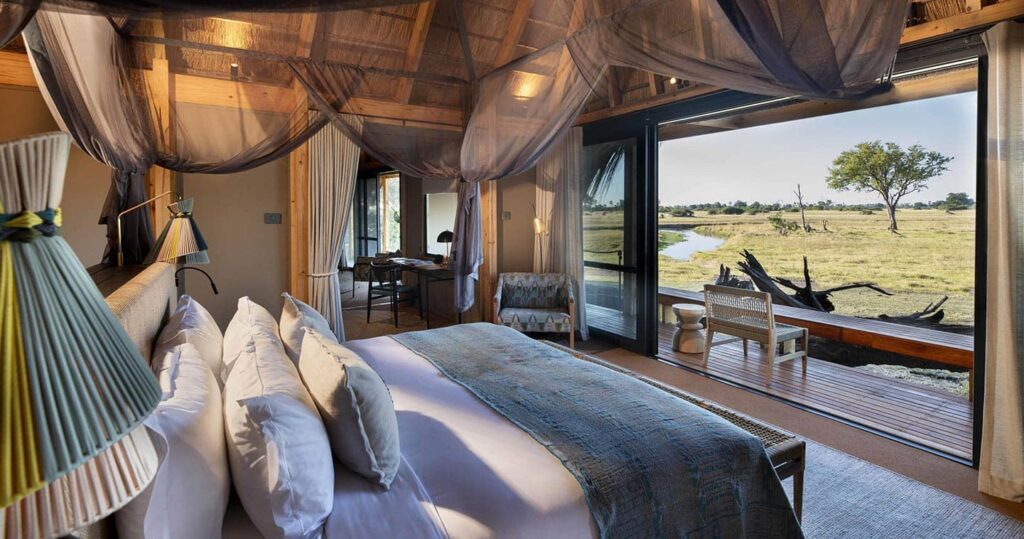
Tau Pan was the first permanent camp built inside the Central Kalahari, and it remains one of its most atmospheric places to stay. Perched on a sand ridge overlooking the wide, grassy Tau Pan, the camp enjoys sweeping views across one of the reserve’s best-known predator areas, and a waterhole in front of camp draws game throughout the day.
The tented rooms sit under thatched roofs on raised platforms, each with en-suite bathroom, indoor and outdoor shower, and a private veranda facing the pan. A central lounge and dining area, a swimming pool and a firepit complete the camp. Activities include morning and afternoon game drives across Tau, Passarge and Phokoje pans, guided walks with San trackers, and stargazing under some of the darkest skies in Africa.
Tau Pan is renowned for black-maned lion sightings, and summer brings large herds of springbok, gemsbok and red hartebeest, along with cheetahs, bat-eared foxes and raptors.
Best for: Travellers who want the classic Kalahari pan landscape, strong summer game viewing and a remote, authentic camp inside the reserve.
Kalahari Plains Camp (Wilderness)
Location: Near Deception Valley, north-eastern CKGR | Style: Raised canvas tents with rooftop sleep-outs | Access: Private airstrip, approx. 1 hour from Maun
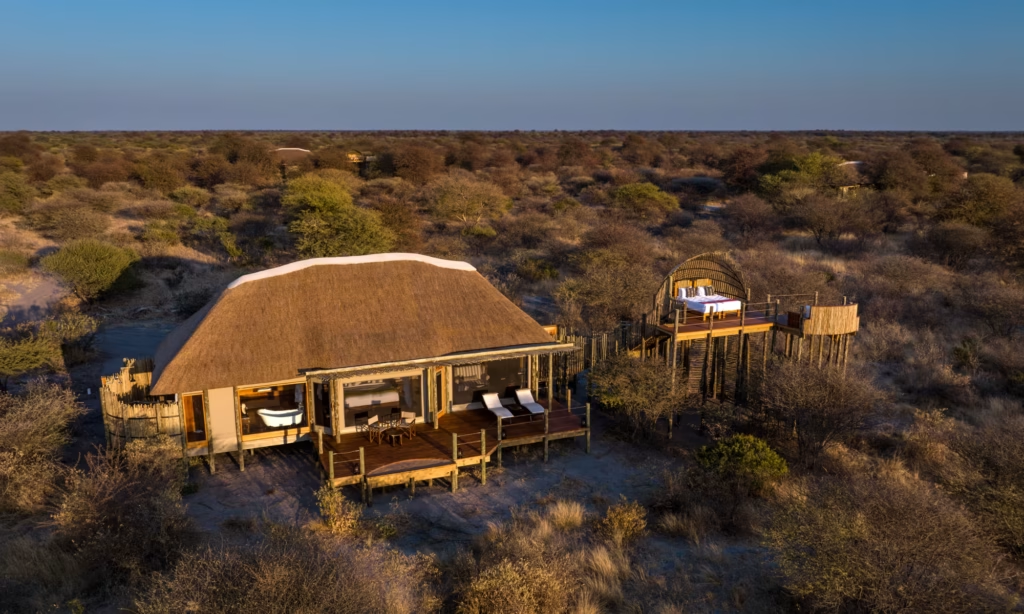
Wilderness’ only Kalahari property sits on the edge of an enormous open pan in the north-eastern section of the reserve, not far from the famous Deception Valley. It is a simple but beautifully designed eco-camp, run almost entirely on solar power, with an intimate number of canvas tents raised on wooden platforms to catch the breeze.
The highlight of each tent is a private rooftop sleep-out deck where you can spend the night under the stars – an unforgettable experience in a place with virtually no light pollution. Insulated canvas helps the rooms cope with the Kalahari’s temperature extremes, and the main area offers a lounge, dining deck, bar and plunge pool.
Activities include game drives, guided walks with San guides, a San cultural walk and stargazing. In the rainy months the surrounding plains attract thousands of springbok, gemsbok and wildebeest, with lions and cheetahs following close behind.
Best for: Green-season safaris, star-lovers, photographers and anyone combining the Kalahari with an Okavango Delta camp.
Lodges on the Northern Boundary
A cluster of private game reserves borders the CKGR to the north. These lodges are not technically inside the national reserve, but they share the same Kalahari landscape and wildlife, and most offer day excursions into the CKGR. Because they operate on private land, they can offer activities that are not permitted in the reserve.
Evolve Back Gham Dhao Lodge
Location: 11,000-hectare private reserve on the northern CKGR boundary | Style: Luxury tents | Capacity: Up to 20 guests | Access: Private licensed airstrip or 4×4
Formerly known as Haina Kalahari Lodge, Gham Dhao (“lion tracks” in the San language) was relaunched by the Indian hospitality group Evolve Back after a significant upgrade. The lodge overlooks a permanent waterhole and offers three categories of tent – Luxury, Superior and a Family tent – all raised on hardwood decks with en-suite bathrooms, indoor and outdoor showers and shaded verandas. Superior tents add thatched canopies and freestanding baths.
Facilities are among the most comprehensive in the Kalahari: a swimming pool and sundeck, boma for bush dinners, bar, gym, and Wi-Fi in the main area. The camp is powered by an expanded solar system.
Activities include day and night game drives, walks with resident San guides, cultural interactions, sundowners and quad-bike excursions, plus full-day trips into the CKGR’s Deception Valley area.
Best for: Families, honeymooners, first-time Kalahari visitors and travellers who want luxury comforts with cultural depth.
Dinaka Camp (Ker & Downey Botswana)
Location: Private game reserve on the northern CKGR boundary | Style: Spacious luxury tents facing a waterhole | Access: Fly-in or 4×4
One of the newer additions to the Kalahari lodge scene, Dinaka is operated by Ker & Downey Botswana, one of the country’s most established safari companies. The camp overlooks a productive waterhole, which becomes a magnet for wildlife in the dry months – meaning you can enjoy excellent sightings without leaving your veranda.
Tents are spacious and elegantly furnished, and the main area includes a lounge, dining area, swimming pool and a sunken hide near the waterhole for eye-level photography. Activities include day and night drives, guided walks, San cultural experiences and excursions into the adjacent CKGR.
Best for: Dry-season visitors, wildlife photographers and travellers who value polished, classic Botswana hospitality.
Deception Valley Lodge
Location: Private reserve bordering the north-eastern CKGR | Style: Thatched suites | Access: Fly-in or 4×4
Set in its own private reserve on the edge of the CKGR, Deception Valley Lodge is known for its warm, colonial-style design and especially strong San (Bushman) cultural experience. Spacious thatched suites offer private lounges, verandas and en-suite bathrooms with views over the surrounding bush.
Because it sits on private land, the lodge offers more flexible activities than camps inside the reserve, including night drives and guided bush walks with San trackers who share traditional knowledge of plants, tracking and survival in the desert. Day trips into the famous Deception Valley inside the CKGR can also be arranged.
Best for: Travellers who place culture alongside wildlife, couples and those seeking comfortable, well-rounded Kalahari stays.
Guided Mobile Camping Safaris
Mobile safaris are one of the most rewarding ways to experience the Central Kalahari. A professional guide and back-up crew drive you through the reserve and set up camp at designated private sites, moving between areas such as Deception Valley, Passarge Valley and Piper Pan over several nights.
Mobile options range from participation trips (where guests help pitch tents) to fully serviced private mobile camps with walk-in dome tents, proper beds, en-suite bucket showers and chemical toilets, and a dedicated chef. Because the guide handles navigation, vehicle recovery and logistics, you enjoy the freedom of a self-drive trip without the risk.
| Mobile Style | What You Get | Indicative Cost (pppn) |
| Participation safari | Small dome tents, shared chores, group departures | US$150 – 300 |
| Fully serviced (scheduled) | Walk-in tents, beds, camp staff, set departures | US$300 – 550 |
| Private mobile camp | Exclusive guide, vehicle, crew and tailored route | US$500 – 900+ |
| Why Choose a Mobile Safari?
You can explore several regions of the reserve on one trip, rather than relying on day drives from a single base. Expert guides know where lions and cheetahs have been moving and how to tackle deep Kalahari sand safely. It offers an authentic, close-to-nature camping experience at a lower cost than permanent lodges. |
Self-Drive Campsites in the Central Kalahari
For experienced 4×4 travellers, camping in the CKGR is the ultimate Kalahari adventure. The reserve has a network of designated wild campsites spread across its main areas. Each site is usually isolated from others, so you often have an entire pan or valley to yourself after dark.
What to Expect at CKGR Campsites
- Very basic facilities: Most sites have a cleared area, a fire pit and, at some, a drop toilet and a raised water-tank shower frame. There is generally no running water.
- Total self-sufficiency: There is no fuel, food, water or firewood for sale inside the reserve. Carry everything you need, including at least 5–7 litres of water per person per day.
- Unfenced sites: Lions, hyenas and other wildlife move freely through camp. Rooftop tents are popular for this reason.
- Booking is mandatory: Rangers at the gates will not let you in without a confirmed campsite reservation for every night of your stay.
- Who runs them: Some campsites are booked through the Department of Wildlife and National Parks (DWNP) reservations offices in Gaborone and Maun, while others are operated by private concessionaires. Always confirm the current operator when booking, as concessions change.
Main Camping Areas Compared
| Area | Highlights | Character | Nearest Gate |
| Deception Valley | Classic fossil valley, lions, cheetahs, springbok herds | Most visited; sites closer together | Matswere |
| Kori Pan | Views over Deception area, good predator activity | Popular, scenic, slightly more private | Matswere |
| Sunday Pan & Leopard Pan | Waterhole, lions, gemsbok, dune-top sites | Excellent, highly sought-after | Matswere |
| Passarge Valley | Long scenic valley, plains game, raptors | Peaceful and remote | Matswere / Tsau |
| Piper Pan | Waterhole, large pans, frequent lion sightings | Shady, scenic, a favourite with repeat visitors | Matswere / Xade |
| Letiahau | Waterhole between Deception and Piper | Quiet, good for wildlife-watching | Matswere |
| Motopi Pan | Northern pans and waterhole | Remote, low traffic | Tsau |
| Xade (south) | Wild, rarely visited south | Very remote; low game density | Xade |
| Self-Drive Essentials for CKGR Camping
Vehicle: High-clearance 4×4 with low range is compulsory. Deflate tyres for deep sand and carry a compressor. Convoy: Travelling with at least two vehicles is strongly recommended. Fuel: Fill up fully in Maun, Rakops or Ghanzi. Long-range tanks or jerry cans are essential – sand driving can double consumption. Recovery & safety: Recovery kit, spare tyres, puncture repair, first-aid kit and a satellite phone or satellite communicator. Booking window: Popular sites (Sunday Pan, Piper Pan, Kori) are often booked many months ahead – reserve as soon as your dates are fixed. |
Gateway Towns: Where to Stay Before and After
Most travellers need at least one overnight stop on the way into or out of the CKGR. Your gateway will depend on which gate you plan to use.
Maun
Botswana’s safari capital is the main hub for fly-in trips and the most common starting point for self-drivers using Matswere Gate. Maun offers a wide choice of riverside lodges, guesthouses and campsites along the Thamalakane River, plus supermarkets, fuel, vehicle hire and outfitters. Plan to stock up fully here.
Rakops
This small village near Matswere Gate is the closest settlement to the north-eastern entrance. Facilities are limited to basic lodging and supplies, and fuel can be unreliable, so many self-drivers fill up in Maun or Mopipi and drive straight through.
Ghanzi
The “capital of the Kalahari” serves travellers entering through the western Tsau Gate or Xade Gate, and those crossing from Namibia. Options include the long-established Kalahari Arms Hotel in town, as well as farm-based lodges and San community-run lodges in the surrounding area that offer authentic cultural experiences.
Lodge Comparison Table
| Property | Position | Style | Night Drives | Price Guide |
| Tau Pan Camp | Inside CKGR | Thatched tents, pool | No (park rules) | $$$ |
| Kalahari Plains Camp | Inside CKGR | Tents + rooftop sleep-outs | No (park rules) | $$$ |
| Gham Dhao Lodge | Northern boundary | Luxury tents, pool, gym | Yes | $$$ |
| Dinaka Camp | Northern boundary | Luxury tents, hide | Yes | $$$ |
| Deception Valley Lodge | Northern boundary | Thatched suites | Yes | $$ – $$$ |
| Mobile safari | Inside CKGR | Serviced camping | No | $ – $$$ |
| Public campsites | Inside CKGR | Wild, self-catering | No | $ |
$ = under US$100 pppn | $$ = US$300–600 | $$$ = US$600+. Policies on night drives depend on location: they are generally not permitted inside the national reserve but are offered on private land.
Best Time to Visit and How It Affects Your Stay
| Season | Months | Conditions | Accommodation Tip |
| Green season | Dec – Apr | Rains bring fresh grass; herds and predators gather on the pans | Peak time for camps inside the reserve; book early |
| Early dry | May – Jun | Pleasant days, cooling nights, game starts dispersing | Good value; mix inside and boundary stays |
| Cold dry | Jul – Aug | Clear skies, near-freezing nights | Boundary lodges with waterholes shine; pack warm layers |
| Hot dry | Sep – Nov | Very hot, dusty, game concentrated at waterholes | Choose camps with pools and waterholes; consider shorter stays |
Getting to Your Accommodation
By Light Aircraft
Scheduled and private charter flights from Maun to the airstrips at Tau Pan, Kalahari Plains, Gham Dhao and other camps typically take 45 to 60 minutes. Flying is by far the most practical option for lodge-based trips and allows easy combination with the Okavango Delta, Moremi or Makgadikgadi. Note the soft-bag luggage limits on light aircraft – usually around 20 kg per person including hand luggage.
By Road
Self-drivers usually enter via Matswere Gate in the north-east (roughly a 4–6 hour drive from Maun, the final stretch on sand) or Tsau Gate in the west (via Ghanzi). Xade Gate in the south-west is the most remote. Boundary lodges can also be reached by 4×4 on sand tracks; ask your lodge for directions and GPS coordinates, as signage is minimal.
Accommodation Costs and Budget Planning
| Cost Item | Budget | Mid-Range | Luxury |
| Accommodation (pppn) | US$10 – 50 (camping) | US$300 – 600 | US$600 – 1,500+ |
| Meals & activities | Self-catered | Usually included | Included |
| Park entry & vehicle fees | Paid at gate/DWNP | Often extra | Often included |
| Flights from Maun | N/A (self-drive) | US$250 – 450 one-way | Charter, included or extra |
| 4×4 rental with camping kit | US$120 – 250 per day | N/A | N/A |
Botswana’s DWNP fees are charged per person per day plus a vehicle fee, with different rates for citizens, residents and international visitors. Tariffs are reviewed periodically, so confirm current rates when booking.
Booking Tips for Central Kalahari Accommodation
- Book early: With only two permanent camps inside the reserve and a limited number of boundary lodges, rooms for the December–April green season can sell out 9–12 months ahead.
- Stay at least three nights: Distances are vast and game moves widely. Three nights lets you explore more than one pan system.
- Combine habitats: Pair the dry Kalahari with a water-based camp in the Okavango Delta or Chobe for a well-rounded Botswana safari.
- Ask about inclusions: Check whether park fees, drinks, laundry, transfers and cultural activities are included in the nightly rate.
- Consider shoulder months: May–June and November often bring better rates and fewer visitors.
- Use a specialist: A Botswana safari specialist can coordinate flights, campsite bookings and lodge availability in a single itinerary.
Sample Accommodation Combinations
| Trip Style | Nights | Suggested Combination |
| Luxury fly-in | 3 | Tau Pan Camp or Kalahari Plains Camp (green season) – add 3 nights in the Okavango Delta |
| Inside + boundary | 4 | 2 nights Kalahari Plains Camp + 2 nights Gham Dhao or Dinaka for night drives and walks |
| Family-friendly | 3 | Gham Dhao Lodge (family tent) with a full-day CKGR excursion |
| Self-drive adventure | 5 | Kori Pan (2) – Piper Pan (2) – Sunday Pan (1), entering and exiting via Matswere Gate |
| Guided mobile | 4 – 6 | Deception Valley – Passarge Valley – Piper Pan with a serviced mobile operator |
What to Pack for a Kalahari Stay
- Layered clothing in neutral colours – days can be hot while winter nights drop close to freezing
- A warm fleece, beanie and gloves for early-morning and night activities (May–August)
- Wide-brimmed hat, sunglasses, high-SPF sunscreen and lip balm
- Binoculars and a camera with a telephoto lens; spare batteries and a power bank
- Headlamp or torch for moving around camp after dark
- Soft-sided duffel bag if flying in on light aircraft
- For campers: water containers, cooler/fridge, gas stove, firewood, rubbish bags and full recovery gear
Frequently Asked Questions
How many lodges are inside the Central Kalahari Game Reserve?
Only two permanent camps operate inside the reserve: Tau Pan Camp and Kalahari Plains Camp. Several other lodges, including Gham Dhao, Dinaka and Deception Valley Lodge, sit on private reserves along the northern boundary.
Can I camp anywhere in the CKGR?
No. Camping is permitted only at designated, pre-booked campsites. You must present confirmed reservations for every night at the entry gate.
Are the campsites fenced?
No. CKGR campsites are completely unfenced, and lions, hyenas and other wildlife regularly pass through. Stay alert, keep food secured and never sleep in the open.
Which is better – a lodge inside the reserve or on the boundary?
Inside camps offer the most authentic wilderness and the best green-season game viewing. Boundary lodges offer night drives, walks and more facilities. Combining both gives you the best of each.
Is the Central Kalahari suitable for children?
Yes, at selected lodges. Gham Dhao Lodge offers a family tent, and many boundary lodges welcome families. Some camps set minimum ages for certain activities, so check policies before booking.
Do Kalahari lodges have Wi-Fi and electricity?
Most camps run on solar power with charging points in rooms or the main area. Wi-Fi is available at some lodges (such as Gham Dhao) but is often limited. Public campsites have no electricity or connectivity.
How far in advance should I book?
For the December–April green season and popular campsites, book 9–12 months ahead. Shoulder-season trips can often be arranged with a few months’ notice.
Can I visit the CKGR as a day trip?
Day visits are possible from boundary lodges and from Rakops or nearby camps, but the reserve’s size means an overnight stay is far more rewarding.
Final Thoughts
Choosing the right Central Kalahari Game Reserve accommodation is the key to unlocking one of Africa’s most extraordinary wilderness areas. Whether you fall asleep on a rooftop sleep-out at Kalahari Plains Camp, watch lions from your veranda at Tau Pan, enjoy night drives from Gham Dhao or Dinaka, or pitch your rooftop tent beside Piper Pan, the Kalahari rewards those who take time to stay and listen to the desert.
| Plan Your Central Kalahari Safari with Marriott Safaris Africa
Our Botswana specialists can match you with the right camp or campsite for your travel dates, budget and interests – and seamlessly combine the Kalahari with the Okavango Delta, Chobe, Makgadikgadi and Victoria Falls. Fly-in lodge safaris • Guided mobile camping • Fully equipped 4×4 self-drive with rooftop tents Marriott Safaris Africa – Perfection Anytime |