
4 day Okavango Delta Safari Tour
4 day Okavango Delta Safari Tour, the Okavango Delta is one of the world’s most extraordinary wildlife destinations — a UNESCO World Heritage Site and one of the Seven Natural Wonders of Africa. Unlike most river systems that flow into the sea, the Okavango River flows inland into the heart of the Kalahari Desert, creating an immense, labyrinthine wetland ecosystem that teems with life.
Covering approximately 15,000 square kilometers during peak flood season (May–August), the Delta is a mosaic of crystal-clear channels, papyrus reed beds, lily-covered lagoons, wooded islands, and vast floodplains. It supports some of the highest concentrations of elephants, hippos, crocodiles, lions, leopards, wild dogs, and thousands of bird species on the entire African continent.

This 4-day itinerary is carefully designed to showcase the Delta’s most iconic experiences: gliding silently through channels on traditional mokoro dugout canoes, tracking lion and wild dog on morning game drives, walking with expert guides through ancient island ecosystems, and drifting along in a motorised boat as elephants bathe at sunset. Every moment in the Okavango is pure, unfiltered Africa.
Tour Highlights
- Mokoro canoe excursions through papyrus channels — the quintessential Delta experience
- Morning and evening game drives across floodplains rich with elephant, lion & wild dog
- Guided walking safaris on remote islands — connect with the bush on foot
- Boat safaris at sunset watching hippos, crocs, and elephants bathing
- Birdwatching bonanza: 400+ species including Pel’s fishing owl & African fish eagle
- Stay in exclusive tented camps and lodges set deep in the Delta wilderness
- Sundowner drinks overlooking seasonal floodplains under vast Botswana skies
- Fly-in access to remote areas inaccessible by road — the true unspoiled Delta
| DAY 1 |
Arrival in Maun & Transfer to the DeltaMaun → Okavango Delta Camp — ~1.5 hrs by light aircraft |
Morning – Arrival & Welcome
Your Okavango Delta adventure begins at Sir Seretse Khama International Airport in Maun — the gateway to the Delta and one of the busiest light aircraft hubs in Africa. Upon arrival, you will be met by your Marriott Safaris Africa representative, who will assist with any final formalities and escort you to the domestic terminal.
Take time to explore Maun briefly — a frontier town that feels like the Wild West of Africa. Browse local crafts at the village market, enjoy a light breakfast at one of the riverside lodges along the Thamalakane River, and watch the steady stream of Cessna 206s and twin-engine Britten-Normans taking off toward the Delta. The energy is infectious.
Late Morning – Fly-In to Camp
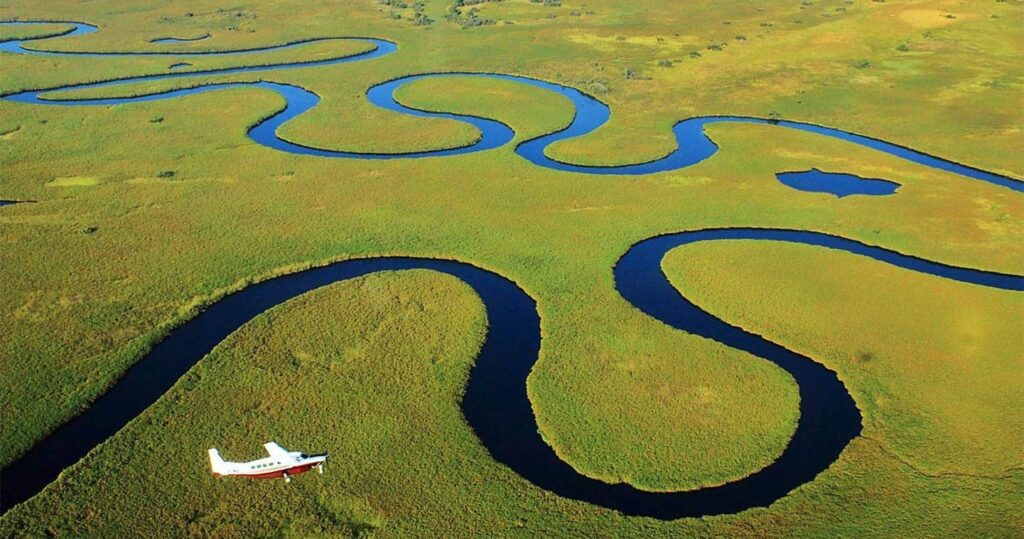
At the appointed time, you will be transferred to Maun Airport’s light aircraft terminal for your scenic fly-in to your Delta camp. This 20–40 minute flight is itself a highlight of the safari. As your small aircraft climbs above the Kalahari scrub, the Delta comes into view — a shimmering, emerald green labyrinth of waterways and palm-studded islands stretching to the horizon. Your guide will point out elephants, hippo pools, and large herds of buffalo visible from the air.
Midday – Camp Arrival & Orientation
Touch down on a private bush airstrip and be welcomed with a cool towel and refreshments by your camp hosts. Most camps in the Okavango are small, intimate, and deliberately designed to blend into their surroundings — raised timber walkways, canvas-walled rooms open to the sounds of the bush, private plunge pools overlooking lagoons, and meals served under African star skies.
Your lead guide will conduct a thorough camp orientation: safety briefing, explanation of wildlife protocols (what to do if you encounter an elephant on the walkway at night), meal schedules, and an overview of activities planned for the coming days. Enjoy a sumptuous three-course lunch in the open-air dining area.
Afternoon – First Mokoro Excursion
After a short rest, your introduction to the Delta begins with an afternoon mokoro excursion. A mokoro (plural: mekoro) is a traditional dugout canoe, hand-carved from a Kigelia sausage tree or constructed from fibreglass in conservation-conscious camps. You recline low in the bow as your poler — a local Bayei tribesman who has grown up on these waterways — stands at the stern and propels you silently through the channels using a long ngashi (pole).
Gliding inches above the water surface, the Delta reveals itself at eye level. Lily pads crowd the shallows, their white and purple flowers opening in the late afternoon light. Reed frogs cling to papyrus stems. Malachite kingfishers flash electric-blue past the bow. Your poler communicates in whispers, pointing to a hippo submerged beneath the surface just metres away — only its ears and nostrils visible. This is the Delta as it has been experienced for centuries.
The excursion typically lasts 2–3 hours, ending at a secluded sandbank or island for a sundowner — cold gin and tonic or local beer served as the sky turns amber and gold over the papyrus beds.
Evening – Dinner & Night Sounds
Return to camp by mokoro or on foot (accompanied by a guide) as the Delta comes alive with the sounds of the night: hippos beginning their nightly graze, the haunting cry of the African fish eagle, the booming chorus of reed frogs. Dinner is a gourmet affair — three or four courses reflecting southern African cuisine, from braised game stew to fresh bream from the Delta’s channels, served around a communal fire.
Your guide will brief you on tomorrow’s early game drive while a stunning canopy of southern hemisphere stars blankets the camp. Retire to your luxury tent and fall asleep to the sounds of hippos, crickets, and distant lions — the pure soundtrack of wilderness Africa.
| DAY 2 |
Game Drives, Walking Safari & Boat SafariFull Day in the Delta — Land, Water & Sky |
Pre-Dawn – Early Morning Game Drive
Rise before dawn to the sound of a gentle knock on your tent and the welcome aroma of freshly brewed coffee delivered by your room attendant. This is arguably the most important moment of any safari — the hour before sunrise, when the bush is coolest, most active, and most atmospheric.
Board your open-sided 4×4 game drive vehicle for a pre-dawn departure. Your professional guide drives with expert precision, spotlight in hand, scanning the grasslands and mopane woodland edges. The Delta at night belongs to the predators: leopards returning from nocturnal hunts, spotted hyenas patrolling territories, and — if you are very fortunate — African wild dogs settling after a night chase.
As sunrise breaks across the floodplains, the landscape transforms in extraordinary golden light. Herds of red lechwe — the Delta’s signature antelope, specially adapted for wading — splash through shallow water. Wattled cranes stalk the grasslands. Buffalo herds numbering hundreds move in dark masses through the mopane. Your guide reads tracks, dung, and behaviour with the instincts of someone who has spent their whole life in this ecosystem.
Key species to look for on morning game drives include: African elephant (huge herds common in the dry season), lion (prides regularly sighted on the larger islands), leopard (elusive but frequently spotted in riparian woodland), spotted hyena, African wild dog, hippo, Nile crocodile, tsessebe, giraffe, zebra, impala, kudu, steenbok, warthog, and serval.
Mid-Morning – Breakfast in the Bush
After 2–3 hours of game viewing, your guide will lead you to a pre-prepared bush breakfast site — a clearing beside a waterhole, a shady sycamore fig grove, or a raised termite mound with sweeping views. Here, the camp’s kitchen team has laid out a full spread: fresh fruit, yoghurt, muesli, scrambled eggs, bacon, toast, freshly squeezed juice, and excellent coffee.
These bush breakfast moments are among the most memorable of any safari. With no glass between you and the wilderness, you eat as giraffes browse acacia trees in the middle distance and ground hornbills march past in their stately fashion. Your guide points out termite mound architecture, explains how the fig tree feeds more species than almost any other tree in Africa, and answers every question about the ecosystem with encyclopaedic knowledge.
Late Morning – Guided Walking Safari
Return to camp briefly before embarking on a guided walking safari — one of the most profound wildlife experiences available in the Okavango. Accompanied by your lead guide (carrying a licensed .375 calibre rifle, a last-resort safety measure) and an assistant guide, you set off on foot across the island’s interior.
Walking in the bush transforms your perception of scale and detail. Tracks you would miss from a vehicle are suddenly vivid in the sand — a leopard’s pugmark here, a honey badger’s digging beside a termite mound there, the slithering trail of a rock monitor leading to the lagoon edge. Your guide reads the landscape like a book.
Botanical wonders of the Okavango reveal themselves on foot: the medicinal uses of the shepherd’s tree, how the knob-thorn acacia’s thorns are hollowed by ants for shelter, the mystery of the ‘snake bean’ sausage tree whose fruit can weigh 10 kilograms. You may walk to within 30 metres of a feeding giraffe, or observe a breeding herd of elephants from downwind at a respectful distance — an encounter of extraordinary intimacy.
Afternoon – Rest, then Sunset Boat Safari
Return to camp for a three-course lunch, followed by the sacred African safari institution of the afternoon rest. In the heat of the Botswana day (temperatures can reach 35°C in October), even the animals retreat to shade. Sleep in your tent, read in a hammock by the plunge pool, or ask your guide to show you the camp’s resident birds — the lilac-breasted rollers, green wood-hoopoes, and red-billed hornbills that inhabit the trees overhead.
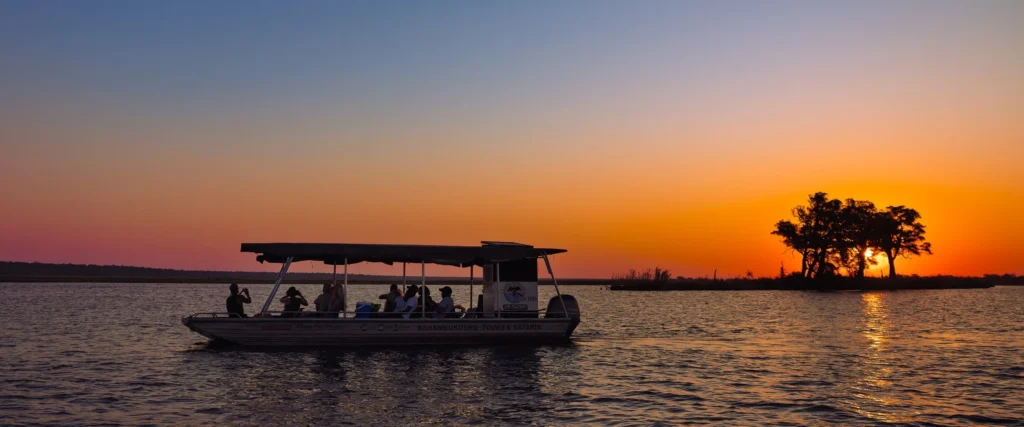
At 3:30pm, board the camp’s motorized pontoon boat for an afternoon and sunset boat safari — a completely different dimension of the Delta experience. Moving through deeper channels and open lagoons, the boat allows you to approach hippo pods at close range (safely, with an experienced guide navigating the approach), watch Nile crocodiles basking on sandbars, and observe the extraordinary spectacle of elephant herds wading or swimming across channels.
As the afternoon light turns golden, keep binoculars trained on the papyrus fringes for the elusive Pel’s fishing owl — a massive, tawny owl rarely seen outside the Delta — and for the African pygmy goose, one of the smallest waterfowl in the world. The bird diversity on a single boat safari can number 60–80 species in a few hours.
Sundowner drinks are served afloat as the orange sun sinks into the papyrus horizon. Hippos yawn and grunt. Fish eagles call from dead trees on the channel edge. It is, quite simply, one of the most beautiful scenes in the natural world.
| DAY 3 |
Island Exploration & Wild Dog TrackingChief’s Island & Moremi Game Reserve |
Early Morning – Chief’s Island Fly-Camp
Day three explores one of the crown jewels of the Okavango: Chief’s Island, the largest island in the Delta (65 kilometres long) and the heart of Moremi Game Reserve — the only protected area within the Delta itself. A short flight or motorised boat transfer brings you to the island’s interior, where predator densities are among the highest in Botswana.
Chief’s Island is legendary for its wild dog sightings. The African wild dog (Lycaon pictus) is Africa’s most endangered large carnivore, with fewer than 6,000 remaining on the continent. The Okavango Delta holds one of the highest densities of wild dog packs on earth, and your guide will use recent tracking data from the camp’s network to locate a pack that has been radiocollared by the Botswana Wild Dog Research Project.
Observing a wild dog hunt is one of the most breathtaking spectacles in African wildlife. With a success rate of 80% (compared to a lion’s 30%), these coursing predators operate with extraordinary teamwork, communication, and speed. Watching a pack of 12–15 dogs fan out across a grassland, communicating with high-pitched twittering calls, and coordinate a chase at 60 kilometres per hour leaves every witness speechless.
Mid-Morning – Tracking & Habitat Study
After the game drive, your guide leads a focused tracking walk in the mopane scrubland — reading the morning’s story told in the sand. Fresh lion paw prints beside a waterhole. The scattered feathers of a red lechwe kill from last night. The drag marks where something was hauled into a thicket. These forensic clues paint a picture of the Delta’s 24-hour drama in extraordinary detail.
Your guide explains the ecological relationship between the Delta’s key species: how hippos create the channels that mekoro use; how elephants break down papyrus reed beds to create open lagoons that support fish and birds; how wild dogs suppress impala populations, which in turn allows riverine woodland to regenerate along channel banks. The Okavango is a masterwork of ecological interdependence, and understanding its connections transforms every sighting from mere animal-spotting to deep ecological appreciation.
Afternoon – Traditional Village Experience
In the afternoon, your guide arranges a visit to a nearby Bayei or Hambukushu fishing village — communities whose people have lived in and around the Delta for centuries. The Bayei are renowned mokoro polers whose intimate knowledge of the waterways has been passed down through generations; the Hambukushu are traditional fishers who use elaborate reed fish traps still made by hand.
This is not a staged cultural performance — it is a genuine interaction with community members who continue to live alongside one of Africa’s greatest wild places. You will see how mokoro are carved by hand from fallen sausage tree trunks, observe traditional basket-weaving (Botswana baskets are among the finest woven crafts in Africa), watch how fish traps are constructed and set, and share tea or sorghum beer with village elders who remember the Delta before eco-tourism changed everything.
Purchases made directly from artisans ensure income goes directly into the community — beautifully woven baskets, hand-carved wooden animals, and beaded jewellery make meaningful souvenirs that support conservation-linked livelihoods.
Evening – Night Drive & Stargazing
As darkness falls, your guide equips the vehicle with a powerful spotlight for a night drive — an entirely different wildlife experience. The Okavango at night reveals species rarely seen in daylight: aardvark snuffling around termite mounds, spring hare bounding through the headlights, African civet slinking through the undergrowth, and porcupine rattling their quills in alarm.
Night drives in the Delta are also one of the finest birdwatching experiences for nocturnal species: Verreaux’s eagle owl (the largest owl in Africa) perching imperiously above the road; fiery-necked nightjars calling their distinctive ‘Good Lord deliver us’ from every thicket; and barn owls hunting the floodplain edges in ghostly silence.
After the night drive, your guide sets up a stargazing session far from any light pollution. In a country with one of the lowest population densities on earth, the Botswana night sky is staggering — the Milky Way an unbroken band of light, the Magellanic Clouds visible to the naked eye, the Southern Cross rotating above the southern horizon. Over a glass of red wine, your guide will point out the navigational stars used by the Bayei for millennia.
DAY 4 |
Final Morning Safari & DepartureLast Game Drive → Maun → Onward Connections |
Pre-Dawn – Farewell Game Drive
There is something bittersweet about the final morning of any great safari — you have barely scratched the surface, and yet you leave carrying memories that will last a lifetime. Rise one last time before dawn and board the vehicle with a mix of anticipation and nostalgia. The bush offers no guarantees, but it consistently delivers something extraordinary on farewell mornings, as if the Delta itself understands the weight of the moment.
Your guide will make the most of this final drive — heading to waterholes known to attract predators in the early morning heat, exploring channels where crocodiles haul out on banks to warm in the first sun, and tracking the movements of a lion pride whose roars echoed through camp last night. These are the moments that define a safari: unhurried, unpredictable, and utterly alive.
The Delta never repeats itself. Seasonal floods change channel courses, elephants push through new paths, wild dog packs shift their ranges. Every visit is unique, and the greatest testimonial to the Okavango experience is that almost everyone who leaves already wants to come back.
Mid-Morning – Camp Farewell & Check-Out
Return to camp for a full cooked breakfast and the bittersweet business of packing. Your camp team will ensure bags are weighed and packed within light aircraft limits (typically 20kg soft-bag per person, with excess storage available in Maun). Exchange details with guides who have become, over four days, something close to friends — their knowledge, humour, and passion for the ecosystem they were born into leaves a lasting impression.
Sign your conservation levy receipt — a portion of every camp rate goes directly to anti-poaching, community conservation, and Botswana’s government wildlife fund, one of the best-funded in Africa. Botswana’s commitment to high-value, low-volume tourism has made it the model for conservation-linked safari development on the continent.
Late Morning – Fly-Out to Maun
Board your light aircraft for the return scenic flight to Maun. Look down one last time at the Delta spreading below — the channel patterns, the islands, the glinting waterways — and trace the route of your mokoro excursions from the air. From above, the sheer scale of this wilderness becomes fully apparent: an inland sea in the middle of a desert, sustained by 15,000 kilometres of river flowing from the Angolan highlands, supporting millions of animals and dozens of human communities.
Touch down in Maun with enough time for a light lunch at one of the riverside restaurants before onward connections. Maun Airport offers domestic connections to Kasane (Chobe National Park), Johannesburg (South Africa), and Nairobi (Kenya), making it easy to extend your safari experience into neighbouring countries.
Onward Safari Options — Extend Your Experience
Guests wishing to extend their journey may combine this Okavango itinerary with:
- Chobe National Park (2–3 days) — the world’s largest elephant population and legendary boat safaris on the Chobe River
- Victoria Falls, Zimbabwe (2 days) — one of the Seven Natural Wonders of the World, just 1 hour by air from Maun
- Central Kalahari Game Reserve (2–3 days) — the world’s second-largest wildlife reserve, famous for black-maned Kalahari lions
- Nxai Pan National Park (2 days) — ancient baobab groves and Baines’ Baobabs, one of Africa’s most iconic landscapes
WHAT’S INCLUDED & EXCLUDED
✔ Included in Your Tour Package
- Return light aircraft transfers between Maun and your Delta camp
- All accommodation in luxury tented camps (3 nights)
- All meals from arrival dinner to departure breakfast (full board)
- All alcoholic and non-alcoholic beverages in camp and on safari
- Unlimited game activities: game drives, mokoro excursions, boat safaris, walking safaris, night drives
- Professional BOGA (Botswana Official Guides Association) certified guide throughout
- Laundry service (daily)
- Airstrip transfers in Maun
- All conservation and park fees (Moremi Game Reserve, Delta levies)
- Emergency evacuation insurance via MARS (Medical Air Rescue Service)
✘ Not Included
- International or regional flights to/from Maun
- Visas and travel insurance (strongly recommended — available on request)
- Personal items, curio shop purchases, and gratuities
- Spa treatments at camps offering wellness facilities
- Excess baggage above the 20kg light aircraft limit
PRACTICAL INFORMATION
Best Time to Visit
The Okavango Delta offers compelling safari experiences year-round, but the character of the visit changes dramatically with the season:
- May – August (Flood Peak & Dry Season): The annual flood from Angolan rains peaks in July–August, filling channels to maximum extent. Mekoro excursions are spectacular. Wildlife concentrations highest as water attracts animals from across the Kalahari. Temperatures mild (15–25°C). Peak season — book 6–12 months in advance.
- September – November (Late Dry Season): Water levels dropping but wildlife exceptional — animals concentrated at permanent water sources. Predator sightings peak. Temperatures hot (30–38°C). Slightly lower rates than peak season.
- December – April (Green Season): Summer rainfall brings dramatic skies and lush vegetation. Fewer tourists, lower rates, outstanding birding (migratory species arrive), resident animals with young. Some areas temporarily inaccessible. An underrated and intimate time to visit.
Packing & Clothing
- Clothing: Neutral colours (khaki, olive, tan, grey) — no bright colours or white in the bush. Layers essential for cool mornings.
- Footwear: Closed-toe walking shoes or light boots for walking safaris. Sandals for camp.
- Sun protection: High-SPF sunscreen, wide-brimmed hat, UV-protective sunglasses.
- Optics: Binoculars essential (8×42 recommended). Camera with telephoto lens if possible.
- Luggage: Soft-sided bags only for light aircraft (no hard-shell suitcases). 20kg limit strictly enforced.
- Medications: Malaria prophylaxis strongly recommended — consult your physician 6 weeks before travel.
Health & Safety
Botswana is a stable, well-governed country with excellent infrastructure for safari tourism. Maun has a good private hospital. All camps have first-aid facilities and direct radio contact with MARS (Medical Air Rescue Service) for emergency evacuation. Malaria is present in the Delta year-round — consult your doctor regarding prophylaxis. Tap water in camps is safe to drink. Wildlife safety briefings are provided at each camp and must be followed at all times.
Visa & Entry Requirements
Citizens of most European, North American, and Commonwealth countries receive a free 30-day tourist visa on arrival at Maun International Airport. South African, Zimbabwean, Zambian, and Namibian citizens have full visa-free access. All visitors require a valid passport with at least 6 months’ validity and two blank pages. A yellow fever vaccination certificate is required if arriving from a yellow fever endemic country.
BOOKING & CONTACT
To book this safari, request a custom quote, or enquire about private departures and tailored extensions, contact the Marriott Safaris Africa reservations team