
Morning Game Drive in Serengeti National Park
Morning Game Drive in Serengeti National Park, there is no better time to be on the Serengeti plains than the first hours after sunrise. The air is cool, the light is soft and golden, and the park’s predators are still active from the night’s hunt. Lions lie bloated beside fresh kills, cheetahs scan the grass from termite mounds, hyenas trot back to their dens, and vast herds of wildebeest and zebra begin to move toward water. A morning game drive in Serengeti National Park is, for many travellers, the single most rewarding experience of a Tanzania safari.
This guide walks you through a complete morning game drive itinerary, from the pre-dawn wake-up call to the late-morning return to camp. It also covers the best areas to drive depending on the season and the Great Migration, what wildlife to expect, current park fees, what to pack, photography advice, park rules for self-drive visitors, and answers to the most common questions.
Morning Game Drive at a Glance
| Detail | Information |
| Duration | 4 to 6 hours (typically 6:00 AM to 11:00 AM or 12:00 PM) |
| Best starting time | As the park opens at 6:00 AM, just before sunrise (sunrise is around 6:15 to 6:45 AM year-round) |
| Prime wildlife window | 6:00 AM to 9:30 AM, when predators are most active and light is best |
| Top areas | Seronera Valley (all year), Ndutu and the southern plains (Dec to Mar), Western Corridor (May to Jul), Northern Serengeti and the Mara River (Jul to Oct) |
| Vehicle | 4×4 safari Land Cruiser with pop-up roof, or a self-drive 4×4 with high clearance |
| Breakfast | Packed bush breakfast at a designated picnic site, or a return to camp |
| Park entry (non-resident adult) | Around US$70 + 18% VAT (about US$82.60) per 24 hours |
| Difficulty | Easy; suitable for children and older travellers |
| Why Go in the Morning?
Most of the Serengeti’s big cats hunt at night and in the cool hours around dawn. By mid-morning, temperatures rise and lions, leopards and cheetahs retreat into shade where they are harder to spot. Starting early gives you the highest chance of seeing predators active, possibly even on a hunt, and the low golden light produces the best photographs of the day. |
Hour-by-Hour Morning Game Drive Itinerary
The timings below are based on a game drive departing from a lodge or tented camp in the central Serengeti (Seronera area). Your guide will adjust the route on the day based on recent sightings, radio reports from other guides, weather and where the herds are moving.
| Time | Activity | Highlights |
| 5:00 – 5:30 AM | Wake-up call | Tea or coffee delivered to your tent; dress in layers |
| 5:30 – 6:00 AM | Light snack and briefing | Coffee, biscuits or muffins by the fire; guide outlines the plan |
| 6:00 – 7:30 AM | Golden-hour predator search | Lions, cheetahs, leopards, hyenas, jackals; sunrise over the plains |
| 7:30 – 8:30 AM | River valley and kopjes | Leopards in sausage trees, hippos, crocodiles, giraffes, elephants |
| 8:30 – 9:15 AM | Bush breakfast | Hot breakfast or picnic box at a designated site |
| 9:15 – 10:45 AM | Plains and herds | Wildebeest, zebra, gazelles, topi, buffalo, ostriches, raptors |
| 10:45 – 11:30 AM | Hippo pool or visitor centre stop | Retima Hippo Pool or Seronera Visitor Centre |
| 11:30 AM – 12:00 PM | Return to camp | Lunch, rest and pool time before an afternoon drive |
5:00 AM | Wake-Up Call in Camp
Your day begins in darkness. In most Serengeti camps, a staff member brings hot tea or coffee to your tent with a soft “jambo” greeting. You may hear the distant whoop of hyenas or the deep roar of a lion still echoing across the plains, a sound that carries up to 8 kilometres on a still night.
Dress in layers. Mornings on the Serengeti can be surprisingly cold, especially from June to August, when temperatures can drop to around 13°C to 15°C before sunrise. A fleece or light jacket, which you will remove by 9:00 AM, is essential.
| Guide’s Tip
Lay out your clothes, camera, batteries and binoculars the night before. Five minutes saved in the dark is five extra minutes of golden light on the plains. |
5:30 AM | Coffee, Snacks and Guide Briefing
Gather at the campfire or mess tent for a quick cup of coffee and a light snack such as muffins, rusks or fruit. Your guide will explain the plan for the morning: which area you will explore, any notable sightings from the previous day (for example, a lion pride on a buffalo kill or a cheetah mother with cubs) and approximately where you will stop for breakfast.
This is also the moment to tell your guide what you most want to see. If you are hoping for a leopard, a river crossing or a particular bird, say so; experienced guides will plan the route around your priorities.
6:00 AM | Departure and Golden-Hour Predator Search
Serengeti game drives may begin at 6:00 AM, and the best guides are waiting at the edge of camp the moment that window opens. As you set off, the pop-up roof of your Land Cruiser is raised and the eastern sky turns from deep blue to orange and pink. Within minutes, the sun rises over the endless plains, creating silhouettes of acacia trees and grazing animals.
The first 90 minutes are the most productive of the entire day. Look out for lions still active after a night hunt, often on the move or feeding at a kill; cheetahs, which hunt by day and are most active in the cool early hours; spotted hyenas returning to their dens; black-backed jackals and bat-eared foxes near their burrows; and vultures circling overhead, which often signal a fresh kill below.
Your guide will scan for subtle clues: alert gazelles all staring in one direction, alarm calls from impala or baboons, or a vehicle parked off in the distance. These signs often lead to the morning’s best sighting.
| Guide’s Tip
Keep your voice low and avoid sudden movements when you reach a sighting. Animals are used to vehicles, but noise and standing figures above the roof line can disturb them. |
7:30 AM | River Valleys and Granite Kopjes
As the sun climbs, the drive moves into the Seronera River valley and the surrounding kopjes, the granite rock outcrops that rise from the grasslands. The Seronera River is lined with sausage trees and yellow-barked acacias, which make the area one of the most reliable places in Africa for leopard sightings. Scan horizontal branches carefully for a dangling tail.
The kopjes, such as the Masai Kopjes, Simba Kopjes and the Moru Kopjes further south, are favourite lookout and resting spots for lion prides. Rock hyraxes, klipspringers, agama lizards and a wide variety of birds also live among the boulders. Along the river, look out for hippos, Nile crocodiles, waterbuck, elephants browsing in the woodland and Maasai giraffes feeding on acacias.
8:30 AM | Bush Breakfast on the Plains
After two and a half hours of wildlife viewing, you will be ready for breakfast. Depending on your camp, this may be a packed breakfast box with sandwiches, boiled eggs, fruit, yoghurt and juice, or a full bush breakfast set up by camp staff with eggs, sausages, pastries and fresh coffee served from a table beneath an acacia tree.
In the national park, breakfast stops are made at designated picnic sites, such as those near Seronera, or at a safe open location chosen by your guide where you can see far in every direction. Toilets are available at most official picnic sites.
| Guide’s Tip
Ask your camp the night before whether they offer a full bush breakfast. It is often included at no extra cost in mid-range and luxury camps and is one of the highlights of a safari. |
9:15 AM | The Plains and the Great Herds
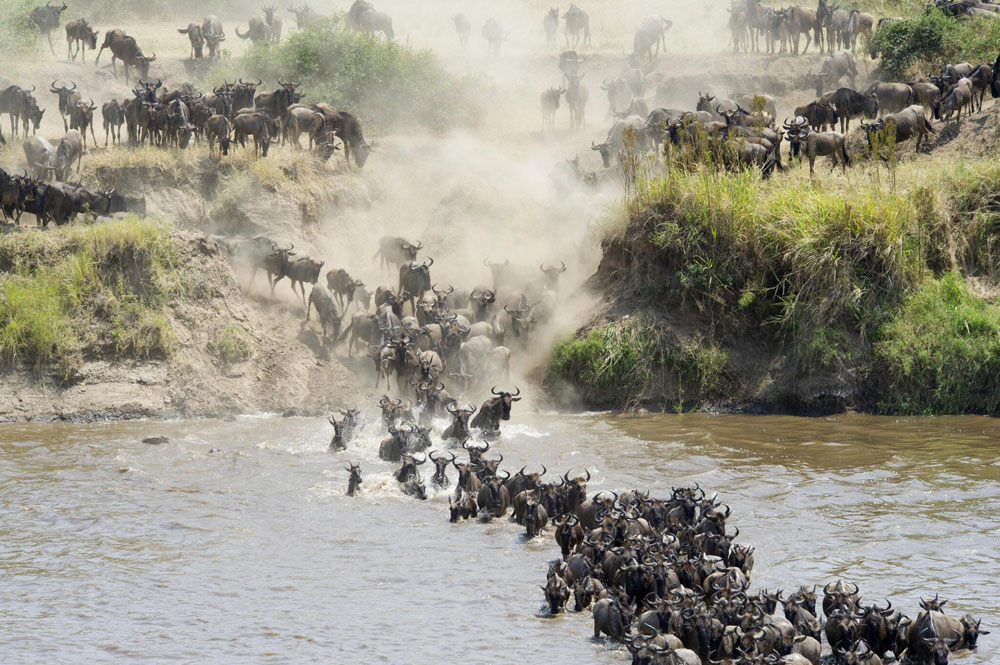
After breakfast, the drive continues across the open grasslands, which are the heart of the Serengeti ecosystem. Depending on the season, this is where you may encounter the Great Migration: more than 1.5 million wildebeest, along with hundreds of thousands of zebras and gazelles, moving in long columns across the horizon.
Even outside migration areas, the plains are rich in resident wildlife, including Thomson’s and Grant’s gazelles, topi, hartebeest, eland, buffalo herds, warthogs and ostriches. Birdlife is outstanding too: watch for secretary birds striding through the grass, kori bustards, grey crowned cranes, lilac-breasted rollers and raptors such as martial eagles and tawny eagles.
10:45 AM | Retima Hippo Pool or Seronera Visitor Centre
Before heading back, many guides include a stop at the Retima Hippo Pool, north of Seronera, where dozens of hippos crowd together in the water, grunting, yawning and jostling for space. Crocodiles often bask on the banks. Visitors are usually allowed to step out of the vehicle at a designated viewing point here.
Alternatively, the Seronera Visitor Centre offers an excellent walking trail with information displays about the Serengeti ecosystem, the migration and conservation history, plus a small café and gift shop. It is a good place to stretch your legs and use clean restrooms.
11:30 AM | Return to Camp
By late morning, the heat builds and most animals settle into the shade. This is the natural time to return to camp for lunch, a shower and a rest during the hottest hours. Many travellers combine their morning game drive with an afternoon drive from around 3:30 PM until sunset, giving a full day of varied wildlife viewing.
If you are on a full-day game drive instead, your guide will continue exploring with a packed lunch, which is the preferred option during the migration when herds may be several hours from camp.
Best Areas for a Morning Game Drive by Season
The Serengeti covers roughly 14,750 square kilometres, and the best area for your morning drive depends heavily on the time of year and the position of the Great Migration. Choosing a camp in the right region is the most important decision for a successful game drive.
| Region | Best Months | What Makes It Special in the Morning |
| Central Serengeti (Seronera) | All year | Highest density of resident lions, leopards along the Seronera River, cheetahs on the plains; reliable year-round |
| Southern Serengeti and Ndutu | December to March | Calving season, with around 8,000 wildebeest calves born daily at the peak; intense predator action at dawn |
| Moru Kopjes | December to May | Lion prides on granite outcrops, ancient Maasai rock paintings, occasional black rhino |
| Western Corridor (Grumeti River) | May to July | Migration herds gather before crossing the Grumeti River; giant Nile crocodiles |
| Northern Serengeti (Kogatende, Lamai) | July to October | Dramatic Mara River crossings, often best in mid-morning; fewer vehicles |
| Lobo and Eastern Serengeti | November and all year | Quiet, scenic kopje country; good for cheetahs and leopards; very few crowds |
Great Migration Month by Month
| Months | Approximate Herd Location | Morning Game Drive Focus |
| January – March | Southern plains, Ndutu | Calving, predators hunting newborns at first light |
| April – May | Moving north through central and western Serengeti | Long columns of herds; lush green season; fewer visitors |
| June – July | Western Corridor, Grumeti River | Grumeti crossings and rutting season |
| August – October | Northern Serengeti, Mara River | Mara River crossings; big herds on the northern plains |
| November – December | Returning south through the east and centre | Herds moving south after the short rains; good value |
| Important Note on the Migration
The migration follows the rains, not a calendar. The timings above are typical patterns, but herds can arrive early or late by several weeks. Your safari operator should track herd movements and recommend the best camp location close to your travel dates. |
Wildlife to Look For on a Morning Game Drive
| Animal | Where to Look | Typical Morning Behaviour |
| Lion | Kopjes, open plains, near kills | Feeding, moving between areas, roaring, cubs playing |
| Leopard | Sausage trees and acacias along the Seronera River | Resting on branches, returning to stashed kills |
| Cheetah | Short-grass plains, termite mounds | Scanning for prey; most likely hunting time |
| Spotted hyena | Plains, dens near roads | Returning from night hunts, socialising at dens |
| Elephant | Woodlands, river valleys, northern and western areas | Feeding and moving to water |
| Buffalo | Riverine woodland, swamps | Grazing in large herds |
| Hippo and crocodile | Retima Hippo Pool, Grumeti and Mara rivers | Returning to water after night grazing |
| Wildebeest and zebra | Depends on migration position | Grazing and moving in columns toward water |
| Giraffe | Acacia woodland | Browsing on treetops |
| Black rhino | Moru Kopjes area (rare) | Occasionally seen at dawn; sightings are not guaranteed |
The Serengeti is also home to more than 500 bird species. Early mornings bring the most birdsong and activity, making this the perfect time for birdwatchers. Endemic and near-endemic species to look for include the grey-breasted spurfowl, Fischer’s lovebird, rufous-tailed weaver and Usambiro barbet.
Optional Add-On: Sunrise Hot Air Balloon Safari
For a truly unforgettable morning, consider replacing or combining your early game drive with a hot air balloon safari. Balloons launch at dawn from Seronera, the southern Serengeti and the Western Corridor, drifting silently over the plains for about one hour at sunrise. Flights finish with a champagne toast and a full bush breakfast, after which you are collected for a game drive back to camp.
| Feature | Details |
| Pick-up time | Around 5:00 AM from your lodge (depending on location) |
| Flight duration | About 1 hour |
| Launch sites | Central (Seronera), Southern Serengeti/Ndutu, Western Corridor, Northern Serengeti |
| Includes | Flight, champagne toast, bush breakfast, flight certificate |
| Typical price | Roughly US$550 to US$700 per person; confirm current rates when booking |
| Booking | Reserve well in advance, especially in July to October |
Morning Game Drive Costs in Serengeti (2027)
If you book a safari package, your morning game drives, vehicle, guide and park fees are normally included in the price. The table below gives a general breakdown for travellers planning a custom safari or self-drive trip. All figures are approximate and in US dollars.
| Cost Item | Approximate Price (USD) | Notes |
| Park entry fee – non-resident adult (16+) | About $82.60 per 24 hours | $70 + 18% VAT; valid 24 hours from time of entry |
| Park entry fee – non-resident child (5–15) | About $23.60 per 24 hours | Children under 5 enter free |
| Concession fee (staying in a lodge or camp inside the park) | About $60 – $71 per adult per night | Charged per night in addition to entry fee |
| Safari vehicle with driver-guide | $250 – $350 per vehicle per day | Includes fuel; shared between passengers |
| Self-drive 4×4 rental | $120 – $250 per day | Plus vehicle entry fee (varies by vehicle weight and registration) |
| Hot air balloon (optional) | $550 – $700 per person | Includes breakfast |
| Guide tip (customary) | $20 – $30 per group per day | Paid at the end of the safari |
| Paying Park Fees
Serengeti park fees are paid electronically by card (Visa or MasterCard) or through your tour operator; cash is not accepted at the gates. TANAPA usually reviews its fee structure each July, so always confirm the current rates on the official TANAPA website or with Marriott Safaris Africa before travelling. |
Planning a Self-Drive Morning Game Drive
Serengeti is open to self-drive visitors with suitable 4×4 vehicles, and a morning game drive at your own pace can be very rewarding. However, it requires careful planning, because distances are vast, road signage is limited and certain rules are strictly enforced.
Park Rules for Self-Drivers
- Game viewing hours: Game drives are permitted from 6:00 AM to 6:30 PM. Driving inside the park after dark is not allowed without special permission.
- Stay on designated tracks: Off-road driving is prohibited in most areas of the park and can attract heavy fines.
- Speed limit: The maximum speed is 50 km/h. Drive slowly to avoid collisions with animals and to reduce dust.
- Stay in your vehicle: Only leave the vehicle at designated picnic sites, visitor centres and marked viewpoints.
- Do not feed or disturb animals: Keep a respectful distance and switch off the engine at sightings where possible.
- Carry your permit: Keep your park receipt with you at all times; rangers may check it at any point.
Self-Drive Tips for a Successful Morning
- Fill your fuel tank the day before. Fuel is available at Seronera, but supplies can be limited and prices are higher than outside the park.
- Download offline maps (such as Tracks4Africa or Maps.me) because mobile signal is weak or absent in many areas.
- Ask lodge staff and rangers at Seronera about recent sightings the evening before your drive.
- Carry a spare tyre, a tyre repair kit, a tow rope and plenty of drinking water.
- Consider hiring a local guide for at least one morning. Their tracking skills and radio network dramatically improve sightings.
What to Pack for a Morning Game Drive
| Category | Items |
| Clothing | Warm fleece or jacket, neutral-coloured long-sleeved shirt, comfortable trousers, closed shoes |
| Sun protection | Wide-brimmed hat, sunglasses, sunscreen (SPF 30+), lip balm |
| Optics | Binoculars (8×42 or 10×42 recommended), camera with zoom lens |
| Photography | Spare batteries, memory cards, bean bag for stabilising on the window or roof |
| Comfort | Scarf or buff for dust, wet wipes, hand sanitiser, refillable water bottle |
| Health | Insect repellent, personal medication, motion sickness tablets if needed |
| Documents | Passport copy, park receipt, travel insurance details |
| Colours to Avoid
Avoid bright white, which shows dust, and dark blue or black, which can attract tsetse flies in some woodland areas of the Serengeti. Khaki, olive, beige and light brown are ideal. |
Photography Tips for the Morning Light
- Shoot in the first two hours: The warm, low-angled light between sunrise and around 8:30 AM gives rich colour and long shadows.
- Use a fast shutter speed: Set at least 1/1000 sec for moving animals and running cheetahs; increase ISO in the early low light.
- Bring a zoom lens: A 100–400mm or 150–600mm lens covers most situations, from lions near the road to distant birds.
- Stabilise your camera: Rest your lens on a bean bag and ask your guide to switch off the engine to reduce vibration.
- Capture silhouettes: Position animals against the sunrise for dramatic backlit images of acacias, giraffes and balloons.
- Put the camera down sometimes: Some of the best moments are enjoyed through binoculars and in memory.
Game Drive Etiquette and Safety
- Never stand on seats or lean far out of the vehicle near predators.
- Keep noise to a minimum and never call out or whistle to attract animals.
- Respect other vehicles at sightings; allow others a turn for a good view.
- Do not ask your guide to break park rules such as going off-road or getting too close.
- Take all litter back to camp, including fruit peels and tissues.
- Follow your guide’s instructions at all times. Their priority is your safety and the welfare of the wildlife.
Sample Full Day: Combining Morning and Afternoon Drives
| Time | Activity |
| 5:30 AM | Coffee and light snack in camp |
| 6:00 – 11:30 AM | Morning game drive with bush breakfast |
| 12:00 – 1:30 PM | Lunch at camp |
| 1:30 – 3:30 PM | Rest, swimming or reading during the midday heat |
| 3:30 – 6:30 PM | Afternoon game drive and sundowner |
| 7:30 PM | Dinner and stories around the campfire |
Morning Game Drive Checklist
- Wake-up call booked and alarm set
- Layers of clothing laid out
- Camera batteries charged and memory cards empty
- Binoculars packed
- Water bottle filled
- Sunscreen, hat and sunglasses ready
- Breakfast arrangement confirmed with camp
- Park permit or receipt to hand
- Wildlife wish list shared with your guide
Frequently Asked Questions
What time does a morning game drive start in Serengeti?
Most morning game drives start at about 6:00 AM, which is when game viewing is permitted inside the park, just before sunrise. Some camps in private concessions bordering the park may depart slightly earlier.
How long is a morning game drive?
A typical morning game drive lasts between four and six hours. Short drives return for breakfast at around 9:00 AM, while longer drives include a bush breakfast and return at about 11:30 AM or midday.
Is a morning or afternoon game drive better in Serengeti?
The morning drive is generally better for predator sightings and photography, because animals are most active in the cool hours and the light is soft. Afternoon drives are still rewarding, particularly in the last hour before sunset, so most travellers do both.
Can I see the Big Five on a morning game drive?
Lions, leopards, elephants and buffalo are regularly seen in the Serengeti. Black rhinos are rare and mainly found in the Moru Kopjes area, so seeing all five in a single morning is possible but uncommon. Nearby Ngorongoro Crater offers better rhino chances.
Is breakfast included on a morning game drive?
In most safari packages, yes. Camps either provide a packed breakfast box or a set-up bush breakfast at a designated picnic site. Confirm the arrangement with your camp the evening before.
Can I do a morning game drive on a self-drive safari?
Yes. Serengeti allows self-drive visitors in suitable 4×4 vehicles. You must follow park rules, stay on designated tracks and respect game drive hours. Hiring a local guide for a morning greatly improves sightings.
Do I need to pay park fees for a single morning game drive?
Yes. Park entry fees are charged per 24-hour period, regardless of how long you spend in the park. Your permit is valid for 24 hours from the time you enter.
What is the best month for a morning game drive in Serengeti?
Good game viewing is possible all year. January to March is excellent for calving and predator action in the south, while July to October offers Mara River crossings in the north. June to October is the dry season, when animals gather near water and are easier to find.
| Plan Your Serengeti Morning Game Drive with Marriott Safaris Africa
Whether you want a fully guided Serengeti safari with expert driver-guides or a self-drive 4×4 adventure with a rooftop tent, Marriott Safaris Africa can help you plan the perfect morning on the plains. We match your travel dates to the best migration areas, arrange park permits, recommend camps and provide well-maintained safari vehicles. Contact our team today to start planning your Tanzania safari. Perfection Anytime. |